
Viva La Frantic


All roads lead to France. With the Daryl Dixon spin-off series taking place in France, and Joker 2 having a French subtitle, there is a curious alignment of stars. This year, there has even been a new Emmanuelle film. It takes place in Hong Kong. Since director John Carpenter is a big fan of H.K. movies, Escape from L.A. could have taken place in H.K. because even Joss Whedon used science fiction to foreshadow the importance of Chinese relations in his Firefly TV series. 1997 was going to be the year when H.K. was handed back to Mainland China, but there was already an American action film called Hong Kong ‘97 (1994). In France, Escape from New York (1981) was known as New York 1997 whereas Escape from L.A. (1996) was known as Los Angeles 2013. In the October 1996 issue (No. 64) of a French magazine called Impact, Kurt Russell had admitted that he is usually an anti-sequel actor since a sequel would take away from the perception of his acting range. The exception to the rule: “I love Snake Plissken. Of all my characters, he's the only one I was willing to see in a sequel.”

Why it took so long to do a sequel: “After the success of Escape from New York, I was eager to return to it. I had the idea of a Los Angeles island, separated from the continent. I asked a screenwriter to write the story, but the tone did not convince me, far from it. John Carpenter and I then decided to write the screenplay ourselves. Much later, I told myself that the time had finally come to reconnect with Snake Plissken. Los Angeles had just endured race riots, an earthquake, floods, and the gang war was in full swing. I met John Carpenter and the producer Debra Hill again. In her kitchen, for five hours, we discussed the project, the details of the story. We had no difficulty in getting Escape from L.A. off the ground. We had been thinking about it for fifteen years! The first day of shooting, we all felt like we had just finished Escape from New York, that we had just parted ways for a very long weekend! Plus, the leather suit I wore still fit me like a glove! It was as if I hadn't gained a single kilo, or almost!”
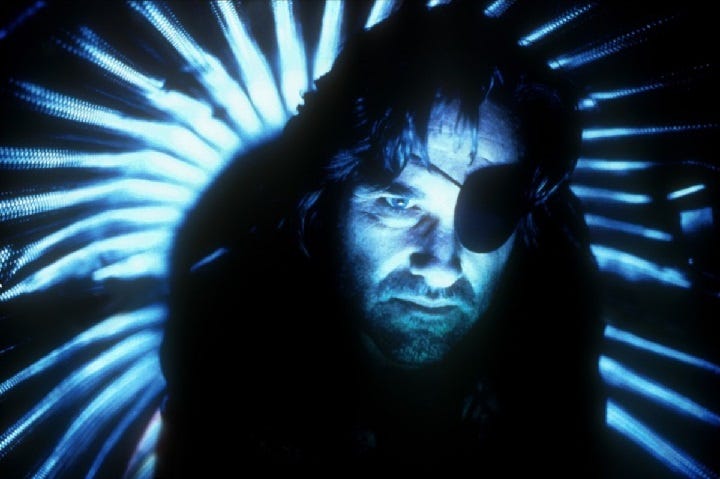
Psychology: “Debra Hill thinks that Snake is the expression of my bad instincts. For my part, I believe that he is an alter ego of John Carpenter! I love John's deadpan humor, his point of view on the world, his fierce, almost comical hatred of authority! On the surface, but only on the surface, Snake is a hero without fabric, in one dimension. I think nevertheless that it is the most complex role that I have played to date! It is impossible to guess his thoughts. In the darkest meanders of my soul, a part of me would like to be like him, to act without hindrance, without the slightest attachment. To develop Snake Plissken, John Carpenter was inspired by a friend at university, an absolute rebel. To John Carpenter and me, Snake Plissken nevertheless allows us to put into perspective our vision of the United States in particular and the world in general. Escape from L.A. is not a political exposé, but a point of view.”

Snake Plissken is not a futuristic version of Clint Eastwood’s cowboys: “Today, Sergio Leone's Westerns are myths, like their characters. His heroes never suffer humiliation, while Snake Plissken, for his part, is constantly flouted and subjugated. That's the whole difference between Clint Eastwood and him. He is constantly humiliated, oppressed, and that is certainly why the public wants even more ardently to witness his triumph. Plissken is humiliated even more because he is forced to do something he would not do on his own authority. It puts Snake Plissken in a very special place among heroes and makes him not very appealing to many potential actors. I think there is a lot of humor and dignity in a character who survives constant humiliation.”
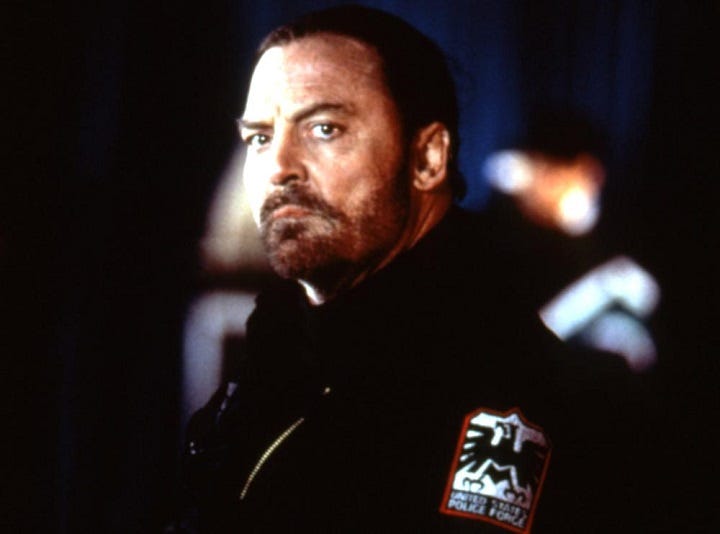
Why characters are surprised by Snake in the sequel: “After Escape from New York, video, cable television channels and satellite transmission appeared. Thanks to these technical innovations, all of America and part of the planet were able to watch O.J. Simpson flee at the wheel of his car. I then thought, “This is what my country wants, to watch this sh!t live on television.” After which, a TV channel essentially devoted to the police was born. Snake Plissken would certainly have been the star. In fifteen years, he has been convicted of 27 new crimes, some of them moral. Enough to justify his omnipresence on television screens. Screens that tend to become larger and larger, sometimes taking on gigantic proportions. A real star on this police channel and elsewhere, Snake Plissken would thus be perceived as a giant, a guy who would easily reach two meters. Today, when people see him in the flesh, they are surprised to meet a...man of normal size - a situation that often occurs to me. People say to me: “Ah, I thought you were taller!” Another humiliation to Snake's credit; it teaches him humility.”
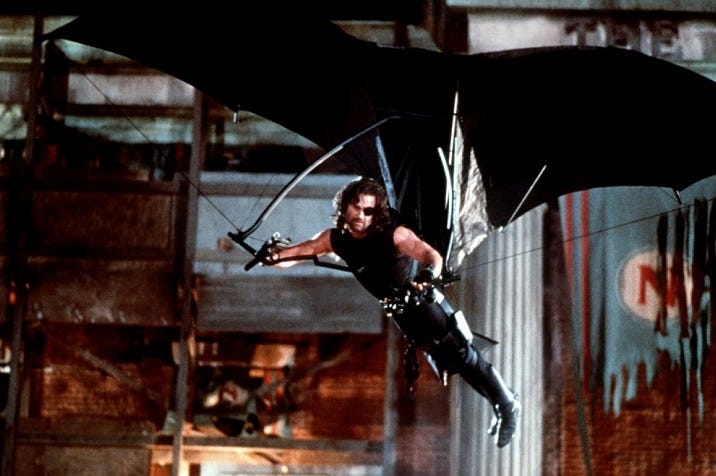
Political commentary: “The future that the film described is a satire of current events, of political correctness. The United States was founded on very simple principles. Its constitution emphasizes that you are free to act, to think as you please, as long as you do not hurt or offend anyone. Current politics are beginning to seriously deviate from this, to preach intolerance. In 1988, I got into serious trouble because I fed homeless people red meat. The press violently attacked me: eating meat is killing animals, so it is politically incorrect! While I was being shot at, the television was broadcasting a report about a beached whale being driven back to sea by dozens of people. My explanations were no match for such powerful footage. In the same vein, we will soon witness the disappearance of the fur industry in the United States. Wearing a mink coat is very politically incorrect. I would rather agree with that, except that if a person wears fur, I would certainly not insult them. They have the right to do so. Our leaders are only concerned with putting obstacles in our way, with restricting our freedoms. As if there were a ministry to stop us from going around in circles, a ministry that would make you feel the time you spend on this planet.”

A biker at heart: “If I ride a motorbike with my hair blowing in the wind, I want to have the right not to wear a helmet. If I smash my head against a wall, it is because I have chosen to, because I have taken responsibility. I understand why motorcyclists must wear this protection. I would even say to my children: If you want to ride a motorbike, wear a helmet! If they do not follow my advice, I will understand perfectly. There, they are risking their lives, not those of others, as an HIV-positive person would do making love without a condom. In this situation, you can kill someone. You are a murderer. All this to tell you that Escape from L.A. poses these essential questions: "How far will we go? What path exactly is this country taking?" And again, how will small morsels of freedom be taken from us? These fragments will become larger and larger.”
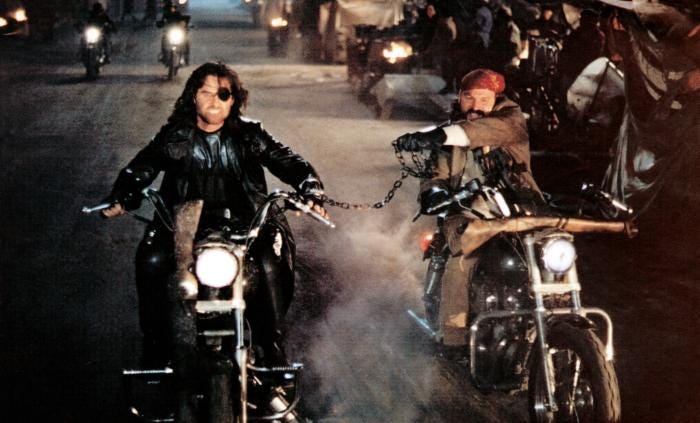
Patriotic paradox: “An attitude as paradoxical as the microcosm of Los Angeles! I live there and, and yet, the city is hardly at its best in the film. I accept this contradiction. I am American, which gives me the opportunity to criticize institutions, laws, and government directions. American nationality also allows me to overcome any feeling of guilt. In this country, there is only a thin line between an experimental approach to governing a society and anarchy. It is first and foremost this examination of society that makes a film even more exciting to make. A necessary examination. If Escape from L.A. had not taken this direction, we would not have made it. The script required half a dozen different versions before we found the right tone.”

Social commentary: “Los Angeles is a prison full of free inmates. You can incarcerate yourself there whenever you want! You know that a gigantic earthquake threatens Los Angeles, that it will be particularly devastating. In this respect, Los Angeles is similar to Pompeii, one of the flagship cities of Ancient Rome. Why didn't the 22,000 citizens of Pompeii leave their island? They were not unaware that the volcano was about to erupt. I'll tell you why they didn't run away. When you study the luxurious houses, the pornographic murals, the surrounding prosperity, you say to yourself: “But it was a permanent party, a party all year round, a great orgy!” Faced with the threat, how did the people of Pompeii react? They did what any human being would have done in their place. They went to see the volcano up close. Men told their wives: “Honey, don't worry. When it blows up, we'll be far away.” And then it blows up sooner than expected. Centuries later, archaeologists find petrified men in the ashes, surprised, looking like they're thinking “Oh, holy shit. We didn't expect that!” Same story in Los Angeles at the dawn of the 21st century. We're there, waiting peacefully for a titanic earthquake to level the city and kill millions. Later, others will say: “But why did they stay?” I'll give you a thousand guesses. Because we're swimming in euphoria. Because it's always a mega-party! Los Angeles is Pompeii!”

In the February 1998 issue (No. 72) of French Impact, Pam Grier said: “I had a great time! I went to auditions with a shell between my legs. When people saw me, they said "That guy really looks like Pam Grier!" Which meant I had hit the mark. In playing the role, I really went all out, thinking that John Carpenter and Kurt Russell could get something funny out of me. A real pleasure because I love Escape from New York. A real pleasure also because I felt like I was in a theater with such a big stage, in the skin of such an extravagant character. I love it!”