
Tour de Force Auteur

Before John Wick, there was John Woo. In the October 1993 issue (No. 47) of the French Impact magazine, John Woo talked about Hard Target (a.k.a. Chasse à l'homme). The French title is Manhunt, which is symbolic because that would later be the title of a Chinese John Woo film. Back to that issue of Impact, he said: “American producers have a false idea of the public's desires. To satisfy what they think is their audience, they make sure that everything is immediately understandable. I find the script for Hard Target a little too linear, a little too simple, probably because it has passed through so many hands and each of the participants has revised it in their own way. However, I managed to flesh it out a little. In particular by describing the social reality of New Orleans - the homeless, the poverty, the unemployment. These details are what I appreciate most in Hard Target. There is not only action and gunfights in my films; the social aspects count at least as much.”
John Woo was asked about future plans. The following statement makes me think that he should have been the one to direct Sylvester Stallone and Sharon Stone in The Specialist (1994): “I meet a lot of people in Hollywood. Stallone would like to work with me, maybe not on the remake of The Killer, but on an original project. He likes the romantic, emotional side of my previous films. He would like me to use that to renew his public image. I also saw Sharon Stone, a really unusual woman, very intelligent, delicate. She also would like to appear in a film similar to The Killer. I was supposed to do Pin Cushion, a science fiction thriller with her, but the shooting of Hard Target did not allow me to do it. For the moment, I am working more seriously on Shadow War, produced by Sam Raimi and Terence Chang. For the first time, I will direct a female hero, a very tough female cop fighting, with her partner, against terrorists. In a year and a half, Quentin Tarantino will have written me a tailor-made script, in the vein of The Killer, whose distribution already includes Chow Yun-Fat. As I want to preserve my personal ideas, to not be swallowed up by Hollywood, I am also writing a story on my side that is shared between Paris and New York. It tells the story of the confrontation of two killers, one young, the other older. And they both hate each other!”
In the December 1992 issue (No. 42) of the French Impact magazine, there was a feature on Hard Target that was not as extensive as what they later did for Crying Freeman (1995) despite Hard Target starring a Frenchman who had been interviewed by Impact since the late eighties. Also, John Woo had already been known for longer than the director of Crying Freeman. Then again, Christophe Gans had a reputation for being the founder of a French magazine called Starfix. They had been printing issues since 1982. Personal allegiances are a tricky thing to navigate around. Hard Target was executively produced by Sam Raimi, and written by a man who wrote Raimi’s Darkman (1990). This man, Chuck Pfarrer, said: “I'm from Biloxi, Mississippi - a small town of rednecks. In the past, I came to New Orleans quite often, but it was while researching for the film that I really discovered it. I followed police officers on patrol. With them, I learned a lot about the incredible savagery of the city, about this violence even more pervasive than that which rages in Los Angeles, about the galloping corruption. Very good for Hard Target all that. This allows us to show a bribed medical examiner who announces that a bullet in the head is a natural cause of death.”
As for how John Woo got involved, Chuck (who co-produced Hard Target) said: “The people at Universal first put me in a screening room. They told me: “Watch this film carefully and tell us if this director would be suitable for Hard Target.” And I watched The Killer. I came out stunned. Immediately, I ran to the big boss' office to shout my joy at the idea of seeing this filmmaker take charge of my script. Shortly after, I went to meet him in Hong Kong. Once John Woo's participation was secured, I revised the story to fit his style, his standards. Hard Target had to be adapted to John Woo and not the other way around. That's how we reworked all the action sequences together. They took on more scope, more excess. In the previous version of the script, we only had two hunters and a few dogs. Everything was multiplied by ten without the concept of the film really changing. Because Hard Target bears John Woo's signature, everything had to be developed to the power of 10 - the guns, stunts, fights… An incredible experience. Plus, John Woo is a great guy. Usually, directors can't stand to see the screenwriter hanging around on set. I think it's the lack of confidence in themselves and in the result that makes them react like that. On the contrary, John Woo encouraged me to come. My presence did not pose a threat to him.”
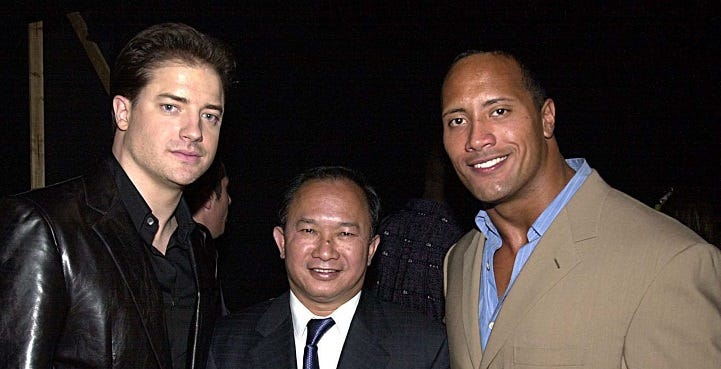
Jean-Claude Van Damme was the closest that John Woo was going to get to directing one of his idols - Alain Delon. JCVD said: “This man has an editing table in his head. His editing is out of the ordinary. He doesn't follow the logic of classic film schools. He learned everything on the job, in improvisation during filming in Hong Kong. It's the same story with actors. If an actor enters John Woo's world, he will experience something wonderful. John Woo speaks little, but everything he says has meaning, real value; he expresses himself through his eyes. So you have to be very sensitive, very receptive to understand him. Like John Woo, I like to dine late at night, and it makes our work meetings easier. We sit around a good table, we talk a lot, we exchange ideas. I appreciate him, he appreciates me. We were made to work together.”
JC clears up a misunderstanding: “Generally, I am asked to shoot a gun or to kick people. Never both at the same time. John Woo, for his part, makes me run, kick and shoot - the whole thing - in a single shot. And then, he is not one of those directors who does as many takes as possible to save himself in the editing. John Woo knows exactly what he wants. He always wants more.”
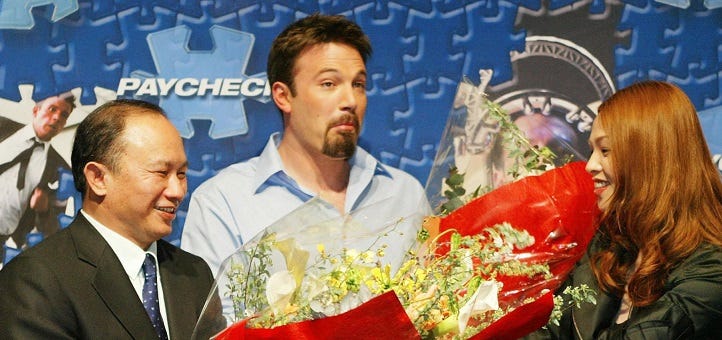
Unlike with Crying Freeman, a reporter from Impact was actually on location for Hard Target. Marc Toullec observed: “In the middle of a buzzing hive, John Woo remains Olympianly calm. Whether the sets are blowing up or the guns are spitting lead, he doesn't flinch. A quiet force, so to speak. And yet, given the scale of the shoot - three months, and the difficulties - there's enough to drive you crazy or into hysteria. John Woo sets an example for the whole team; he doesn't show any impatience or any visible sign of nervousness, other than running his left hand through his hair a thousand times a day. He barely murmurs “Time, I need more time...” But the deadlines are inflexible.”
Sam Raimi’s producing sidekick, Robert Tapert, said: “John Woo doesn't have the same generosity in terms of scheduling as in Hong Kong, but he's happy to have more toys to play with. The censorship could hit one hard, but Hard Target would be too violent. Here, The Killer and Hard-Boiled would be banned for under-18s and Bullet in the Head would be completely banned. But the John Woo style can be imported to Hollywood in a less extreme way. There is no question of making a fifty-minute sequence like the finale of Hard-Boiled. The Americans wouldn't understand.”
Another Robert - an armorer nicknamed “Rock” Galotti - said: “Certain machine guns are banned from sale in the United States, so we have a vigilant policeman watching our stock at all times. I don't want to contribute to arming the neighborhood delinquents. They're armed enough as it is. For sure: John Woo is going to become the best action film director in the country. That is, if he wants to stay there. Van Damme likes him a lot. He's going to want to make another film with him.”
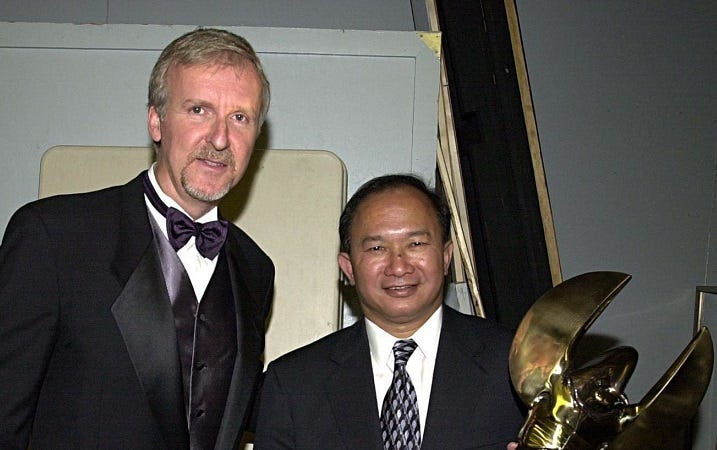
Stunt coordinator Billy Burton referred to The Killer (1989) and Hard-Boiled (1992): “These two films are a real slap in the face for us Americans who think that we're the best at this. I've been to Hong Kong and the guys really go the extra mile, sometimes to the detriment of danger. The way that John Woo films the shootouts and stunts impresses me. It's pure choreography. I think we could systematically add musical accompaniment to these scenes. John Woo does it, by the way. Nothing is static with him. There's always something happening in the camera's field of view. In an explosion sequence, one guy burns in the background while another crashes on a motorcycle and a third shoots. I really learn a lot with John Woo.”
Lance Henriksen was the third actor considered for the role of the villain. Julian Sands was the first choice but he asked for too much money. The second actor in the running for the role was Malcolm McDowell but he was filming in Africa. Speaking of Africa, Lance said: “In Hard Target, there is a sequence where I explain to a future victim how a brave hunter in Africa is buried. In front of the grave, his family mourns him for hours. He will be respected forever. I then tell this guy that this could have been the case for him. I shoot him. This scene was not in the script, but I got so immersed in the story that this metaphor was born spontaneously. Hard Target is an important film for me, maybe the most important. On set, I improvised a lot. John Woo gave me permission to finish off a guy in flames following an explosion, because that's what you do on the battlefield. Another guy is bitten by a snake. Rather than watch him die from the venom, I wring his neck.”
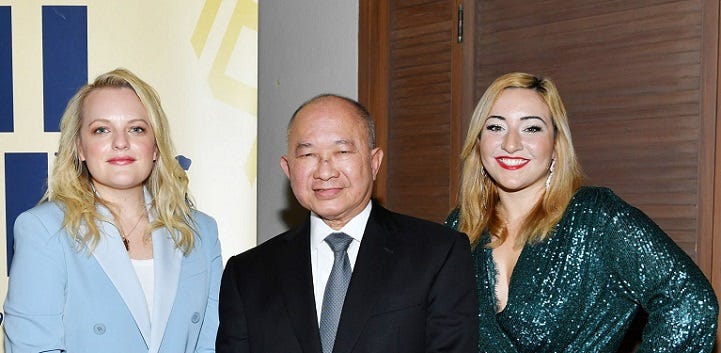
About the aftershock of playing Emil Fouchon: “It will be very, very hard to give up Fouchon. It takes me about a month to completely get rid of the influence of a role. When I'm shooting outdoors, I like to drive home, to have time to take a step back. But for a week, I look like a wreck, I can't even answer the phone. I'm knackered, a bit like a diver after a long decompression.”
Interviewer Marc Toullec noticed that Lance got along wonderfully well with John Woo. Lance was asked to explain this immediate complicity: “In him, I found a twin spirit to mine. He directs me as no filmmaker has done before. Whereas on my previous film, Jennifer 8, I had to follow the text line by line, I can improvise as I please on Hard Target. Here, I feel free, as if I were naked, running on a sunny beach. A wonderful impression. John Woo is also a true gentleman, an incredibly kind man. We share the same life experience. We both lived on the streets and got through it; it creates bonds. The other day, John asked me to do without a stunt double for a scene where my coat burns. I did it, for him, knowing that it could go badly. The stuntmen comforted me, advised me. I was shaking like a leaf, but, paradoxically, I wasn't afraid. Really, Hard Target is a very important film for me.”