
The Taboo Connection

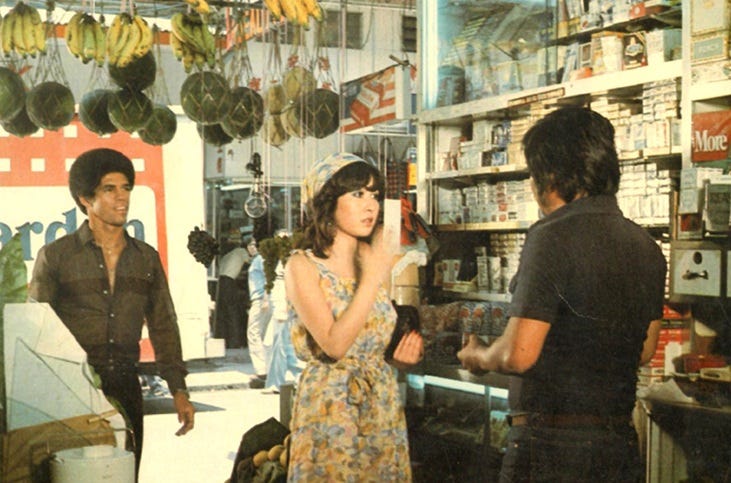
Black Bear, Yellow Lion. When Bruce Lee came up with the Black Panther and Yellow-Faced Tiger title in 1970, he was more American than he was in 1960. Using Hong Kong figure of speech, he could be described as a banana - yellow on the outside but white on the inside. Because Bruce poached Nora Miao from A Man Called Tiger in 1972, director Lo Wei decided to steal the second half of his title for another film. If Bruce had said “Over my dead body” then he was in for a post-mortem shock because the June 1974 issue of Fighting Stars (an American magazine) confirmed that Chuck Norris was approached to star in Lo Wei’s Yellow-Faced Tiger almost immediately after Bruce died. It was filmed in the city that Bruce was born in - San Francisco. In his lifetime, he had already seen a Taiwanese film company steal his Black Panther title. Black Bear, Yellow Lion would have been a suitable substitute. When writing a letter to screenwriter Stirling Silliphant in 1969, Bruce Lee predicted that the year was going to do for the Chinese man what 1968 did for the black man.
You can find the letter in Marcos Ocana’s 2019 book about Bruce’s unmade project, The Silent Flute. Bruce’s black co-star in Enter the Dragon (1973), Jim Kelly, definitely had yellow fever. The film’s assistant director, Chaplin Chang, had put together a book of interview transcripts. This Chinese book, The Bruce Lee They Knew (2013), featured information that was not allowed to be included in the English language market when the time came for director Robert Clouse to write books about the film and Bruce’s life. When Clouse interviewed Chaplin Chang, it was indirectly stated that Jim Kelly was going to prematurely leave anyway. In Hong Kong, Jim had contracted a sexually transmitted disease that hospitalized him for a couple of weeks. After he exited the hospital, Jim could barely finish his final scene with Shih Kien. John Saxon was a different kind of sick in that he was getting fed up of fighting by the end of the twelfth (and final) week, so Jim Kelly should have been the one to fight Bolo Yeung.
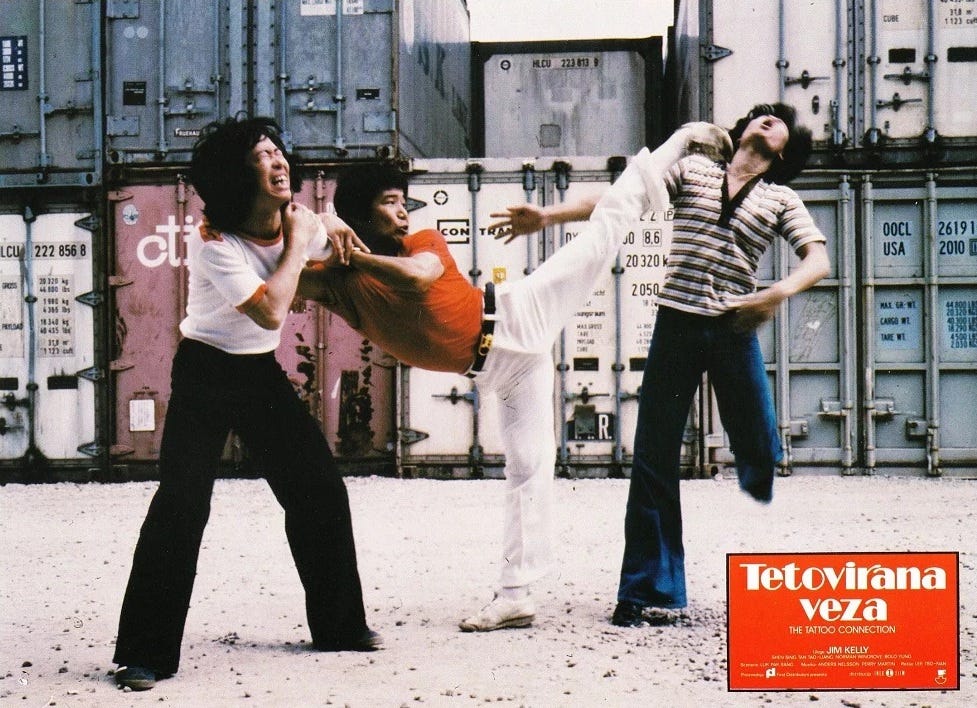
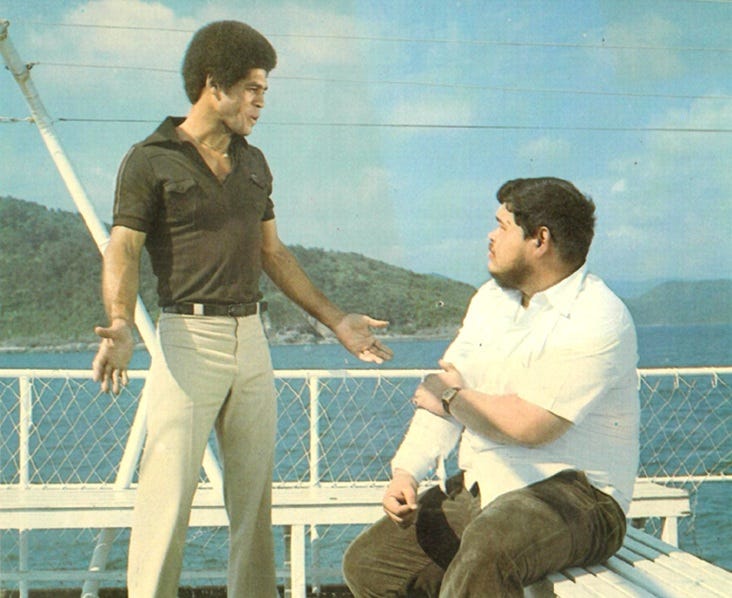
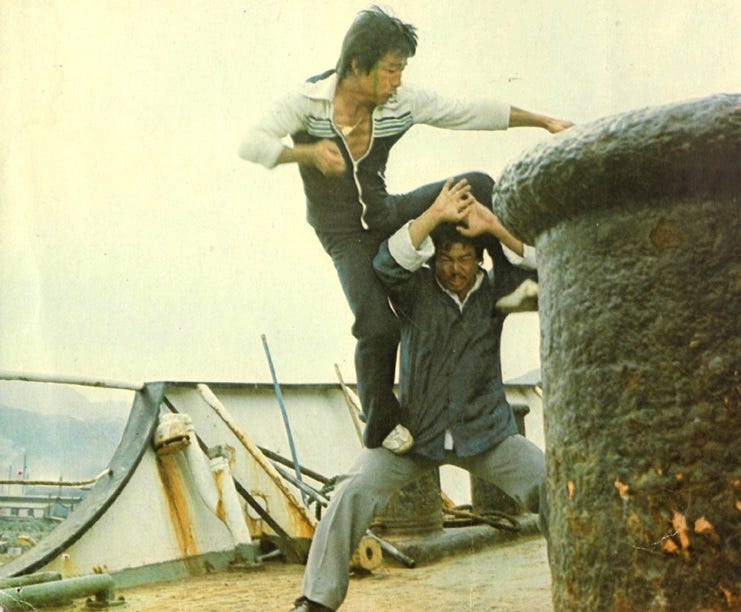
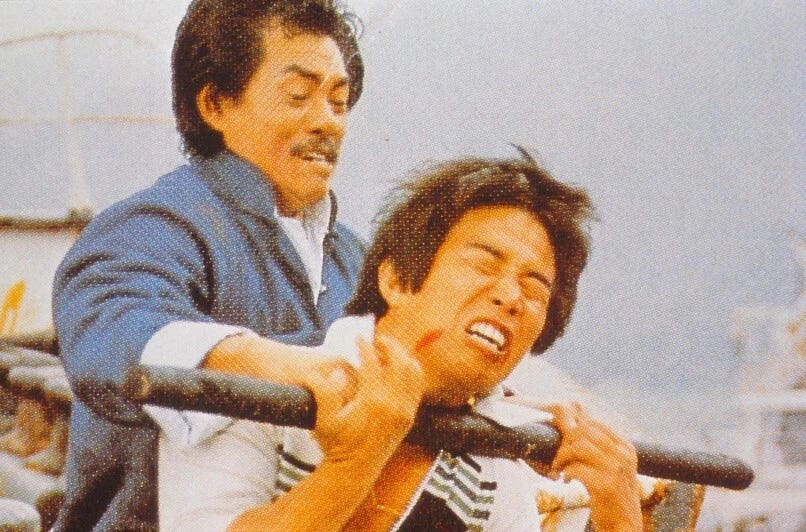
It’s not a coincidence that The Tattoo Connection (1978) was a Hong Kong film where Jim teams up with a Chinese man as they take on Chen Sing from Black Panther (1973). Jim and Dorian Tan Tao-Liang also fight Bolo. Mr. Yeung has some explaining to do. In the September 1990 issue of Martial Arts Illustrated, he claimed that his character in Enter the Dragon was originally intended for a Westerner. Oddly enough, Bolo was the first Chinese person to be cast. He was cast in December 1972 whereas the main villain, Shih Kien, was cast well into the following month. Rockne Tarkington, the original black actor who was chosen to play Williams, was said to have dropped out right before filming began because of a pay dispute. Actors don’t accept projects because of the screenplay alone, so it’s more likely that he dropped out when John Saxon’s agent demanded that Roper no longer exits stage left. As such, Williams still gets to be in the first two acts but no longer gets to fight Bolo.
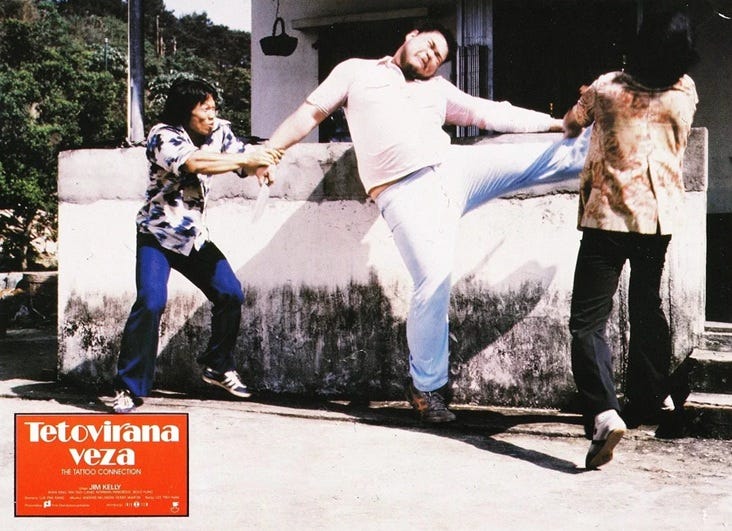
The Tattoo Connection sees poetic justice take shape in the form of poetry in motion when Jim Kelly gets to fight Bolo Yeung. Hong Kong was too slow to capitalize on Jim’s fame. In the April 20, 1978 issue of a black magazine called Jet, it was reported that he was going to Hong Kong to shoot a film. The Tattoo Connection was released in Hong Kong cinemas on July 27, so those Chinese film-makers really knew how to crank them out. What’s curious about this is that Sammo Hung’s parody of Bruce Lee’s The Way of the Dragon (1972) was not only released in the same month but it had finished its Hong Kong theatrical run on the day before The Tattoo Connection came out. As was the case with Black Panther, Sammo’s Enter the Fat Dragon has a Chinese martial artist made up to look black. By comparison, Bruce’s posthumously completed Game of Death had compensated for the absence of Kareem Abdul-Jabbar by filming a shorter black guy from a lower angle.
Enter the Fat Dragon and The Tattoo Connection were released five months after the Hong Kong release of Game of Death. Also released in 1978 was Ron Van Clief’s return to Hong Kong cinema with Way of the Black Dragon. Some of the Chinese guys who had worked on that movie, including the fight choreographer, were members of Sammo Hung’s stunt team. Hong Kong film fans can be critical of how the titles of films are changed for Western audiences. It should be noted that the English title of a Hong Kong film isn’t always a direct translation anyway, but I can imagine Bruce Lee being aghast at The Way of the Dragon being retitled as Return of the Dragon had he lived long enough to see that happen. In his lifetime, Bruce saw The Big Boss (1971) and Fist of Fury (1972) respectively retitled as Fists of Fury and The Chinese Connection. A Chinese title like Black Bear, Yellow Lion could possibly have been reformatted as Black Power, Yellow Fever despite Enter the Dragon being proof of how a metaphorical title can go down well with U.S. audiences.
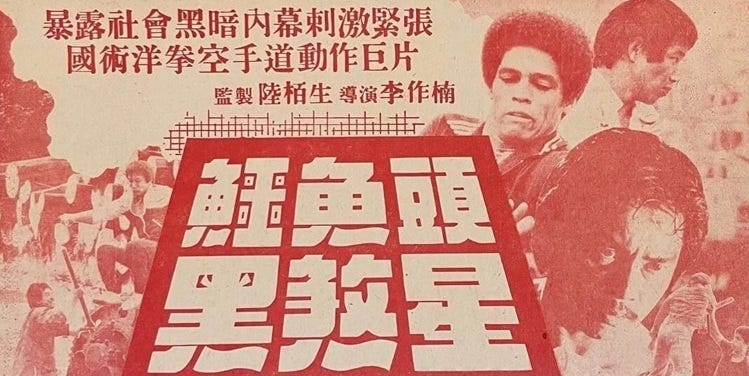
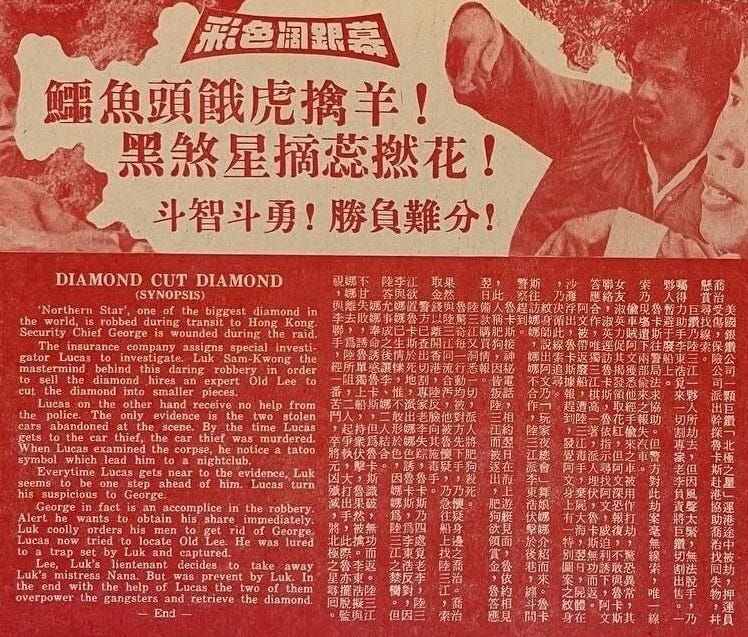
The Tattoo Connection is an example of a film with an abstract title and multiple titles. In Taiwan, it was called Giant Diamond Storm. When I was browsing a Taiwanese auction site called Ruten, I saw a 1978 brochure from the company behind the film. First Films was a Taiwanese company with a Hong Kong subsidiary. Their Hong Kong brochure was written in both English and Chinese. It advertised ten martial arts films. The Tattoo Connection was listed at the bottom with a simple Chinese title: Tattoo (it was the working title). When the film was released in Singapore, the English title was Diamond Cut Diamond. The Chinese title in Singapore and Hong Kong was Crocodile Head, Black Demon. In Cantonese slang, a crocodile is a criminal but a crocodile pool can also refer to the Hong Kong Stock Exchange. It’s not a coincidence that Bruce Lee fan Wong Jing made a 1989 film called Crocodile Hunter when you see the Easter eggs that he put into the movie.
The Chinese leading man of The Tattoo Connection, Tan Tao-Liang, previously had an indirect connection to Wong Jing. In 1977, Tan starred in a period version of Bruce’s Game of Death called Duel with the Devils. This was made to cash in on the fact that the director of Enter the Dragon was going to complete Bruce’s shelved film. Jing’s father, Wong Tin-Lam, made an appearance during the banquet scene in Enter the Dragon. Jing did not work on Duel with the Devils but he was affiliated with the company that made it - Tam’s Film Company. The name refers to actor Tam Bing-Man, who can be seen in Golden Harvest’s 1973 documentary - Bruce Lee: The Man and the Legend. Wong Jing’s affiliations with Tam’s company can be seen in the following instances: The Great Man (1977) was written by Jing's mentor, Lau Tin-Chi. The Utmost Greatness (1979) was written and directed by Jing's father. Crazy Boy and Pop-Eye (1979) was written by Ng Yu, whom was one of Jing's male colleagues at the TVB network. Finally, Cunning Tendency (1978) was written by both Jing and Ng Yu.
Duel with the Devils was released in September 1977 whereas Game of Death was principally photographed by November with some reshoots in December. By the time that we get to First Films making The Tattoo Connection in 1978, it actually came off as a surprise that Dorian Tan Tao-Liang was cast as a fill-in for Bruce Lee. When Lo Wei directed Yellow-Faced Tiger, the selected star was Don Wong Tao. He played a cop whose black cop sidekick goes from being dispatched to disposed. Therefore, it’s not much of a male bonding movie. The film was released in America as Slaughter in San Francisco. In 1978, Don Wong went to San Francisco again to star in a film called Tiger Man. This was directed by an Italian, Matt Cimber, whom was long divorced from Jayne Mansfield. Don’s father had worked in the Italian film industry, so Don speaks English like Al Pacino. No joke; listen to his audio commentaries. Dorian Tan was a better kicker, so it’s just as well that Don wasn’t cast in The Tattoo Connection.
The director of the film, Lee Tso-Nam, would later direct Don in a modern Korean film called Wild Panther (1984). It not only has the same co-screenwriter (Chang Hsin-Yi), but one of the bad guys similarly has an eye patch. In The Tattoo Connection, the one-eyed bad guy was the same Hong Kong actor who pretended to be black in Enter the Fat Dragon. His name is Lee Hoi-San. There is a June 1996 video interview that Jim Kelly did where he had claimed that Bruce Lee wanted to do a film where Jim was his co-star. Cinematographer Tadashi Nishimoto had previously confirmed this in an interview for a Japanese magazine in the ‘70s. In the December 1994 issue of a British magazine called Impact, Bolo claimed that Bruce didn’t want to do any more movies in Hong Kong after Enter the Dragon. Not only that, but Bruce didn’t want to live in Hong Kong any more. As for the proposed movie with Shaw Brothers, House of Flying Daggers (2004) and Sword of Destiny (2016) are proof that you can pass off foreign locations as ancient China.
On his website, martial artist Jim Tracy (a Caucasian) had an anecdote involving one of his younger brothers: “Bruce Lee wanted to rewrite Will’s screenplay Tong and remove Joe Lewis and put himself in the lead role. Bruce Lee was now the most famous actor in the world and impossible to get hold of to finalize the deal. It wasn’t like the old days when Bruce Lee lived in Oakland and would call us at our Karate school in San Francisco and say ‘I am leaving home now and I will be over in a few minutes.’ Then Bruce Lee died suddenly. The movie deal died just as suddenly.”
In the fall 1973 issue of Professional Karate, aspiring martial arts actor Joe Lewis pitched the film: “It’s a film about the mafia moving into San Francisco. There’s a conflict between the mafia and the Tong, which is the Chinese underground, which creates a very interesting story line and a very interesting plot. There are ten fight scenes in this particular film. We are scheduled to go into production some time in August of this year. It’s going to be a pretty good film. There’s a $1,800,000 budget on this particular film. I am playing a starring role and at the present time I don’t know who the rest of the cast will be. I know that Toshiro Mifune will probably be playing opposite me.”
Toshiro Mifune was one of Bruce Lee’s idols. You learn a lot about a person’s death going by the actions of people afterwards. Bruce’s childhood best friend, Unicorn Chan, never worked with the Golden Harvest film company again, with the exception of wanting to publicize him for the benefit of Japanese tourists when Game of Death was released. Several years ago, a Japanese man on Facebook had shared a late ‘70s anecdote involving himself and Unicorn. Apparently, Unicorn told him that Golden Harvest’s founder, Raymond Chow, was responsible for Bruce’s death. Nora Miao didn’t renew her contract with them after it ended in 1974. Similar to Unicorn, she only returned to them to honour Bruce’s memory. In her case, it was allowing herself to be interviewed for a documentary called Bruce Lee: The Legend (1983).
Murder is no laughing matter. In March 2010, Jim Kelly announced that he was going to write a book where he would clear the air on Bruce still not getting the respect that he deserved as a martial artist. In August 2010, Ahna Capri (one of their castmates from Enter the Dragon) died in a car accident. Adding to the spookiness is that her final credential as an actress was an appearance in a season 2 episode of Mrs. Columbo. It aired on November 22, 1979 - five days before what would have been Bruce’s 39th birthday. The relevance is heightened by the fact that 1979 was when Game of Death had its U.S. release date - five months before November. Presumably, Ahna Capri couldn’t appear in Robert Clouse’s worst film because she was acting in a TV movie called Nowhere to Run (which aired on January 1978).
Ahna’s final theatrical film, however, was The Bingo Long Traveling All-Stars & Motor Kings (1976) where she is simply credited as the prostitute. In his 1987 book about the making of Enter the Dragon, Robert Clouse insinuated that she was a yacht girl. Her final theatrical role is worthy of note because the film starred Billy Dee Williams, Richard Pryor and James Earl Jones. Symbolically, it earned US$33 million at the box office. It wasn’t a flop. It actually made three times its cost and then some. Had Bruce Lee not died, any one of those guys could have worked with him on a movie. As for black martial artists, one potential candidate was Carl Scott - a Kung Fu master who even got to appear in Bruce Lee - True Story (1976) before working with that film’s star on Last Strike (1977). The latter was released in the U.S. as Soul Brothers of Kung Fu where the Chinese star was credited as Bruce Li. On a similar note, The Tattoo Connection has a Barry Norman lookalike named Norman Wingrove.