
The Puma

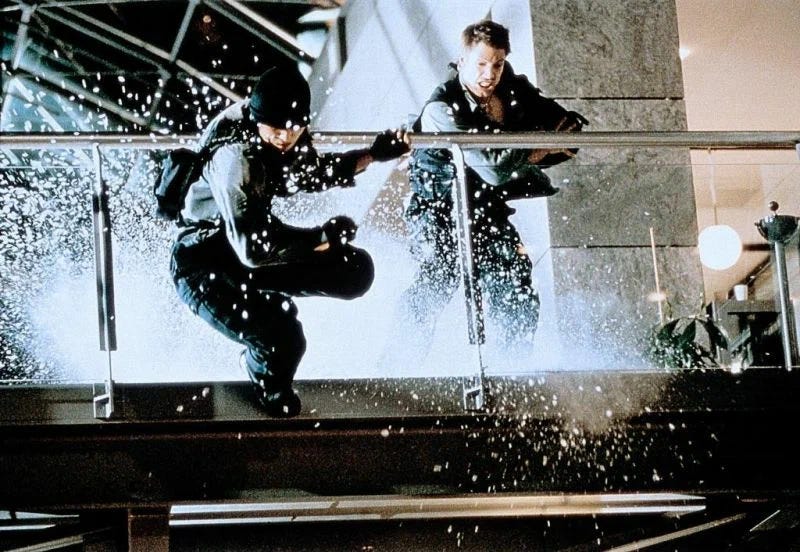
When being asked to direct Hong Kong action for a German TV series, Donnie Yen found himself giving a crash course in crash test dummies since most of the people involved in the production were not actually stuntmen despite being trained in different forms of martial arts. Back in the nineties, there was a concern that a Hong Kong fight choreographer would never agree to work on a TV series because the schedule would be even more stifling than working on a film for an overseas company. In Hong Kong, more time can be spent on TV fight scenes but that didn’t stop the artistic and commercial success of Sammo Hung’s U.S. series: Martial Law (1998 to 2000). It’s because of this series that The Puma came into existence, and why Donnie accepted.
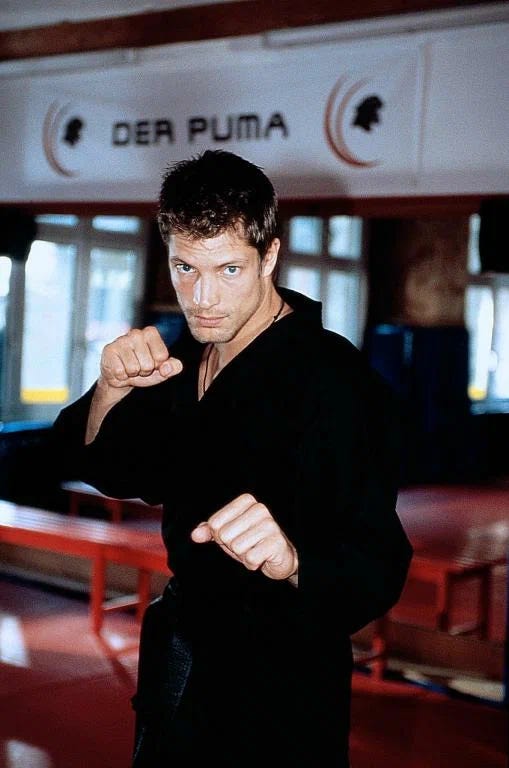
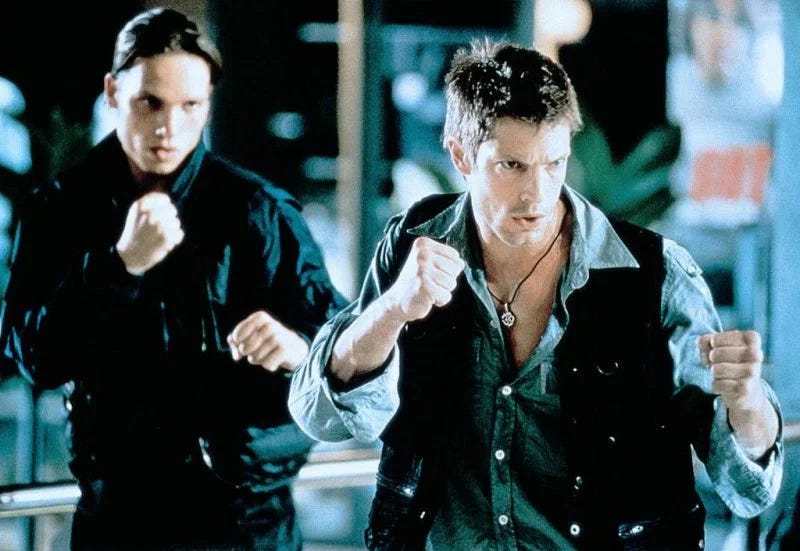
Because of himself having a fanbase in Japan, it was truncated into a TV movie when aired over there. It’s what they call a digest version. His Fist of Fury TV remake had already been aired in Japan as a digest version. In a rare book called Donnie Yen’s Action Book, he went into more detail about The Puma than before or since. There’s not exactly a chapter on the German TV series, so I had to put together the references scattered throughout the 2005 book. The Japanese book also contains contributions from other people e.g. Mickey Hardt, the star, said: “You hurt yourself, you use up your energy, but in the end you're strong enough to get the job done. Stuntmen are incredible guys. They're used to being in pain. Or they don't know pain.”
The Adam Joseph Copeland lookalike also said: “I've been training in martial arts for a long time. However, even if you can do amazing kicks in real life, it doesn't make you look good in front of the camera. I've heard actors bullsh!t that they did all the action themselves. That's impossible. Why? First of all, even if you do some of the action yourself, insurance companies won't allow an actor to do all the action, especially if it's a dangerous move. It's not something that insurance will cover if something happens. When I was hospitalized, a car came to pick me up. Donnie took care of me in many ways.”
Donnie was so impressed with Mickey Hardt’s talent and perseverance that he landed him the gig of villain in a Hong Kong vampire movie called The Twins Effect. As you can see, Mickey looks like the wrestler who is also known as Edge (although I prefer Adam’s original wrestling name: Damon Striker). In Donnie Yen’s Action Book, the titular subject said: “Most of the actors were not stuntmen. However, each of them had experience in kickboxing, Taekwondo, and other forms of training, and as a result of regular exercise at the gym, including stretching and rehearsing maneuvers, all of them were able to perform convincing movements.”
When interviewed for the book by translator Tome Urakawa, Mickey Hardt said: “The way that the camera was used became an explanation of the scene. For example, there was a shot where the main character, played by me, stumbles into the frame looking for tools to fight the enemy. Donnie used a close-up of my eyes wandering then a POV shot in which the camera moved to one object, then to another, making the act of searching itself an act.”
Susanne Hoss, co-star, also talked about her own experience for Donnie Yen’s Action Book (2005): “Donnie always showed me where the camera was and where I was kicking. The important thing is not to have a realistic fight, but to match the action to the camera.”
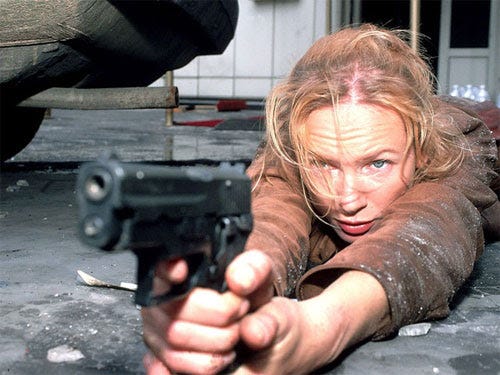
About the above character, Donnie said: “There is a scene in which a female police officer runs toward her own gun that has been knocked down, and watches it slide along the ground and fall into a hole. A close-up of it was taken in a long shot from a distance. In reality, the actress was hardly running at all, but instead took a step on the spot, which was captured by the camera as the moment she rushed towards the gun as if she were running fast.”
The following anecdote from Donnie makes me wonder if he had seen a 1998 Hong Kong action film called The Blacksheep Affair (starring Vincent Zhou): “There is a scene where several prisoners fight in a prison shower room. When the team arrived at the scene, the lights were set on the opposite side of the building from where they had been scheduled due to the drama they were filming earlier. The actors and stuntmen quickly recoordinated their movements in the opposite direction from the pre-choreographed direction, which saved them time from wasting time moving the lights.”
About editing, Donnie said: “There are two main types of close-ups. This difference has important implications when editing. The first one is done as part of the editing process during shooting i.e. in-camera editing. For example, there is a wide shot of Mickey Hardt getting punched. What follows is a close-up shot of his reaction. This connection method was already planned during the filming stage. The second type is when the director has not already thought of the shot. Typically, a close-up of the hand is used as an insert or what they call a pick-up shot. This is where you have to think about what’s needed when you are undergoing post-production. As a result, the transition from shot to shot may not always be smooth.”
For Donnie Yen’s Action Book, cameraman Pascal Mundt said: “The important thing is to take as many shots as possible so that you can make various choices during the editing stage.”
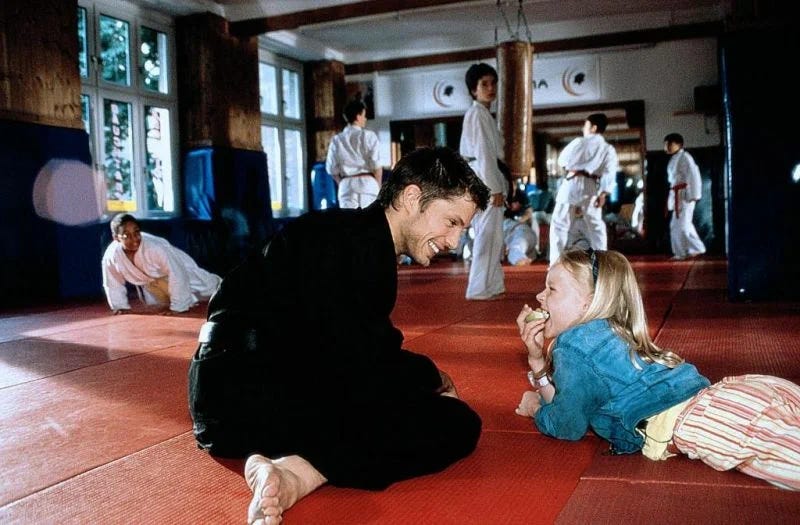
Donnie elaborated: “For example, let's say you're shooting a close-up of Mickey Hardt walking out of the frame or doing an action. While the camera was still rolling, I asked him to make ten more expressions, to come out of the frame from this side, to do that spin, to step back. You can do it if you have a little time. Then, if you need some kind of insert later, you can do it as long as it's successful.”
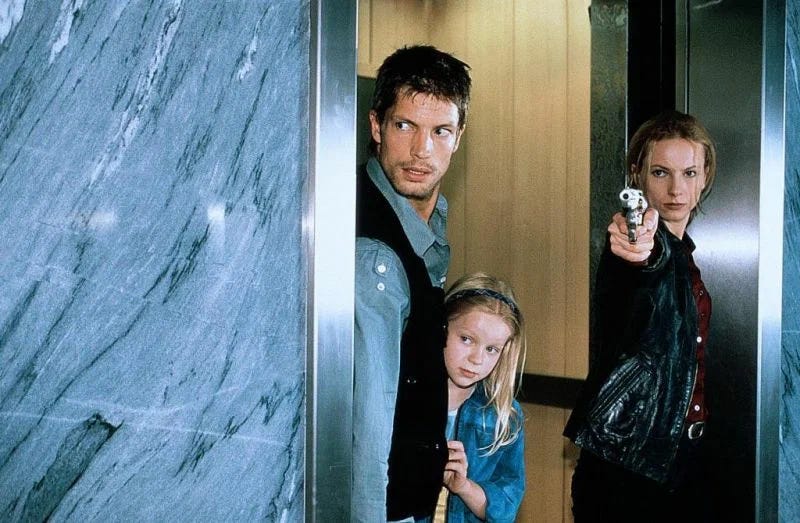
Donnie gives another example by giving you a set-up: “There is a scene where Jackie, a female police officer, and the main character Josh, played by Mickey Hardt, are in a building where they chase bad guys. The bad guy uses a stick to knock Jackie's gun away, causing it to slide across the floor. She lunges for the gun, but the man knocks it farther away, causing it to bounce off the wall and fall into a hole in the floor. Just then, Josh front-kicks the bad guy and the men start fighting.”
How Donnie approached it as an editor: “When editing, I connected the scenes as follows. Jackie runs towards the gun, and the gun slides across the floor. Cut to a close-up of the gun. Then we cut again to the shot of the gun falling into the hole. Next is a fighting scene between two men. You can't show both the falling gun and Josh's kick in the same shot. That's why we first showed the gun situation and then Josh's kick, but if we just showed Josh's kick, it would have felt a little silly. The relationship between the two men fighting must also be captured. Therefore, we use montage. Following the kick, we cut back a few steps to Mickey's chase, cut back to the falling gun, then cut back to the men, and then brought in the kick.”
Like a musician, Donnie knows how to do improv to cover up a blunder: “I filmed an action scene in which a stunt double is attacked by three bad guys and rolls around on the ground. He twists and turns, then suddenly performs a somersault and dives out of the frame. When shooting, I forgot to take an intermediate shot of the transition from rotation to diving.”
He also said: “When I filmed The Puma, I tried a lot to get the right angle. Therefore, I tried dividing the series of movements into a maximum of four movements. This is because it is not possible to fit the flow of multiple movements into one fixed angle. No, it's not impossible, but you need to choreograph it according to that angle.”
One of his gripes is interesting because he already had the experience of being an action choreographer for Hong Kong television: “Long takes cannot be used in TV shooting. If the shots are long on TV, the audience will get bored. The opening action scene in Germany ended beautifully with a vast crane shot, but it was ultimately cut. It would be a problem if viewers thought that was the end and changed the channel.'“
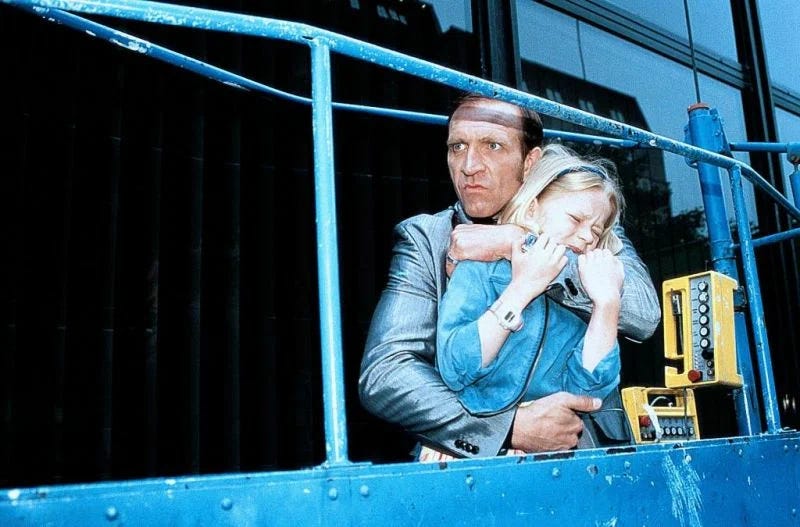
As for why he chose to work on a German TV series instead of a U.S. one like Martial Law, one could assume that it was due to the lack of union issues that prohibits stuntwork along with the nonexistence of meddling executives, prima donnas and Teamsters. However, Donnie gave the game away when he said: “For some reason, there are many German Steadicam operators in Europe and America.”
Donnie’s memory of a stand-out moment: “I remember filming a scene where a gun suddenly falls onto a table and breaks things on the table. A stuntman who was called to throw a gun noticed that there was a Buddhist statue on a table, and as he is a Buddhist, this action violates his religious beliefs.”
This is ironic because Kung Fu was developed by a Buddhist monk. Back to Donnie: “When we shot the scene where a stuntman lunges out of the windshield of a van, it took an hour to install the sugar glass windows. Also, since even sugar grass can cut, flesh-colored tape was carefully wrapped around the stuntmen's necks. In another scene, a prop chair was suspended from a wire and sent flying across the set to add power to Mickey Hardt's kick. The wire was pulled just a little before Mickey kicked. What is needed is instantaneous timing. If you pull too quickly, it won't look like the chair flew away as a result of the kick; on the other hand, if you pull at the same time as you kick, there will be a time lag for the force to pass through the wire and reach the chair.”
Stuntman, choreographer and director Kenji Tanigaki is a member of Donnie Yen’s team. As such, he was the “supervisor” or editor of Tome Urakawa’s translations. Donnie Yen’s Action Book was a strange project, but it’s only natural for Kenji to be allowed to have his say in the text: “During the making of Ballistic Kiss, I was working hard when people were quitting one after another due to various reasons. Donnie gave me a lot of discretion. He'll tell me things like “Come up with ideas” then “You'll learn how to edit”' and “You'll need to put together close-ups.” I learned a lot from that period. When it came to The Puma, he told me to do the camerawork.”
The twist in Tanigaki’s tale: “It may come as a surprise, but the first time I felt confident as a professional was after participating in The Puma. Until then, I wasn't sure if I could make it in this world, but it was through The Puma that I was able to establish a work format that made me realize this is how I should do it. It was very meaningful for me to experience the process of starting work from scratch in Germany, which is said to be an action desert, and training staff to make what I want to do come true. In Hong Kong, everyone knows what an action is, so Donnie doesn't bother to explain it, but in Germany he has to clear his mouth and explain what an action is.”
Kenji’s first step towards becoming a director: “Moreover, when I communicated this to the other staff, I had to explain it in English, not in Japanese or Cantonese, so I had to sort it out in my head. When I'm working with Donnie, I have to take notes, prepare storyboards, guide the actors, say what I need to say without hesitation to the cameraman, and sometimes I have to give ideas to the director. Sometimes it doesn't happen. The fact that I have to do everything means that I have confidence in everything I do, and thanks to that, I am now able to ask any of the staff at the site to tell me what to do, without hesitation. You can approach it with as much force as you like. Being an action director requires not only technique but also the ability to handle the scene, and perhaps that attitude is what Donnie taught me the most.”
Donnie Yen reflects on a moment of product placement involving a fight scene with Michael Woods: “We shot close-ups of Michael's walking legs from the side or front, showing off his Gucci shoes because Gucci provided the costumes for free, and in return we agreed to film them.”