

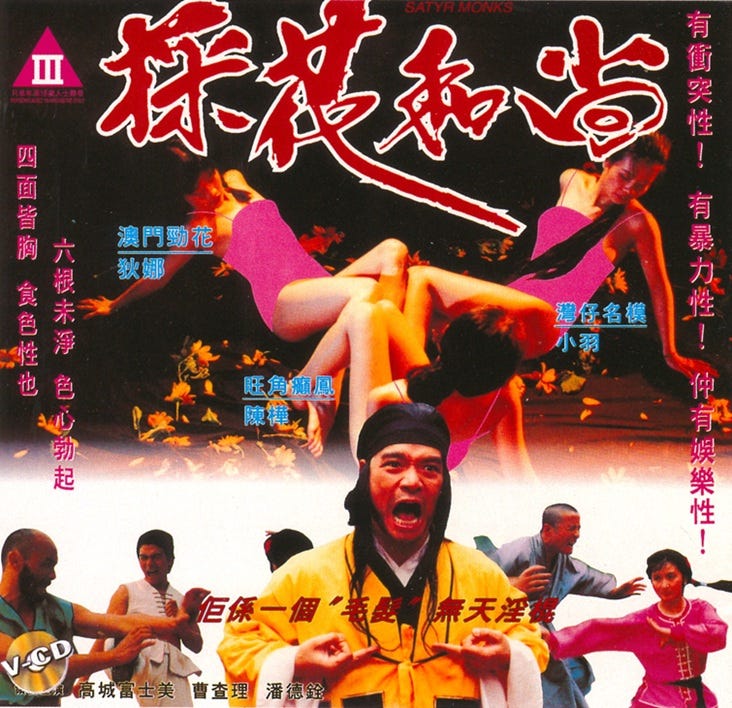
This Hong Kong film is called Satyr Monks (1994). The man in the yellow garb looks like Stephen Chow but it isn’t him. It’s Steven Poon Tak-Chuen. It’s akin to Bruce Lee having imitators named after him. In the case of Stephen Chow, Flirting Scholar (1993) became the highest-grossing Category III film by hauling over HK$40 million. Even HK$30 million was seen as an unattainable gross. About the trio of women who represent this film rating on the VCD cover for Satyr Monks, the pink bathing suits weren’t the first layer of digital superimposition. If you look at the theatrical poster on IMDB, you will see that two of the women wore superimposed black bikinis while the bottom woman was naked. This reminds me of something that was brought to my attention by Maddy Smith. On Monday, February 3, 2020, there was an episode of The Bachelor where three g-stringed women became victims of bad photoshop. The moral of the story is that it’s better to use pan-and-scan than attempting to turn bikini bottoms into boxer briefs. It reminds me of how Stephen Chow’s Shaolin Soccer (2001) was digitally modified for its U.S. release to give a naked goalkeeper some dignity.
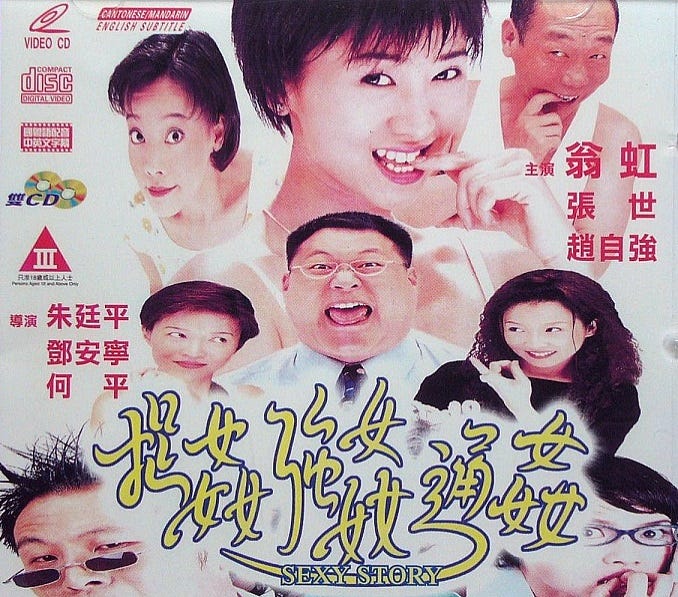
Back to Category III, it was quite gimmicky for such a film to play with the number three by having a trio of women. Also common was to have a III-rated film that was an anthology consisting of three stories e.g. My Better Half (1993), Amazing Stories (1994), Three Sexy Stories (1996), Sexy Story (1997), Lady in Heat (1998) and Water Margin: Heroes Sex Stories (1999). With the exception of the first and final anthologies, every film was Taiwanese. Perhaps they knew from the Red Shoe Diaries series that erotic stories are best without the story being padded out. My Better Half is notable for how the only character on the poster wants to name her children after Stephen Chow and Vivian Chow. The latter is not related to the former but they did star in a film together - The Unmatchable Match (1990). One unmatchable match would appear to be Stephen and Jet Li. They only did one film together, Dragon Fight (1989), despite the fact that they worked with the same director - Wong Jing - on a surprising number of films within the timeframe of 1993 to 1995.
When Stephen and Jet filmed Dragon Fight, it was in San Francisco - where Bruce Lee was born. Perhaps 1989 was when Stephen became inspired to play Bruce as a younger man. One of Stephen’s friends and TV colleagues was a Bruce Lee fan named Donnie Yen. Given that Jet and Donnie had attended the same Wushu academy in Beijing, there was an opportunity to make a film that rivalled the three-hander of Jackie Chan, Sammo Hung and Yuen Biao. NewspaperSG, a Singaporean website, has articles in both English and Chinese, but they’re not merely duplicates of each other. From what I can gather, mid-December 1991 was when it was announced in the Hong Kong press that Stephen was going to star in a film called Young Bruce Lee. It was going to be a drama because Stephen was tired of not being taken seriously as an actor, despite the fact that he was already established as a drama actor. He actually won an award for Best Supporting Actor in Taiwan’s Golden Horse ceremony. The film, Final Justice (1988), starred Danny Lee.
In 1975, Danny Lee played Bruce in a Betty Ting Pei biopic called Bruce Lee & I. It was released in 1976: the year of the dragon. In 1988, the next year of the dragon, Danny signed Stephen Chow to his own production company - Magnum Films Limited. In 1992, Danny transferred Stephen’s contract to a company called Win’s. This was owned by the Heung brothers - Jimmy and Charles. Stephen’s salary went from HK$700,000 to HK$3 million. Besides the upgrade, the most interesting detail is that Charles used to be married to Betty. A month before Bruce died, Charles starred in a Kung Fu movie called The Big Showdown. This was directed by Wong Jing’s dad, Wong Tin-Lam. Fast-forward to December 1991, it was reported that Stephen and Jing were going to make Young Bruce Lee via a newly formed company called Cross Star. The director was going to be Gordon Chan, and filming was going to begin in March 1992.
None of these details were mentioned in either of Jing’s memoirs (2011 and 2025 respectively). The only detail that lines up is that Golden Harvest were going to be involved. The collaboration with Bruce’s former company is because they owned the rights to his movies, but Young Bruce Lee was going to take place way before the 1970s. Wong Jing claimed that he took Stephen Chow to Golden Harvest’s third founder, Choi Wing-Cheong. This man was so superstitious that 1988 was the only time that he attached his name to a film as producer. It wasn’t so much because it was the year of the dragon, but because the Chinese people regard eight as a lucky number. Sammo Hung’s Paper Marriage, a shelved 1986 film that was shot in Canada, was released in April 1988. Also released in that month was a Taiwanese film titled Osmanthus Alley, which Choi Wing-Cheong worked on as a production manager. Neither film had an exceptional box office result.
Choi Wing-Cheong was so mysterious that he could almost be regarded as a silent partner of Golden Harvest. I wrote about him before in a 2018 WordPress article titled Antagonist’s Anniversary, and a 2024 Substack article titled Every Nook and Cranny. In April 1991, Wong Jing had already formed a production company called Wong Jing’s Workshop. Choi was the man who inspired him to start his company. When Jing began directing Jackie Chan in Golden Harvest’s City Hunter circa June 1992, it was most likely because of Choi. H.K. actors and directors really knew how to multi-task, not just Jing. Stunt coordinator Ching Siu-Tung simultaneously worked on City Hunter and Jing’s Royal Tramp II, starring Stephen Chow. About Young Bruce Lee, Jing’s version of events was that himself and Stephen were each to be paid HK$4 million until, as the weeks went by, Stephen opted to be paid HK$8 million to star in Gordon Chan’s The King of Beggars (1992). This was a Win’s production where the distributor, Gala, was a 1992-established offshoot of Golden Harvest.
Royal Tramp II was also a Win’s production, as was Fight Back to School III. The latter was the final film that Jing did with Stephen in 1992 (it was released in January 1993). When both men decided to do a comedic version of Basic Instinct (1992), it wasn’t really a sound idea. Basic Instinct earned HK$27 million after it premiered in March 1992 whereas Jing’s threequel earned HK$25 million. In theory, the threequel could have been a Category III movie but Jing copped out. Bruce was so foul-mouthed that a movie about him should be rated III. There is no real good reason why Stephen couldn’t do Young Bruce Lee. According to Jing, Stephen was going to be the writer. This means that it was his screenplay, and he was free to do with it what he liked. Stephen even tried to resurrect the project in 1997 with Jeff Lau as the director, but this was after he stopped working for Win’s in 1996.
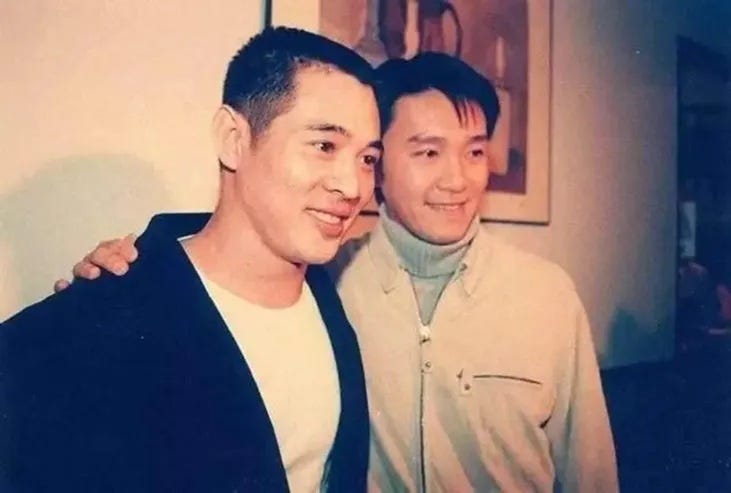
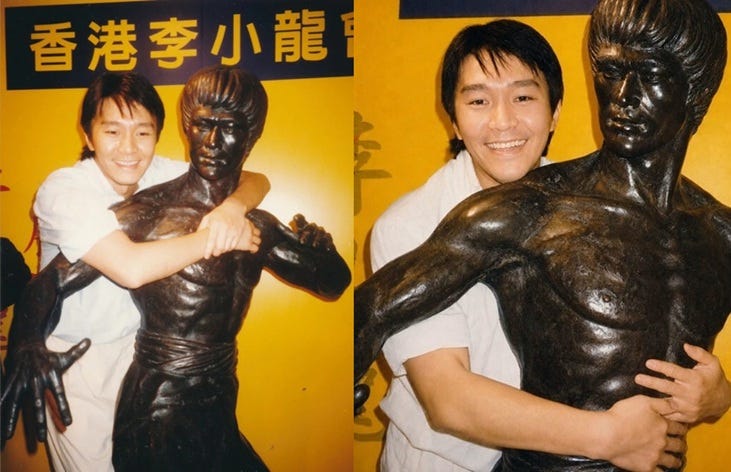
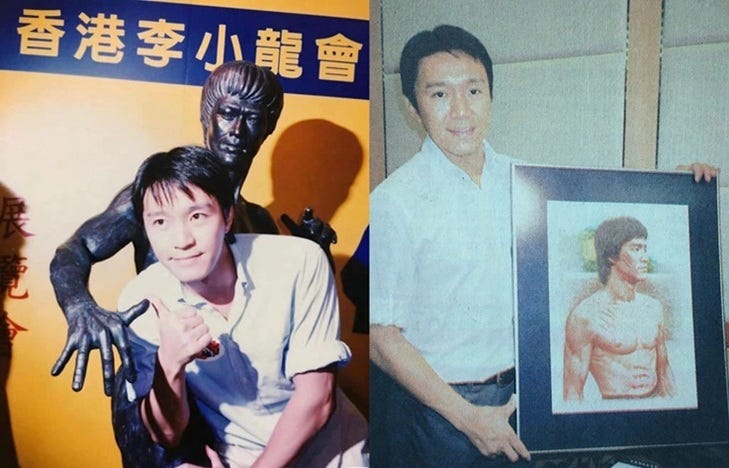
As for Gordon Chan, he liked Bruce enough to remake Fist of Fury with Jet in 1994 i.e. Fist of Legend. The above photo was taken in 1995. Also present were Rosamund Kwan and Karen Mok. Jet’s movie with Rosamund, Dr. Wai in the Scripture with No Words, was going to be released in March 1996. Stephen’s movie with Karen, The God of Cookery, was going to be released in December 1996. The reason why Stephen didn’t reunite with Gordon Chan in 1997 was because of Stephen being a control freak during the making of King of Beggars (1992). Directors in Hong Kong can be equally accused of being ladder climbers as their U.S. counterparts, but there’s only so much that one can take. Back to the above photo, 1995 was historically significant for the Bruce Lee fanbase. First, the Hong Kong fan club was formed with Stephen being one of the honorary chairmen. In fact, he was the one who is responsible for the statue that you saw earlier on. Stephen didn’t personally make it, but he made it happen.
The second Lee-themed event in 1995 was the release of a Wong Jing movie called High Risk. Jacky Cheung plays the role of a Bruce Lee imitator whose personal life and professionalism is comparable to Jackie Chan. Cheung was not a Chan clone for real, but he was given his anglicized name due to his resemblance. Cheung is not so much an action movie star as an actor in general. Ironically, Stephen Chow could have played the role of Frankie Lone. By not having a Dragon Fight reunion, High Risk became a Once Upon a Time in China reunion since Cheung played Buck Teeth So (in the 1991 film where he is unrecognizable). High Risk certainly has the makings of a Stephen Chow movie. Besides the use of Cantonese slang, two of the actors had been regular collaborators of his. Lee Lik-Chi plays a nerdy journalist whereas Vincent Kok Tat-Chiu plays the news cameraman. As time went on, Wong Jing and Lee Lik-Chi became known for having each directed eight films starring Stephen.
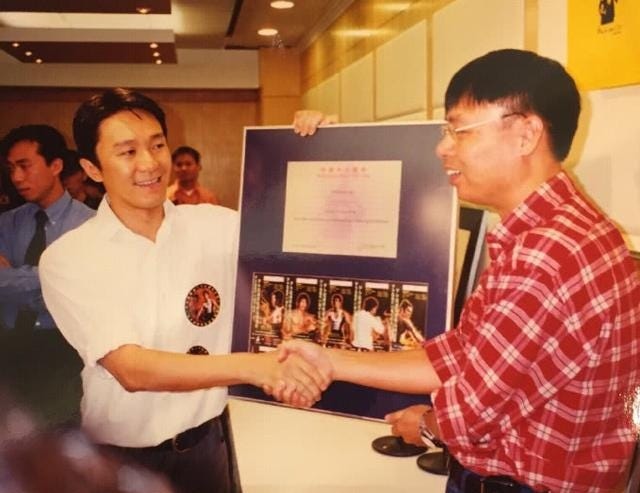
In the October 1995 issue of Cinemart, an article about Bruce had revealed that Ng See-Yuen legally changed Leung Choi-Sang’s name to Bruce Leung Siu-Lung after Lee died. Ng produced the film that turned Stephen into a superstar: All for the Winner (1990). In 1990, Stephen began filming a contemporary parody called Fist of Fury 1991. When it finished being screened in Hong Kong, it was April 17, 1991 - the day after Jing formed Wong Jing’s Workshop. Stephen’s affecionate spoof was rated Category III. In 1991, there were 563 III-rated films (i.e. foreign and domestic), but 401 of them had to be censored. Part II of the 1991 lampoon was released in January 1992 with only a slightly diminished return of HK$22 million (it was rated Category II). In February, ATV announced that they were going to put together a series about the young Bruce Lee.
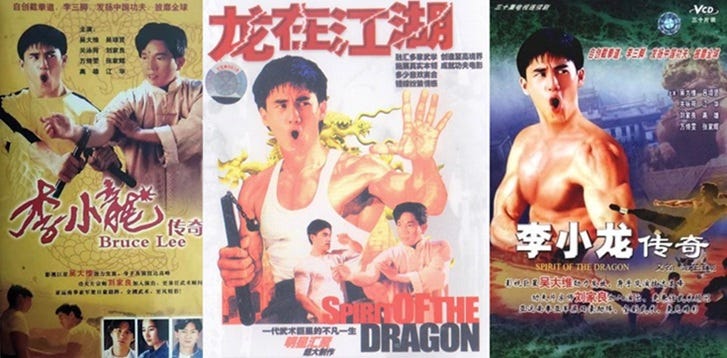
Spirit of the Dragon starred David Wu, who co-starred alongside Donnie Yen in Tiger Cage II (1990). When Donnie worked with Stephen Chow on TV, it was for a rival network called TVB. The day before Stephen’s III-rated Flirting Scholar finished its H.K. theatrical run in July 1992, Spirit of the Dragon began airing. There are some curious politics in the Hong Kong film industry. Jet Li was going to be directed by Billy Chan Wui-Ngai (one of Bruce’s stuntmen) for The Dragon Gate Inn but then his manager’s murder happened in April 1992. In May 1992, Universal began filming Dragon: The Bruce Lee Story. If Jet liked Billy Chan then he could have got him to be the director of The Bodyguard from Beijing (1994) and My Father is a Hero (1995) instead of Corey Yuen, who makes the action look cartoony (but then part of the charm of vintage H.K. cinema was that you were watching live-action anime).
Let’s not forget that Jet had his own production company, but I suspect that Billy was affiliated with a rival Triad to Jet’s main producer - Jimmy Heung (who owned the Win’s company). Let’s also not forget that Bruce formed his own gang when he was a teenager. Seven months before the Category III rating began in November 1988, there was a teenage crime film that was released. Titled Gangs, the censors demanded thirty cuts, along with swear words being bleeped. The director resented this. It took several months for all parties to agree to a compromise. In April 1988, the film was released with an entire scene excised, and several shots of three other scenes removed. As for the dialogue, 23 lines were redubbed. Born in June 1962, Stephen Chow should have counted his blessings that he didn’t become a major movie star before the Category III rating emerged.
Had Young Bruce Lee been made with Stephen and Wong Jing, there’s a good chance that a Chinese chick named Chik King-Man would have been cast. She looks like Cheng Pei-Pei, who began acting in 1964 prior to being simultaneously signed alongside Bruce to Golden Harvest in 1971. Chik King-Man was a regular player of Category III movies. Also, she was in Stephen’s All for the Winner (1990) and Forbidden City Cop (1996). For Jing (as director and/or producer), Chik acted in Money Maker (1991), Young and Dangerous (1996), Portland Street Blues (1998), Sex & Zen III (1998) and Her Name is Cat (1998). The latter had the potential to be the ultimate Cat III movie, but it was rated II-B. High Risk (1995) could have been rated III had Jing allowed viewers to see what was inside the April 1995 issue of Playboy (i.e. the U.S. edition).
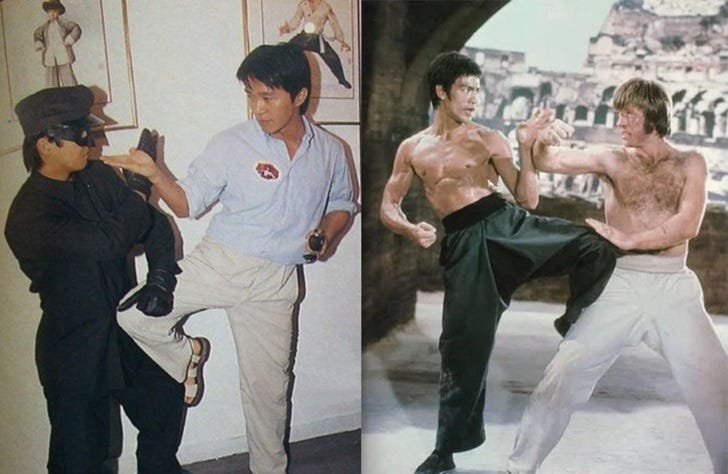
Back to Satyr Monks (1994) starring Steven Poon, the director had an association of sorts with Jet Li. In 1988, Sek Bing-Chan directed a documentary featuring footage of Jet. Titled Dragons of the Orient, it was about the Beijing Wushu scene. Almost every Sek Bing-Chan film featured martial arts actors. As a writer, he worked alongside Phillip Ko Fei on six films from 1999 to 2001. Phillip had worked as a stuntman on two of Bruce Lee’s movies: Fist of Fury and Enter the Dragon (1973). Sek most memorably directed Lam Ching-Ying for R*pe in Public Sea (1993). Lam directed a Kato-driven movie called The Green Hornet (1994) before Jet Li played a Kato-esque character in Black Mask (1996).