
Sans Protégé

Not only is John Woo without peer but he is without pupil. When Paycheck was released in 2003, it had been ten years since the release of his first Hollywood film. In 1993, the French Impact magazine was going strong. By 2003, the magazine had been out of print for three years. I’ve read a couple of Woo-related issues that I haven’t covered yet. In the February 1996 issue (No. 61), John Woo was handed the task to hit two birds with one stone - talking about his latest cinema release and his first TV movie. But first, he was asked to express his rearview mirror perspective on Hard Target (1993): “I believe that I had partly failed by pride. I was too ambitious; I desired too much to put some in. Wanting to preserve at all costs my style, to work the characters in a different direction than I always had done, to always add more action, violence and emotion. I learned from this experience. There are some lessons that really helped me for Broken Arrow.”
John Woo puts down a common comparison made embarrassing by the fact that both films share the same screenwriter: “Broken Arrow has nothing in common with Speed. One takes place entirely on a bus, the other in the desert. In fact, the idea for Broken Arrow came to Graham Yost by chance. He was simply inspired by discussions with a friend who was passionate about everything to do with nuclear weapons, particularly the loss of ballistic missiles. Incidents like, in 1989, the American submarine that forgot its missiles somewhere off the coast of Norway, or the B-1 bomber that sank in the Mediterranean! The subject fascinated me at a time when trafficking linked to the arsenals of the former Eastern bloc was increasing.”
John Woo is also a writer as proven by his many Hong Kong credits: “I accepted Broken Arrow because I was able to bring a personal touch to the original script, to emphasize the violated friendship of the two main characters, to modify certain sequences. The boxing match at the beginning, for example, was there, but in the form of a sports program that Vic Deakins and Riley Hale were watching on television. I thought it would add extra vitality to integrate it directly into the action, that these few minutes of friendly confrontation would already teach a lot about the conflictual relations between the two main protagonists. Similarly, I wanted Broken Arrow to end with a mano a mano fight, not with a classic gunfight as Graham Yost had planned. I also brought this idea which consists of showing Christian Slater, between Samantha Mathis' legs, shooting his rival. Samantha Mathis, I fell in love with her when I saw her in The American President. We managed to convince the studio to hire her instead of taking a more famous face - Drew Barrymore or Sandra Bullock for example.”
Casting John Travolta: “I suggested him to the producers for a very simple reason: John Travolta in the role of a b@stard is surprising. I wanted him to appear at the beginning as the sympathetic characters that he usually plays. He had to be endearing, so that we wouldn't immediately identify him with the dangerous psychopath that he would later turn out to be. His temperament is the opposite of that of Riley Hale played by Christian Slater, an army pilot who knows how to keep his cool in all circumstances.”
Why Slater was cast: “I see in Christian Slater a sort of young Steve McQueen. Like Steve McQueen, the effectiveness of his acting comes from a very well-balanced mix of strength and weakness. It was after seeing him in True Romance that I thought of him for Broken Arrow. John Travolta and Christian Slater are not athletes, but it was imperative that they be in shape for the film. After a good workout, they proved themselves to be up to the task, especially in the boxing match in the opening credits. Carlos Palamino, a former world champion, was in charge of introducing them to this sport.”
Back to Travolta: “John Travolta has a way to embody this villain - his gaze can be extremely gentle and, in a fraction of a second, his eyes become devilish. I also got on very well with him. No communication problem between us, no need to rehearse scenes before filming. I walked with him on the set as naturally as if I were with Chow Yun-Fat! In addition, when angry and really not smiling, I retreated into my shell, so John came to me to tell me a few jokes, just to cheer me up, to make me laugh despite the problems.”
The conditions of shooting in the Montana desert: “The heat was overwhelming and we had to be terribly wary of tornadoes. But it was a flooded river that caused us the biggest problems. We had to take refuge on the roof of the train, a roof so slippery that some people fell off it. In one scene, Christian Slater is hiding under one of the cars and the safety cable holding him gave way. For a few seconds, I really thought we were going to lose him. To avoid going under the wheels, he held on to the structure as best he could, a few inches from the tracks. He escaped with a few superficial burns, protected as he was by very resistant clothing. I have to give credit to the actors, who were very bold in getting into the game, generally without a stunt double.”
John Woo compared the two main characters to ones in a much earlier film of his: “The villain played by John Travolta is a direct reference to Waise Lee in Bullet in the Head. Like him, he is trying to escape his condition by collecting as much money as possible. The means matter little to him. Like him, he betrays a deep friendship through greed. For his part, Christian Slater is like Tony Leung in the same film; he refuses corruption, remains true to himself and leads the fight to the end, when he could give up the fight at any moment.”
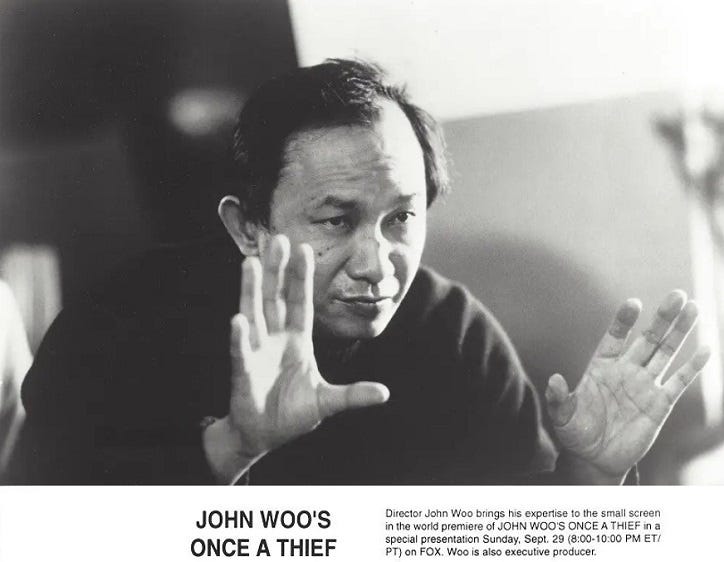
John was asked why he remade one of his Hong Kong movies as a Canadian TV movie: “It was the screenwriters Glenn Davis and William Laurin who came up with the idea for Once a Thief in its current form. They loved the original film, and felt that it had the makings of a very good TV series. Two and a half years ago, they came to offer me to sponsor the project. At first, I wasn't very keen. Mainly because of ignorance. I knew absolutely nothing about TV production. Except for a few episodes of The X-Files, I only watch TV for the news. With many scripts in development, I had little time to devote to Once a Thief. However, I had read the screenplay, which I found interesting, quite good even insofar as it emphasized an emotional aspect that I had not exploited in my film.”
At this juncture, I should note that the original Once a Thief was conceived as a dark film before the box office failure of Bullet in the Head made John Woo switch gears. Anyway, back to his interview for the French Impact magazine: “Faced with the insistence of Glenn Davis and William Laurin, I finally gave in. I was also very curious about working in television. I, who had become accustomed to big productions, suddenly had to face conditions that were much less comfortable. For a budget of $4 million, I had to complete the pilot of Once a Thief in 25 days of shooting. But this challenge is not the only reason for my collaboration. Terence Chang, my agent and producer, and I found there to be material to realize an old ambition. Assuming that I direct the pilot of Once a Thief, that it achieves a certain success, a series would be launched. By associating my name with it, I could also control the creative aspects. And why not make this series a test bed for young directors? I have spoken at length with so many film students who were just waiting for this. With young actors too. As for money, I don't care. Many of my films have made quite a bit of money, so I wanted to return the favor, to do something for others.”
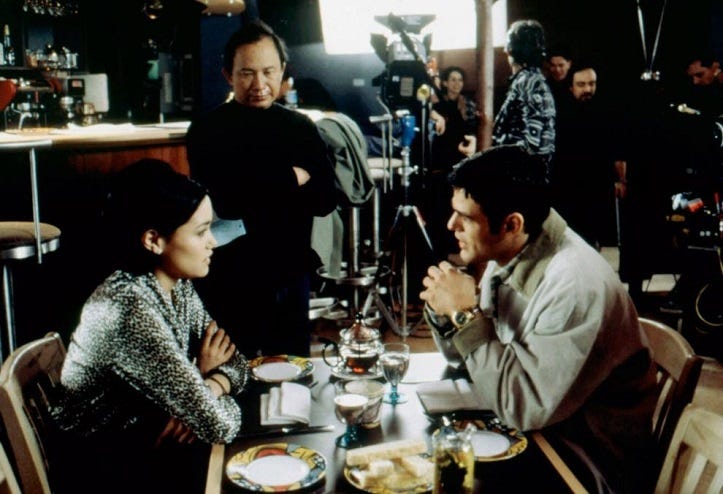
As for how John Woo adapted to the constraints of a television shoot: “You have to work quickly, film as intelligently as possible in a minimum amount of time. Unlike me, the technicians on Once a Thief were used to these frenetic rhythms. They also knew my previous films, my way of moving the camera. So we found a way to frame the sets with rails to allow the longest possible tracking shots. Cut by David Wu, the editor of The Killer, these images gave a multitude of usable shots. On a shoot like this, you have to constantly be cunning. I didn't make anyone's job easy, because I like to have choice, to try several angles, a luxury that television doesn't generally offer its directors. For some of the action sequences in Once a Thief, we had little more than a day or two to shoot.”
Examples: “For the final scene on the docks, we couldn't go over 6 hours. No shooting after 11pm. Afterwards, our explosions would have woken up the local residents and the police would have intervened. Crazy! Sometimes, the set for a scene was being built while I was wrapping up the previous one on the set next door. An hour before filming, I didn't know what it would look like exactly! Sometimes we would shoot in four or five different sets on the same day. It was forbidden to exceed two, three or four takes, depending on the schedule, for each shot! Thanks to the organizational skills of the Canadian technicians, I was able to complete Once a Thief. Multiplying the shots, camera movements were very important to me because I wanted it to feel more like a film than a TV movie. In fact, cinematographer Bill Wong and editor David Wu, two long-time collaborators, helped me keep this commitment.”
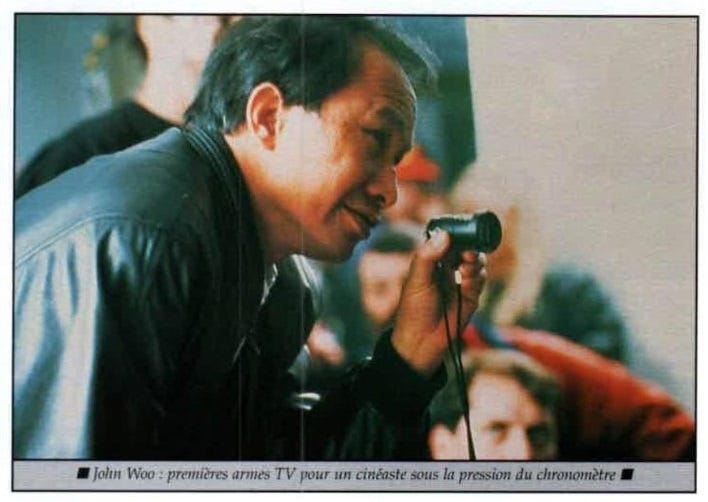
As to how it affected John’s temperament: “It would be a lie to claim that such an experience does not involve a certain frustration. The positive side: to try to experiment constantly. I must also admit that Once a Thief offered me the opportunity to live with healthy, simple and hard-working people. Unlike a film shoot, you do not constantly come up against ego problems, games of wrestling for a little more power, pettiness... You do not have to constantly report to the studio, to spend endless hours in meetings that follow one another without a specific goal, to all this procrastination on the choice of this or that star, to take into account everyone's opinion... It is freedom in short! If it rains cats and dogs, which was often the case in Vancouver, you can immediately fall back on another sequence, another set, improvise. On a big Hollywood movie, people are twiddling their thumbs and waiting for the rain to pass and for things to dry! On Once a Thief, we implemented new ideas directly without waiting for the green light from production. In Hong Kong, I worked like that. It’s my favorite method.”
Censorship: “Television involves a set of regulations. It is strictly forbidden to shed blood. It is forbidden to show a weapon pointed at someone's head, to use certain vocabulary... So we found ways to describe the action differently, by limiting concessions to the strict minimum. Sometimes, you have to know how to prefer humor to pure violence! It is the dialogue that has caused me the most problems. In all my films, especially those produced in Hong Kong, I favor the visual. No question of wasting time blabbering, and that is the very principle of television. First, I asked Glenn Davis and William Laurin to review the script and to use more images than words in the narration. They explained to me that television didn't allow it, that the spectators listened more than they watched their sets. That's why the characters spend their time explaining the story, reminding us of what's happening, emphasizing their moods... This overabundance of dialogue almost drove me crazy!”
In the August 1998 issue (No. 75) of French Impact, John Woo talked about his next TV movie/pilot - Blackjack (not a gambling/heist caper). This was a month after the first and final season of Once a Thief stopped airing. Woo was asked why he was doing TV again: “I dream of small productions that do not constrain me - films made in conditions close to those of the New Wave. A small team, great flexibility, great mobility. The possibility of doing as I please. The less money at stake, the freer I would be. Ultimately, making TV films like Once a Thief and Blackjack relates to the working conditions of independent cinema. They made me realize that I had no desire to make blockbusters for the rest of my life. Today, I want to move towards more cerebral works, more focused on the characters.”
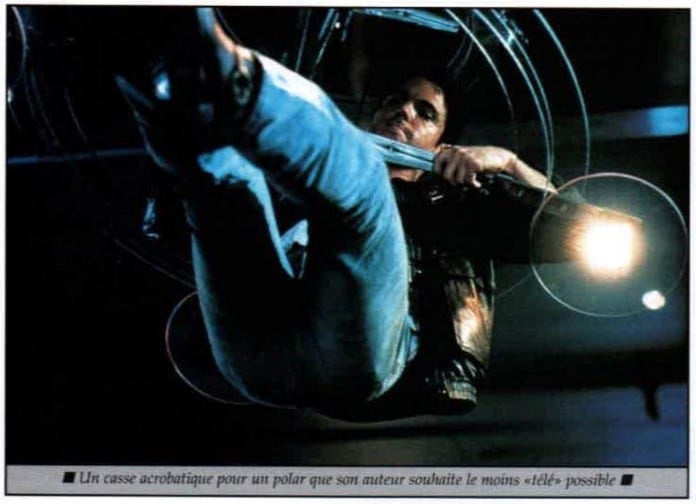
John was asked if doing a TV movie is like taking a vacation in comparison to major Hollywood films: “Not at all. Of course, on a TV project, you can easily get lazy. But that's not my style. I always give 100%. I work to the maximum of my abilities. What's more, television imposes a very fast shooting pace. The abundance of action sequences in Blackjack made it all the more difficult to maintain. No, Blackjack was not a vacation at all. Especially since on the set in Canada, the temperature dropped very low. It was Siberian cold. Immediately afterwards, I went on to shoot a Nike commercial in Brazil. There, the temperature was scorching. The transition was not easy. Making commercials, especially the Nike one with the footballers in the airport, taught me a lot about telling a story in a few minutes - arouse a very strong emotion in a very short time, manage humor and the human aspect. A good workout. Exciting.”
Why he shot Blackjack instead of another pilot: “While filming the Once a Thief pilot, I made a promise to the bosses of Alliance Communications. I gave them my agreement to direct the pilot of a second series. After the shooting of Face/Off, Alliance sent me the script for Blackjack, suggesting Dolph Lundgren in the first lead role. To be honest, I had some reservations about this. They vanished at our first meeting. Not only is Dolph Lundgren a formidable actor who has rarely had the opportunity to assert his talent, but he is above all an extraordinarily kind guy. Someone who is also very cultured, clearly more intelligent than the vast majority of action movie stars. On screen, you have never seen his true face, his true artistic personality. It was the prospect of changing his image that pushed me to get involved in Blackjack. With Alliance pressuring me to start filming as soon as possible, we were unable to rework the script. We didn't have enough time to make the necessary changes. Although we revised and corrected it day by day on the set, the story told doesn't really enchant me. The fact remains that Blackjack was above all an opportunity to work with Dolph Lundgren, to rehabilitate him.”
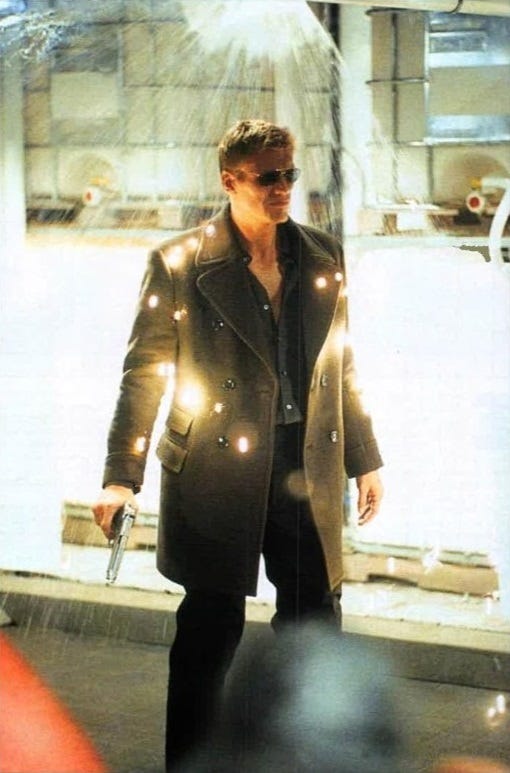
Why the villain is grandiloquent: “The script gave little indication of his behavior, his personality. It simply said "the killer." So I fleshed him out as best I could, making him a terribly frustrated actor. It was at this stage that I took on the Phantom of the Opera - his grandstanding, the tragic side of his personality, his "loser" side, his loneliness... Like the Phantom of the Opera, the killer in Blackjack no longer makes any difference between good and evil. We practically improvised this aspect of the plot on set, day by day. Blackjack develops another fantastic aspect, notably via the villain's lair. I asked the artistic director for a gothic decor, in keeping with the killer's personality. So we watched black and white films from the 1930s. The old Draculas with Bela Lugosi, the Frankensteins with Boris Karloff.”
Recently, John Woo missed a beat when he decided to remake The Killer instead of bringing to life his original vision for Once a Thief. A romantic at heart, John was asked how Blackjack differed from his previous films: “There are no major differences. In Blackjack, I made sure to strengthen the love story. The characters' feelings concerned me a lot. The humor, in particular. It's a shame we didn't have the time to improve the script. On television, everything goes so fast.”