
Sacré Bleu

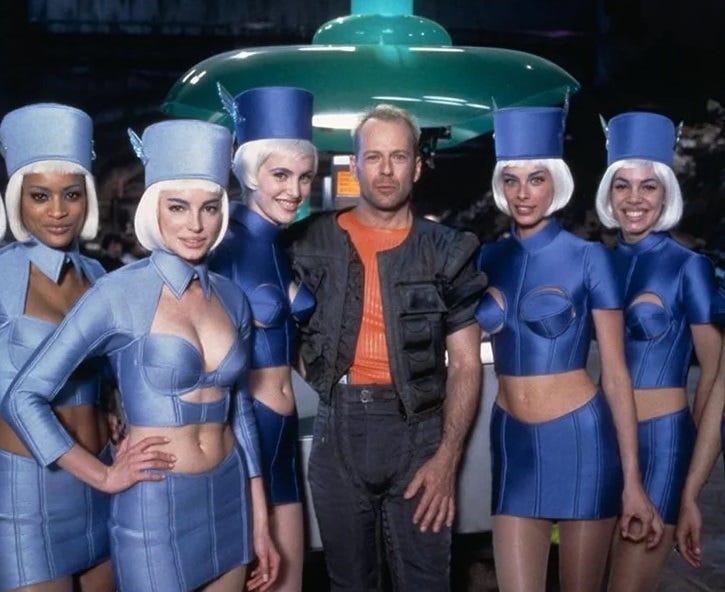
Luc Besson’s life is the worst kind of blue movie. Coincidentally, he made a film called The Big Blue (1988). Seriously, Luc is arguably the prime example of what it means to use a casting couch. He cast his wife to play the titular La Femme Nikita (1990). The film is such a success that Anne Parillaud wins the award for Best Actress at the 16th César Awards on March 9 in 1991. To get you up to speed, Luc Besson was born on March 18 in 1959. Luc and Anne divorced in 1991. When Luc turned 32, he had to wait until Maïwenn Le Besco turned 15 in April before they could have sex. Believe it or not, 15 is the age of consent in France. Making matters worse was that Luc Besson had met first Le Besco when she was 12. They got married when she was 16. In 1993, she gave birth to their child but Maïwenn was three months away from turning 17. When she did turn 17, she made an appearance in Luc’s Léon. This was filmed from June to October in 1993. The film is about a 12-year-old girl who has the hots for a hitman who is in his mid-thirties. So far, so skeezy.
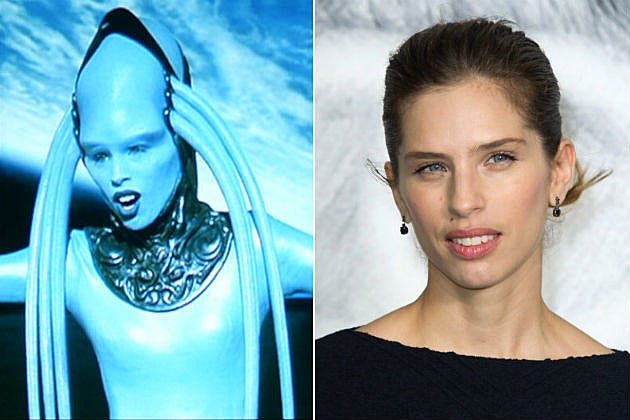
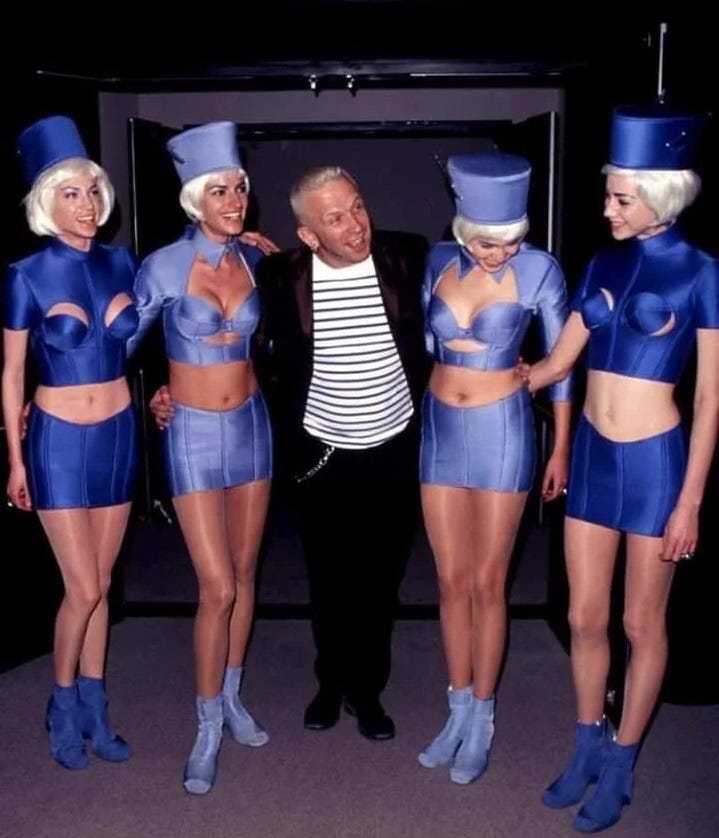
Maïwenn appeared in his next film - The Fifth Element. This was filmed from June 29 to November 23 in 1996. But wait, there’s more. They divorced in 1997 because Luc Besson was getting intimate with actress Milla Jovovich during the making of the film. Milla was born on December 17 in 1975, but she was 19 when she was cast. Milla became Luc’s new wife in 1997. She was cast as the titular Joan of Arc, and the film was released in 1999 - the same year that the couple divorced. Taking you back to The Fifth Element, the costume designer was the below man: Jean-Paul Gaultier. He was famous in England for being the co-host of a documentary series called Eurotrash. His fashion, along with himself, appeared in a 1994 American film called Prêt-à-Porter. It would have been a show of good faith had he appeared in The Fifth Element, but it was deemed acceptable that production photos featuring himself could be inserted into magazines such as Mad Movies. Speaking of which, the May 1997 issue (#107) had a six page feature on the film.
Luc Besson: “I wanted to make a film that was truly entertaining. But we never work for a particular audience: we simply hope that an audience will be seduced, touched, moved and its number doesn't matter. For The Last Battle, for example, the spectators were relatively few in number... but very happy. For The Big Blue, the audience was much, much larger and people were just as happy, even if they weren't necessarily the same! The Fifth Element is truly an invitation to escape. I believe that you have to feel this need, this desire, and that you have to be in this state of mind to fully enjoy the film.”
Luc also said: “The title of the film refers to the four elements of ancient Greece: Earth, Wind, Fire and Water, which, combined, create the fifth element: Life. One day, my father told me about Plato's writings and handed me a book: 'Did you know that your film is a remake?' I read the book and the similarities between Plato's work and my screenplay were mind-blowing!”
Luc has another way of describing the film: “If I had to define The Fifth Element, I would say that it is a third of Brazil, a third of Star Wars and a third of Jacques Tati! Gary Oldman, after seeing the film, told me that it was Star Wars on acid!”
As George Lucas said - a film is only as good as its villain. Trite but true. From Lucas to Luc: “Working with Gary Oldman is a real pleasure. I knew him a little before the filming of Léon and we got on well straight away. For The Fifth Element, he said yes without even reading the script. So I did the same when he came to me later with the script for Nil by Mouth, which he wanted me to direct and produce. This is a great lesson in cinema: see The Fifth Element, a let's say "light" adventure film - and Nil by Mouth, a very personal film depicting very harshly on society, made by the same people.”
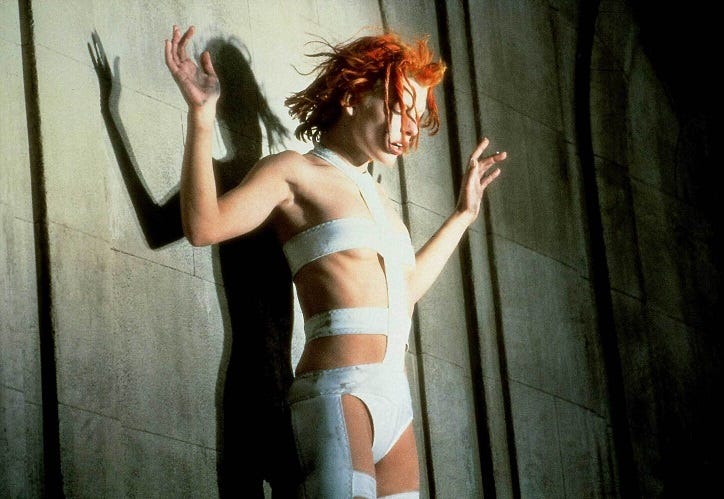
Both films were selected at the Cannes Film Festival, Nil by Mouth having the honor of being in competition. Back to The Fifth Element, the film followed the Luc Besson trope of a female character who has to protected yet trained. In the case of The Fifth Element, Luc didn’t realize that he was essentially talking about the prototype of Leela in Futurama (1999): “To embody Leeloo, I wanted someone we hadn't seen much of yet - I definitely didn't want any "references" - and also a very beautiful face but one that came from somewhere else. I met a lot of models and among them was Milla Jovovich who really seduced me during our second meeting, at the tests, where she showed great ease, without any restraint. She worked hard for eight months: singing, acting, karate... She even learned 400 words of an invented vocabulary and all the dialogues of the film in this language.”
It should be noted that the mid-to-late nineties was a time when Bruce Willis actually surpassed Arnold Schwarzenegger and Sylvester Stallone in commercial relevance. In terms of success, Bruce was on top form with Die Hard with a Vengeance, 12 Monkeys, The Fifth Element, Armaggedon and The Sixth Sense. As a heads up, Christophe Lambert is the true name of Christopher Lambert. Anyway, Luc said: “Bruce is first of all a very good actor. The problem is that stars of his stature are often used as such and not as actors. Bruce can do anything, play anything, and I think he had fun on this shoot because he could do so many different things. I didn't write the role of Korben Dallas with him in mind - I never write for anyone in particular. What interests me is to write a character overall, then to work on the approach with the actor. The important thing is to tell yourself at the end of the shoot that no other actor could have played this role. I like this feeling: Christophe Lambert was the best for Subway, Jean-Marc Barr for The Big Blue or Jean Reno for Léon. Bruce was in any case ideal for this film. He, I think, broke all speed records I brought him the script which he immediately read, and two hours later he said to me "Yes, it's OK, I'll do it"! I thought I was dreaming...”
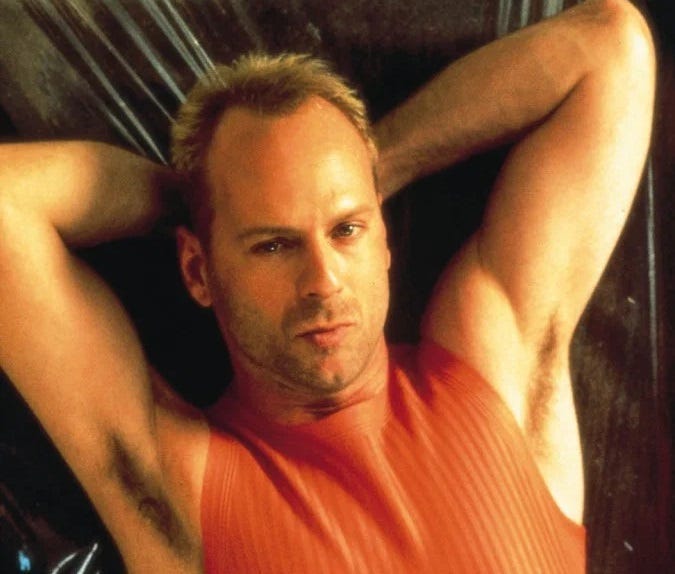
Luc Besson boasted: “There are 240 special effects shots in The Fifth Element. It was a painstaking work of a kind that was a bit new to me and very laborious: the cars fly, there are aliens, etc. It's a bit frustrating for directing actors and for a large number of shots there was a very precise mechanism to adjust. So I complied with the constraints until the end but I must admit that it wasn't the most exciting part for me.”
It was the most expensive French film. The budget was 500 million francs: “On The Fifth Element, everything was actually multiplied by five! There was a year and a half of preparation, then it stopped. With 400 pages of script and a budget estimated at some 800 million francs, the film was practically unfeasible. Too big, too expensive, too soon! We had to think. So I shot Léon... Then I set off again for a year of preparation. A year of hindsight that allowed us to better identify the problems, and therefore to resolve them.”
Luc had to curtail his ambitions. Given that he later collaborated with Corey Yuen Kwai (with and without Jet Li), it wouldn’t be a stretch to assume that Luc is a fan of Hong Kong action films. Even the way that he films is similar in method. He said: “Most American directors use six cameras for coverage then they shoot and find the rhythm of the sequence in the edit. For action scenes, I do things differently. I write a choreography, as you would define dance moves. It's a very precise cut that allows to use a single camera and to shoot the shots one by one, exactly as I imagined them.”
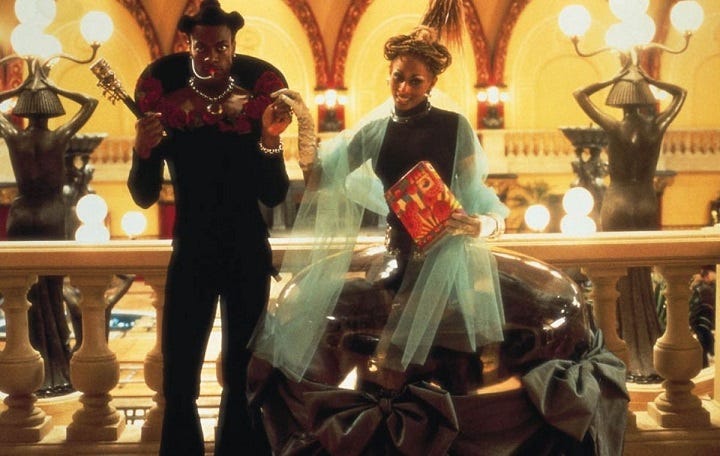
Robert Mark Kamen was the co-writer. He has been Luc’s screenwriting partner for quite some time now. Besides the Taken films and the Transporter movies, they have collaborated with each other on Kiss of the Dragon (2001), Danny the Dog (2005), Lucy (2014), Anna (2019), Colombiana (2015), Bandidas (2006) and The Warriors Gate (2016).
You can’t pull a fast one on the French, especially if you’re a compatriot. Journalist Vincent Guignebert observed that the first strip of the Métal Hurlant comic book also provided the obvious starting point for the plot of The Fifth Element. Luc Besson was self-conscious enough to deflect before diverting: “My mother probably had a lot more influence on what I do than all these films! In fact, The Fifth Element is a comedy. Besides, on the set, the actors pushed from everywhere: they were all funny and had a great desire to play, to have fun with their character. As soon as Bruce Willis, Gary Oldman or Milla Jovovich warmed up, the acting, and I would even say the madness, could begin. We rehearsed a lot to have marks, a working base and not waste time during filming with its extremely important technical requirements. The rehearsals were done without text to keep some distance and as soon as the actors were warm, I stopped. You have to dust off but not go too far so as not to lose spontaneity.”
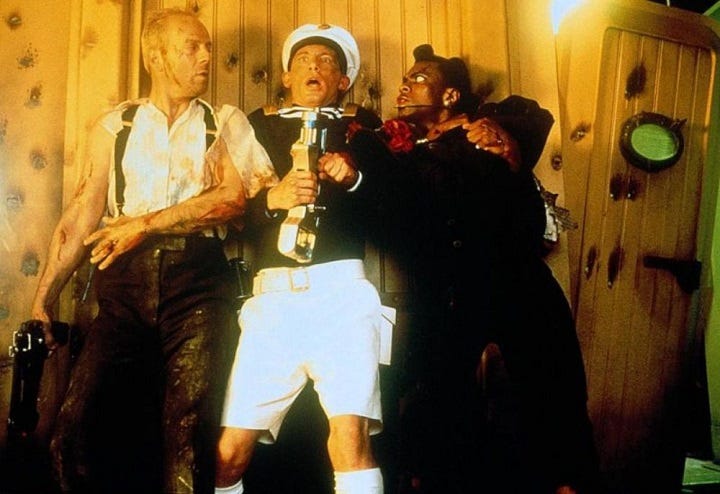
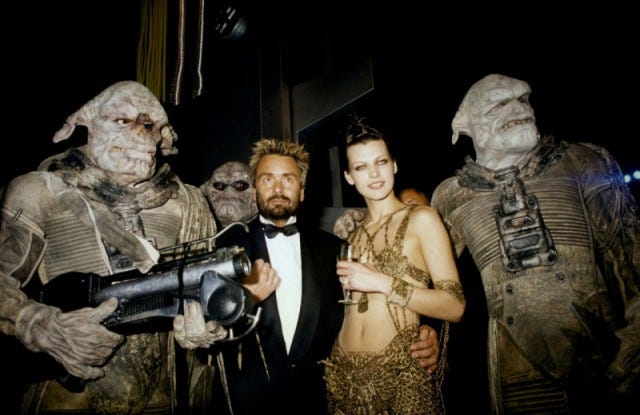
All three men in the below photo have met Jackie Chan. Bruce expressed an interest in working with Jackie but they couldn’t find the right script. Lee Evans played Jackie’s sidekick in The Medallion (2003) way after Chris Tucker had done the same in Rush Hour (1998). The last bit of the next quote explains why Mad Movies and Impact were not allowed to do features on Luc Besson’s previous films: “When you have a monster or an alien in a screenplay, you can't assess its cost price before knowing what it will look like. You have to engage designers to get an idea. Seven artists worked for a week and came back with about sixty designs for the Mondoshawans. All I had to do was choose the one that came closest to the creature I had imagined. We used the same method for all the ingredients in the film. The story is set in the 23rd century, and we spent a year designing the spaceships, the vehicles, the various creatures, the weapons, the apartments... Even details like the plates, the credit cards, or the forks had to be clearly designated. I'm not used to sharing with a lot of people. I'm more of a solitary type. On The Fifth Element, I had to change my working methods. I have a taste for secrecy because I like to surprise the spectators, and even the technicians. I want to discover the emotion or astonishment on their faces.”
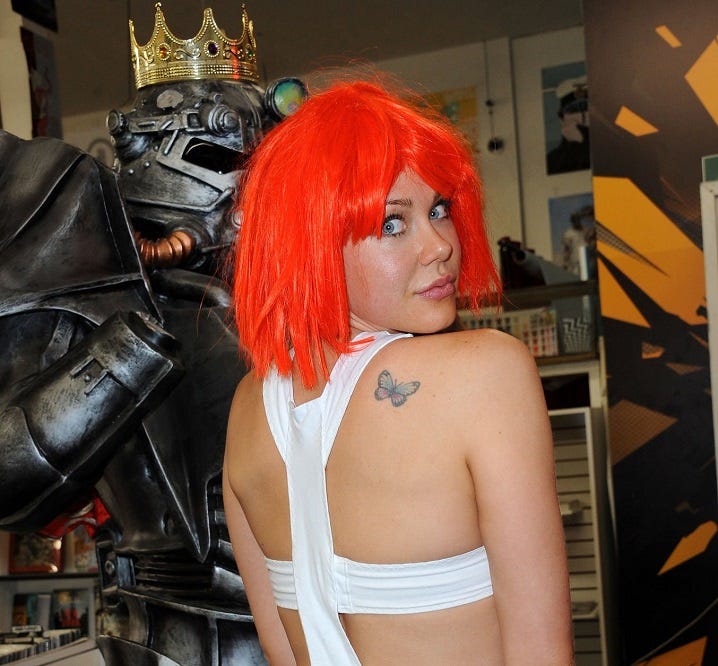
Let’s get back to what should have been an underage sex scandal. With Cannes being the home of two film festivals, one for X-rated films and another for regular films, it shouldn’t be a surprise that there were people from around the world who took advantage of France’s age of consent. At Cannes, there were yacht parties. A person could get drunk, the yacht could be taken somewhere outside of French waters where they could be blackmailed with the threat of legal action. Never mind Jeffrey Epstein's Island, Cannes was the ideal paradise. Second to that is Venice. Besides their film festival, the age of consent in Italy is 14. Luc Besson has been to the Venice Film Festival just like Harvey Weinstein had. When I see the word paradise, I think of French actress Vanessa Paradis. Born in December 1972, she was 14 when she became a pop star in 1987 thanks to a song that was written specifically for her by a pair of middle-aged men. It’s a sign of Luc Besson’s erotic taste, not just Jean-Paul Gaultier’s imagination, that an X performer like Maitland Ward (as seen below) took a shine to Milla’s iconic costume so strongly.
Speaking of Jean-Paul Gaultier, it was only fair that he got a chance for his say to be included in a magazine: “Five years ago, I learned that Luc Besson was going to make a science fiction film and that he was looking for someone for the costumes... I was delighted! I wasn't disappointed at all, right from our first meeting. I felt right away that he lived his films. He was totally into it, everything was already very precise and very clear in his head. The idea of working with Besson excited me, I knew I was going to give it my all. It was afterwards, once we had agreed on how it would unfold, that I read the script and was won over. He's quite a warm person, very likeable, just like what I had seen. He has a paternal side and he likes to explain... He would make an excellent teacher, because he knows how to take the time to express himself. Then, there was the script. Luc already knew the film by heart: it was incredibly precise and impressive. I have rarely seen anyone so precise. Even in the way of filming, five years before he knew more or less how he was going to construct his shots!”
JPG continued: “When I read the script, there were these characters, like Ruby, the radio host, who is quite exuberant and funny. He introduced them all to me, gave me information on their psychology, on the time, the places, and I started to make approach sketches. I also did research on hairstyles. For the villain, for example, I had thought of a sort of Hitler with a skull a bit like a prosthesis, and with a quiff. Immediately, Luc told me what he liked. He immediately had arguments because he knew what he wanted. For example, for Bruce Willis, the pants shouldn't really be like jeans; I showed materials and Luc immediately liked rubber. For my part, I had thought of things with reinforcements and combat stuff, but which still show the anatomy. I wanted the man to be sexy. Women must be sexy, men too. A hero must be sexy, mentally and visually. At the beginning, it was a question of me dressing all the characters: there were about sixty with the soldiers, the stewards, the hostesses... But my schedule was turned upside down. As the work was taking place in London and I was not free, Luc decided that there would be a costume designer to follow the progress in the workshops. I gave instructions and I dropped by when I could.”