
Raison d'être

Sylvester Stallone is the thinking man’s action hero, albeit off camera. He is a lot smarter than people realize - something that was evident in his 1998 interview with British director Mike Figgis. The French Impact magazine had some remarkably clever comments from Sly…
December 1996 (No. 65) - doing the publicity rounds for Copland and Daylight
“I was in perfect physical condition for so long, hyper-muscular, that I became a prisoner of my own body and, consequently, of the unconscious vanity that results from it. When you seek this plastic perfection, you are in some way a slave to yourself. I was a kind of sick person, a junkie; my body, my muscles dictated my existence, my diet, absolutely everything. You become a pile of sculpted meat while the intellect drifts more and more. It took me years to become aware of it. Today, I am past the age. Thanks to Copland, I found a pretext, a good alibi to escape the dictates of appearance, to find a lost balance. Moreover, for the first time, I had to gain weight. An obligation because the character I embody has no discipline in life. He does not impose himself by his stature, his fists, but by the power of his words, the rage of his diction. These extra kilos have considerably weighed heavily on my game. When you are more fleshy, you walk differently, you even speak differently.... You are not the same anymore. Copland allowed me to mature, to grow up, to exorcise once and for all the uncertainties of my youth. Not only am I at a crossroads in my career, but also of my private life. I realize how wrong I was when I devoted only 20% of my time to my family time.”
“Modern heroes are not mountains of muscle. Women, men in the street are all or almost all potential heroes. Their strength is mental, psychological, not physical. An inner power. When I visit a hospital to meet a mother who, for six months, has been at the bedside of her comatose child and who does not give up, I realize that heroism is not the prerogative of superheroes, of cinema. Courage also means unconditional investment in a cause that we know is lost, but for which we continue the fight, the idealistic struggle. This is also the case of Kit Latura in Daylight. This guy is a man of flesh and blood. Not a Superman like those I have played so far. He is close to the roles recently played by Harrison Ford, in The Fugitive for example. His films are action, but also benefit from an innovative script.”
“Many of my films deal with these themes - sacrifice and redemption. Redemption because, at the beginning, Kit Latura is not a hero, a providential savior. In the past, he has even been accused of cowardice. He faces himself. Kit Latura was not born a hero; he becomes one by force.”
October 1997 (No. 70) - doing the publicity rounds for Copland
“For me, the role of Freddy Heflin is a return to the roots. Like Rocky and Rambo in their early days, Freddy Heflin grew up at the bottom of the ladder. Like them, he also grew up in pain, sorrow and regret. Over the years, Rocky and Rambo have transformed themselves into supermen, into invincible ambassadors of America. Even if they have won the public's favor, these heroes have gradually become inaccessible. True icons. At the beginning, they were Mr. Everyman. Which is what Freddy Heflin is today. At first, it seemed strange to me to take it all in the face without reacting, to remain silent instead of kicking over the traces. But neither Rocky nor Rambo were supposed to take the upper hand.”
“I want to repeat the Copland experience. On condition, of course, that I find a script of this level. At one time, I wanted to stop big-budget action films. That's no longer my intention, I want to play the alternation. To shoot modest films and Hollywood mega-productions that offer me interesting roles. One thing is certain: I don't want to work for money anymore. I want to work on quality projects. Whether they cost ten or a hundred million dollars are ultimately of little importance to me.”
“By gaining a belly, I realized that I was killing a part of myself, the pretentious and narcissistic Rocky that I was. It's a facet of my personality that I want to bury for good. Conforming to the image of Freddy Heflin gave me this possibility. Gaining weight allowed me to find myself, to humanize myself. Twenty-five kilos changes a man. Not only in terms of the belly, but also in the mind. The only one who appreciated this transformation was my wife. She found me charming with this extra weight. She also found me much more relaxed, kinder, less restless. Natural with all this fat that lined my belly. I could barely breathe with the effort. So it was normal that she found me so kind and gentle.”
“Without this weight gain, I would never have been able to play Freddy Heflin. As I was before, I did not correspond to the character. It would have made no sense to have abs of steel and firm muscles. The sheriffs of deep America have nothing to do with the image of super-cops conveyed by cinema and television. They are generally guys who lack training, sometimes even obese. To play Freddy Heflin, I therefore adopted the Robert De Niro method from Raging Bull. And it is a very effective method on a dramatic level. It changes you and from the inside and out. I ended up expressing myself differently, moving differently. I sometimes felt so bad about myself that the weight inspired a genuine unease in me, pushing me to fight my own anxieties. It is something quite astonishing.”
“I did some research in field with the Institute for the Deaf and Hard of Hearing in New York. I placed a silicone prosthesis in my left ear in order to naturally accentuate my inability to hear on one side. Deprived of 50% of your hearing, you are immediately destabilized. This infirmity unbalances you, tires you, makes you dizzy. During the filming of several scenes, I suffered. On screen, it is not a gimmick when Freddy Heflin has difficulty listening. The prosthesis placed in the ear caused me a problem that I did not expect. I measured very badly the power of my own voice. I did not know whether I whispered, whether I spoke normally or significantly louder. It was a learning curve to find the right tone. It took a lot of self-control, concentration and self-discipline.”
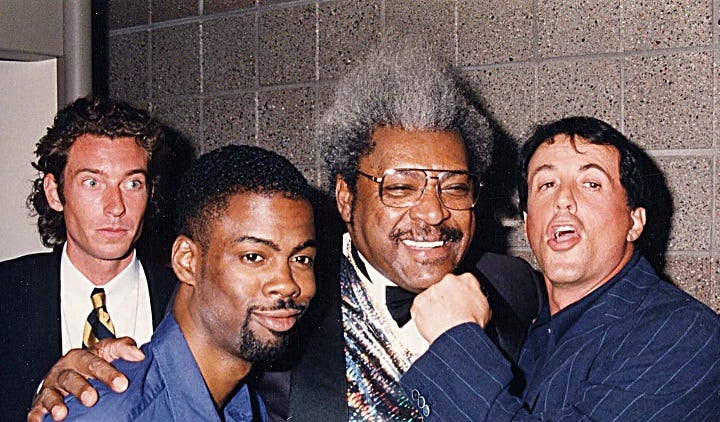
April 1992 (No. 38) - doing the publicity rounds for Stop! Or My Mom Will Shoot
“I think Cardinal Mahony is not entirely wrong. I don't make violent films that glorify violence. When you make a film as militaristic as Rambo, you have to find a strong counterpoint in the story. The films I see today, since Rambo 3, are much more violent than before. However, I do not support censorship. The only area where it should apply is in the depiction of drug use on screen. I therefore partly support Cardinal Mahoney's theses.”
“After a year in which disarmament has become a universal credo, in which the very image of the army has become obscene, it is high time to heal the planet. And Rambo is going to do it! I will have to make Rambo the first ecological warrior, a soldier of Green Peace or of a movement. I think that this Rambo 4 could really make people aware of serious problems that do not interest them enough in their daily lives.”
“I should have directed Rocky 5. In ten years, John Avildsen's vision, who directed the first Rocky, and my vision have not converged. We had two different conceptions of the character. But John and I are still good friends. It was just a matter of different points of view on the work. I wanted a bigger, stronger Rocky 5. That's how I had written it. But from the first day of shooting, everything started to change under the influence of John Avildsen. The studio refused all the completed sequences and so we kept reshooting everything. Again, these issues are not personal. They are just work issues.”
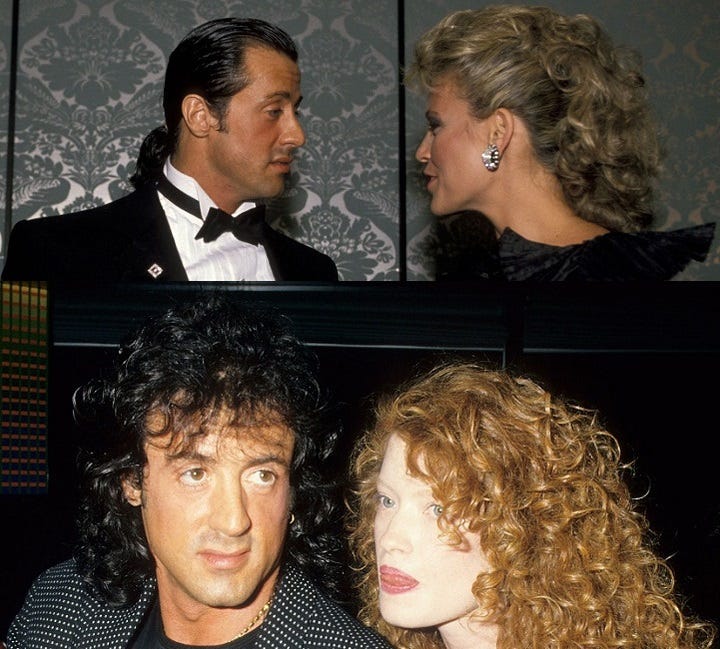
October 1993 (No. 47) - doing the publicity rounds for Cliffhanger
“Cliffhanger was summed up as follows: "Guys fight on top of a mountain". Apart from the fights, there was nothing. I agreed to shoot the film on condition that the script be revised, rewritten. Five days before the start of filming, since I had not been entirely satisfied, and since I could not work from an imperfect manuscript, I set to work myself. I thickened the psychology of my character, emphasized the anxiety that was eating away at him, eliminated the humor, gave more importance to the villain. For me, the villain is, in fact, the cornerstone of films of this genre. It is the wickedness of the villain of the service that makes the hero strong. A hero is always easy to portray. On the other hand, managing to create a good villain is another matter. Every time I found myself facing a weak, insignificant opponent, the film was a disaster.”
“Rambo is a pure, sympathetic character. I considered the second from another angle: to give him the opportunity to win a war that was once lost. I didn't realize at the time the political implications of Rambo, the danger he represented, his vengeful, revisionist character. Taken too seriously, and that was the case, Rambo became a rather dubious symbol. Cobra comes from another reality. The 30,000 murders committed per year in the United States, the 60 assassinations perpetrated every weekend in Los Angeles, as well as the case of the Zodiac Killer, a serial killer that the police have never managed to put behind bars, greatly inspired me. Because of this, and also influenced by Michael Mann’s Manhunter, I felt the need to write the story of this cop who is as crazy, as fascist as the assassins he hunts. But, once again, Cobra represents values, an ideology, which I do not adhere to.”
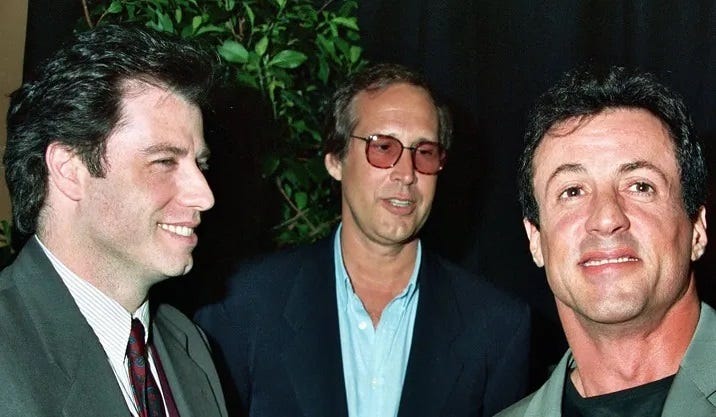
“In today's film industry, all actors have a label on their back. Some are supposed to excel in a register and, as soon as they stray from it, the audience energetically reminds them that others have already been there before, and especially much better than them. So there is no question of venturing too far, to each his own. That's the rule in Hollywood. Let's face it, I will never be as funny as Chevy Chase. And then Clint Eastwood won his Oscar thanks to Unforgiven, where he plays for the twentieth time (at least) a cowboy!”
“Up until now, I've always tried to pull the covers over myself, to put myself forward as much as possible, to stick my nose in everything. Life has taught me that this was an attitude that was detrimental to the film. In Cliffhanger, I therefore surrounded myself with actors who were better than me. In terms of casting, I wanted the best - actors who really motivated me, who pushed me by their very presence to surpass myself. Michael Rooker is one of the best of his generation, John Lithgow is a brainiac... I had to work hard to stand up to them in front of the cameras.”
“I would also like to say that cinema barely reveals half of my true personality. On screen, my dialogues are reduced to a minimum while I am someone who likes to talk, who devotes a lot of time to intellectual activity, to spirituality. But I imagine that a film that gives too much importance to the real Sylvester Stallone would not attract the big crowd.”
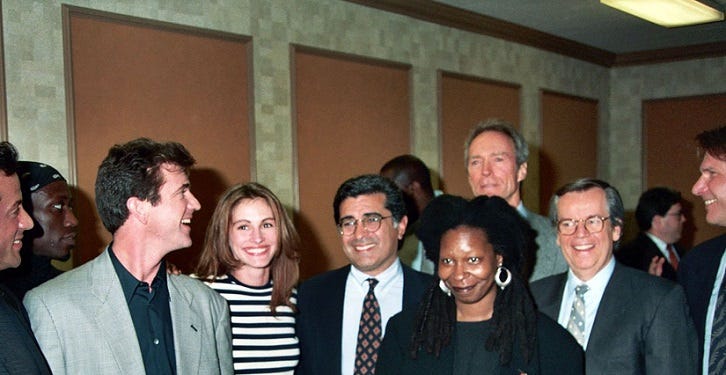
“I still consider action cinema to be very interesting. Even though many call it stupid and backward, it brings in 90% of Hollywood's vital revenues. Without Terminator, Spielberg or Rambo, there would be no Martin Scorsese, no artistic films. Action films keep the Seventh Art alive. My films, those of Arnold, Bruce Willis and others, should be taken as fairground attractions. They have no intellectual pretension, they are just entertainment, fun. After having somewhat disowned this style of spectacle, I am proud of it today; I no longer reject it with ingratitude. After all, the first Rocky was first and foremost a social film where you could smell the street. The time has come for me to accept the family to which I belong.”