
Peckinpah's Peer

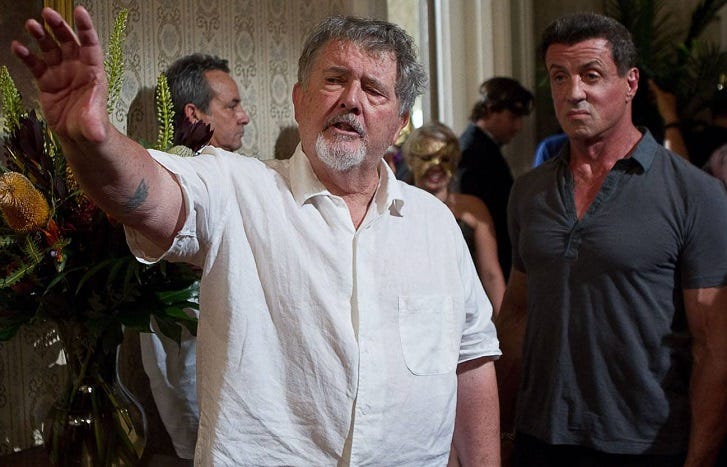
Walter Hill worked with Sam Peckinpah. Titled The Getaway, Sam directed Walter’s screenplay as a 1972 star vehicle for Steve McQueen. In 1977, Walter directed his own car chase movie - The Driver. His interview for Mad Movies was spread across issues 181 and 182, which made for an appealing transition from being a 2005 Christmas gift to a 2006 New Year’s gift. He explained why the characters in The Driver didn’t have names: “It was kind of a joke. I actually think it was a mistake to have opted for that. Screenwriters, myself included, of course, very often avoid the "real" work: they spend days researching character names, looking in directories, and snooping around to find what might be suitable. Anyway, I was with some friends one evening, and I said, "All this research for character names is stupid. When you listen to people after a movie, they talk about it using the actors' names, not the characters' names. So you can make a feature film where the heroes don't have names and no one will notice." That's what I ended up doing.”
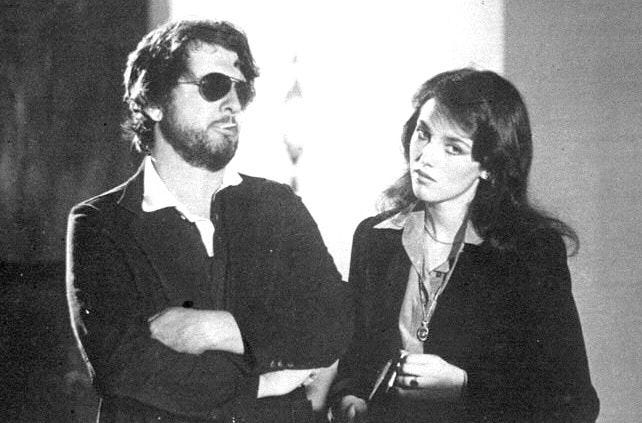
The mistake: “But where I made a really big mistake was at the end of the film, during the credits. Indeed, you realize that the functions of character-specific names: Ryan O'Neal - The Driver, Bruce Dern - The Detective, Isabelle Adjani - The Player... That gave the game away! I think otherwise, no-one would have noticed. But hey, it gives the film a certain authenticity, and this idea fits its style perfectly. And to think it all started as a joke between friends! Well, I still didn't have a very good experience, even though I hear today that my film was ahead of its time. Because let's not forget that The Driver flopped in the United States, even though it did rather well in Japan and Europe. (pause) Besides, if I hadn't moved on to another project afterwards, I don't know if I would have survived...”
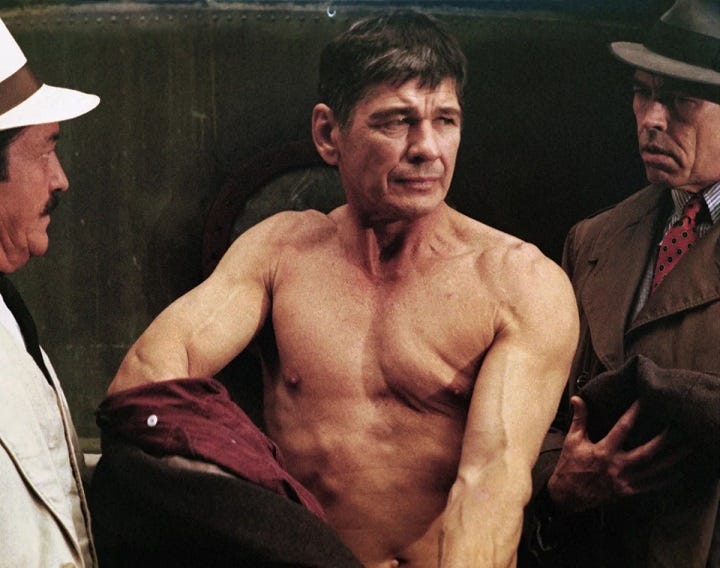
Hard Times (1975): “For my first film, the studio was already trying to provide inappropriate details, and the executives were asking themselves the following question: "Charles Bronson is going to New Orleans to fight, that's a fact. But can't we give him a good reason to go there, like money for example?" I didn't want to, because otherwise we fall into typical Hollywood formulas, like: "He needs money so his daughter can have her leg operated on...". No joke, they really offered me this kind of scenario! And I tirelessly replied: "The character who has a good motivation is boring. What we need is more mystery around this character!" It's true that it's not a very original approach today, but 25-30 years ago, it was still very avant-garde. And often, the actors didn't like it either... you have to know that at the time, the system wasn't the same, and the expectations that genre films aroused were very different.”
This could be chalked up to director Sergio Leone: “I'm sure he influenced me, in a way. When I was a kid, I watched Westerns all the time. On Saturdays, I went to the double-bill program, which showed the latest films, then I would move on to another theater, which showed Westerns all day long. They were very often B-Westerns, a universe in which I was totally immersed... But there's one thing I noticed at the time: Westerns often started with a guy who arrives in town. Then he does something, he shoots someone, and everyone wonders: "What's going on?" And finally, the explanation comes: he had been imprisoned even though he was innocent, or someone had killed his sister, or something like that. What I understood then was that the most interesting part of the story came before the final explanation. Basically, the less you explained things, the more interesting they were. So, I think my affinity for this kind of story and their concept of mystery dates back to that time. Afterwards, Leone was, of course, a master at it. But even today, many people don't like this kind of film, which is too lacking in explanation for their tastes.”
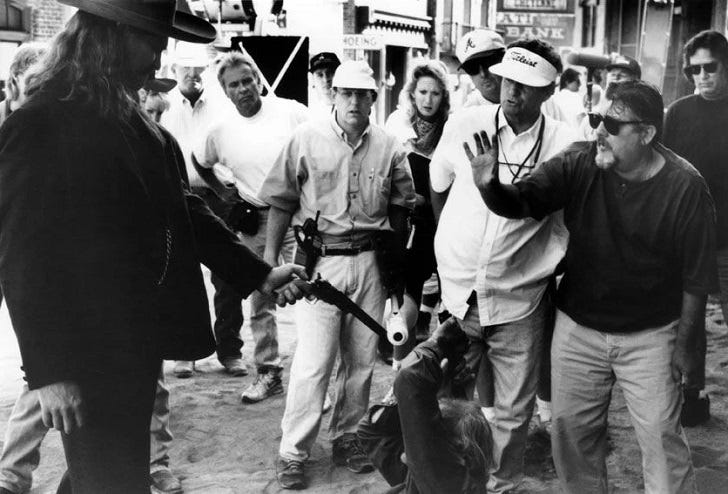
The universal appeal of Westerns and their ability to be remade: “One of the reasons I like Westerns is that they tend to have a very direct and simple narrative. This then allows for more importance to be given to the characters' behavior and the theme itself. It's more "cinematic." My rule is this: there are things that come across better in a novel, and others in a film. Clearly, not everything is transposable from paper to image and vice-versa. Personally, I've always appreciated the absence of cultural pretensions in films. And ironically, this absence paved the way for the glory of cinema. Take Buster Keaton: he was purely cinematic in essence. I try to make that kind of cinema, even if sometimes I had to give it up for purely financial reasons. That said, I sometimes think I've achieved what I wanted; this is the case, for example, with Wild Bill, which, if we refer to what I said previously about purely cinematic subjects, represents the best I can do in terms of pure cinema.”
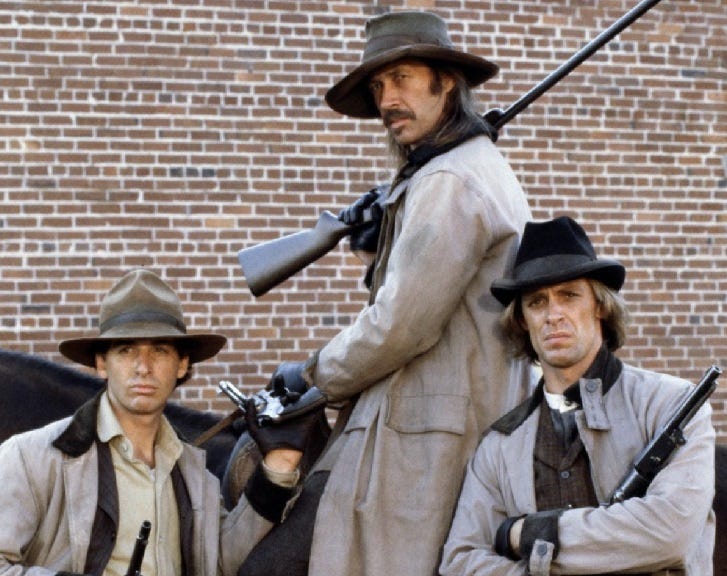
The Long Riders (1980) shares many similarities with Sam Peckinpah's The Wild Bunch (1969), so now is the time for a return to the intro of my article. Walter said: “You have to know that, above all, he was a very acerbic and very funny person, but above all, he was incisive and could be hurtful. He liked to test people... I admire him enormously; he was a great director, and a very cultured person to boot. The success of The Getaway allowed me to become a director, and for that alone, I will always be grateful to him. Subsequently, after I began my directing career, we remained on good terms, even though Sam still liked to think of me as his screenwriter. But to get back to The Long Riders, one day we had a discussion about the direction of the film. Sam then began: "A lot of people say that you use slow motion like me. They're wrong, aren't they?" I replied: "Yes, they're wrong." "Why?" he retorted. I ended up giving the following explanation: "You use slow motion to make something more real, to extend this reality... In The Long Riders, slow motion represents the other side of the world, the nightmare. It is ultimately only the reality of this nightmare." And then he replied: "That's true, doctor!" because that's how he called his collaborators.”
Nostalgia beckons: “This reminds me of another anecdote, still about slow motion. One day, he got very angry after coming across a critic's article accusing him of copying Arthur Penn and the bloody finale of Bonnie & Clyde. I walked into the office at that moment, and Sam was there. I asked him what was wrong, and he told me about that famous critic. I then said to him, "Don't pay attention, everyone knows it's fake and that you stole it from Kurosawa!" This joke didn't really please him; he took a bit of a dislike to me, and as a result, I remained in disgrace for a week!”
Moving on to the next issue of Mad Movies where Fausto Fasaulo’s interview was increasingly helped by Agathe Dupuy serving as a mediator because of her translation skills. Walter Hill was humble about the influence of 48 Hrs. (1982): “Many elements from the buddy movie were already present in embryo in Hard Times and The Driver, with their well-defined antagonists. The same goes for Southern Comfort, where there was already a bit of all that. As for 48 Hrs., the film owes a lot to Nick Nolte, who was constantly acting on set. About this, I kept telling him: "Stop acting, be yourself, show your personality." That made him annoyed! "I'm an actor!" he would retort. And it's true, he's a very good actor. One day, on set, he said to me: "You know, the script isn't good and the character is poorly written..." (laughs) You could say he's a natural, even though I often told him that, in my opinion, he was imitating Wallace Beery too much with his raspy voice.”
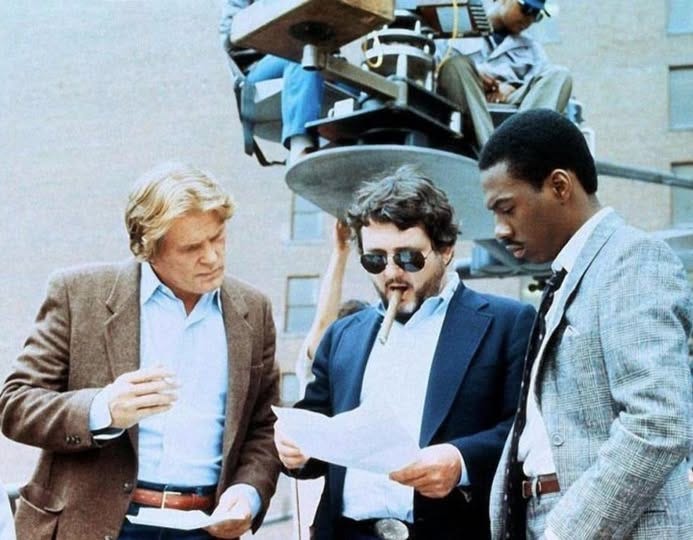
Of course, you can be humble without being disingenuous. Walter proves this, but only because he was being prompted: “It’s true. Even I've noticed that 48 Hrs. has been imitated a lot. I don't really know what to say about that. Being imitated is always flattering. That said, claiming that I've been copied is also patting myself on the back, and I don't condone that. You know, one of the great enemies of getting things done in Hollywood is ego. You have to try to control it. Artistic modesty is a virtue for me, and unfortunately, that's not the case for everyone.”
Extreme Prejudice (1987) was based on a story co-written by John Milius. Referrring to the Carolco company, Walter Hill said: “They were very interested in the script and seemed determined to make it happen. John's story focused more on the military characters. What really interested me was the Texas Rangers. So Washburn came on board, and we worked on the characters' reasons and motivations for their trip to Mexico, an element that was barely explored in John's script. So we invented the character Cash Bailey, played by Powers Boothe, and that of Sarita Cisneros, played by Maria Conchita Alonso. For my part, I really fleshed out the characters played by Powers and Nick. As the rewrite progressed, the military aspect of it faded. That's the difference between John's script and mine. In the end, I think it's a good film, even if, even today, I don't really like the ending. The producers wanted us to escalate the action, to go further and further into the violence. I found it a bit exaggerated at times...”
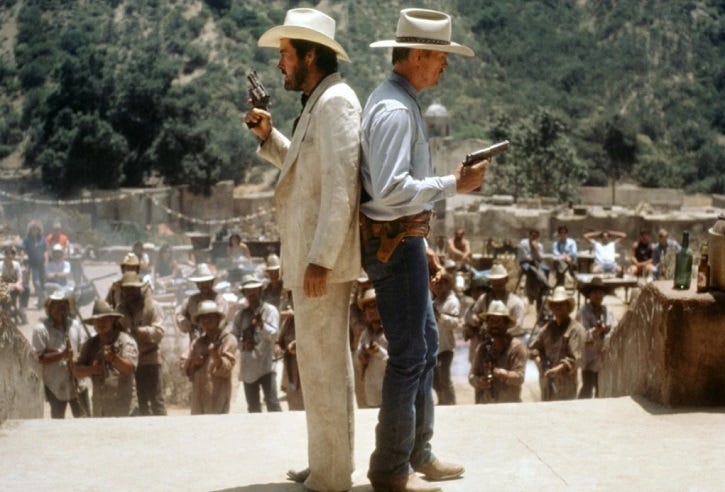
Ironically, the shootout is reminiscent of Sam Peckinpah’s The Wild Bunch. When asked if he really didn’t like his own finale, Walter said: “Not particularly, I prefer the one at the gas station which is I find to the best scene I've ever shot. You know, I'm very surprised that you're so interested in this film, where ultimately everything rests on the dialogue and the nuances in the relationship dynamics. Well, it was still a rather difficult experience, with a rather trying shoot in El Paso.”
Last Man Standing (1996) was a simultaneous homage to Akira Kurosawa and Sergio Leone. Akira died in 1998, hence what Walt said: “The producer, Arthur M. Sarkissian, had the rights and came looking for me to entrust me with the direction. I refused at first, because making a remake of a Kurosawa film is simply suicide. Then he came back, telling me that he had spoken to Kurosawa's family, who had agreed to me directing the film. It was very flattering, but it was still suicide! Then, they kept harping on this story, and I finally said that I would write the screenplay on the condition of having Mr. Kurosawa's approval, and that I would perhaps direct the film only if he found the script "correct." In short, it has been said that Kurosawa's source of inspiration was Dashiell Hammett's Red Harvest, which was about gangsters in a Western town. I then thought that if I were to write the script, it might be interesting to take this idea and use this unemployed killer/gangster, lost in the middle of nowhere during Prohibition.”
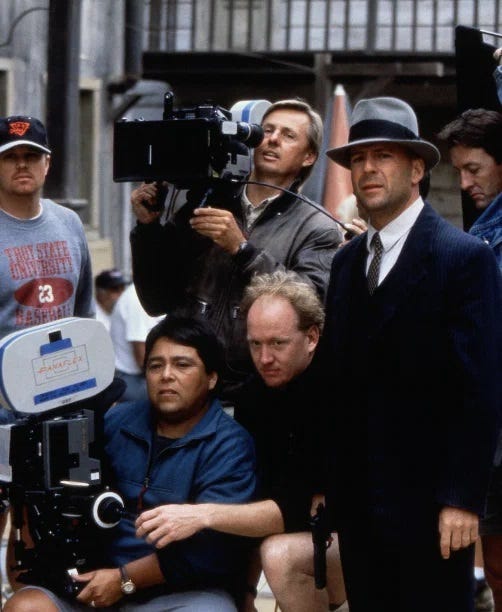
Akira’s Yojimbo (1961) was remade as Sergio’s A Fistful of Dollars (1964): “I thought about Kurosawa's film and Leone's, but it was obvious that I couldn't repeat what they had done. Besides, I think Kurosawa is far superior to Leone. On the other hand, I thought that both directors had opted for the easy option by portraying a character with sympathetic nihilism. So perhaps we should try to do something else. So I said to myself: why shouldn't his sensitivity be completely consumed? He would have seen everything, done everything, committed all the sins. That was my approach. Then I sent the script to Bruce Willis, who called me and said, "I know what you want. You want me to do Robert Mitchum!" And that's indeed what I wanted, so filming could begin.”
Kurosawa’s two cents as relayed by Hill: “I'm told he quite liked it. He even sent me a big photo of himself; it was really nice of him. That said, for me, Last Man Standing isn't a remake, but a very loose adaptation. And of course, when the film came out, all those f#*king critics said, "How dare he do a remake?" While I think the film is pretty good overall, it can't be said that it really reached its audience, and that's a shame.”
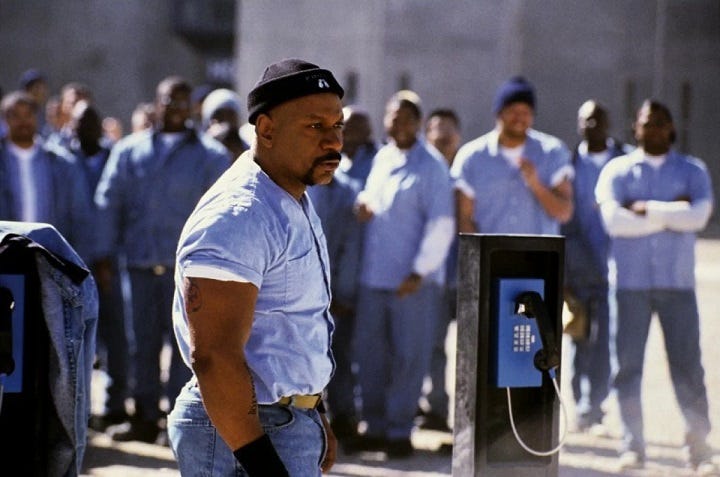
Undisputed (2002) was comfort food after the mishap of Supernova (2000): “It was horrible working with those jerks. Supernova had really poisoned me; I couldn't even find work after that failure. That's how it is in this business; there are ups and downs. With Undisputed, I had the opportunity to shoot on a low budget. David Giler and I then thought about a boxing-related subject. You know, we read articles in the newspapers every day about Mike Tyson and his prison escapades. So we wondered what prison might be like for a guy like Tyson. What's it like when the toughest guy in the United States ends up in the hole? There are plenty of other tough guys in prison, and especially plenty of former boxers to face. You might remember heavyweight Sonny Liston, who was champion in prison? Well, the idea was to have guys like Mike Tyson and Sonny Liston meet in jail. So we started with that concept, which was a very short story with a very small budget. Again, it was a kind of distillation of the genre, as was Hard Times. I even allowed myself a nod to Leone at one point in the film, when Chuy, the Mexican, says - Maybe it was all a dream, maybe it was just Once upon a time in prison.”