
Parvenu Chagrin

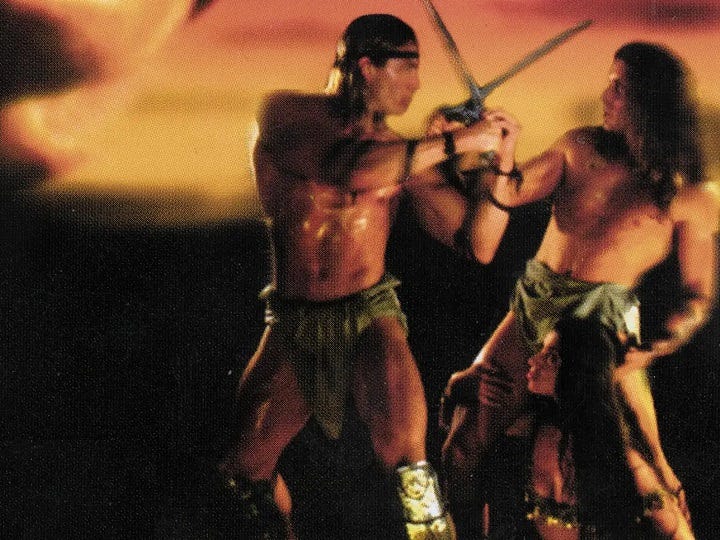
This is French for rags-to-riches sorrow. Both words are used in the English language but there’s more leeway for chagrin in French because it can mean heartache, pain, stress and unhappiness. In English, it usually means annoyance. By comparison, parvenu can also mean reached in French. In English, parvenu can be a backhanded compliment that describes a poor man as being a fish out of water when interacting with people who achieved their fortune in the world of academia or at least through the income of their academic parents. In the case of Fred Olen Ray, one could joke that he achieved riches through rags i.e. making cheap movies featuring women who are scantily-clad. This is definitely the case when a woman’s clothes are ripped off or if the film takes place in a primitive setting (ancient or apocalypse) such as the above pseudo-parody: Wizard of the Demon Sword (1991). You could call it a bit of a reach, but that actually reflects the alternate meaning of parvenu. Fred Olen Ray was interviewed by Maitland McDonagh for the October 1987 issue (#11) of a French magazine called Impact. Here are some choice selections intercut with stills of famous people who he has directed…
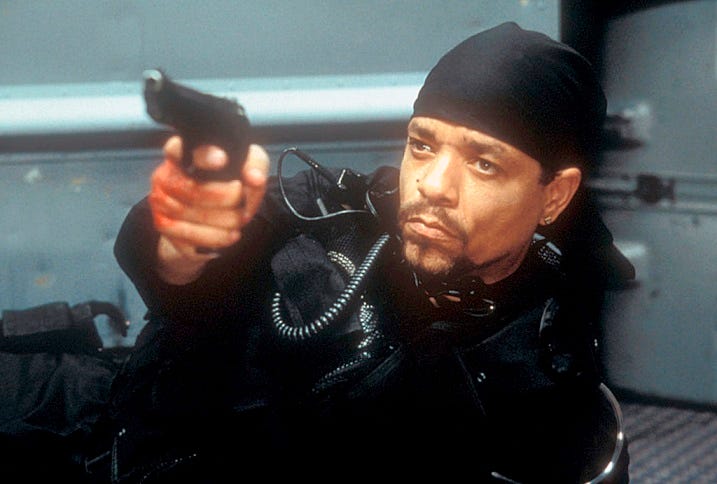
His humble origin: “Nothing very glorious. I was first a vadonc, then a set photographer.”
Va donc means “Go then” in French. Even the interviewer was taken aback by Fred’s slang, so Maitland repeated it. Fred said: “Yes: Go and make me a coffee, Go and get the bread for the sandwiches, Go and adjust that projector... Jack of all trades, if you like. But my horizons seemed blocked. So I went to Orlando, Florida where I became a technical assistant for a television channel.”
What made him decide to become a director: “The network I worked for had just bought some equipment, cameras and stuff. I took one, a Bolex, and started shooting whatever. I bought $40 worth of film, made a monster mask, and shot a few scenes where a guy chases girls in a parking lot. A friend of mine introduced me to a producer who had retired in Florida; I projected my masterpiece on my dining room wall, we talked, and we came to the following conclusion: for $15,000, my little film could become a real feature film. My mother got a bank loan by mortgaging my motorcycle, and that's how Alien Dead was made. Only I didn't have any training in filmmaking. So I bought myself a guidebook like Cinema in Ten Lessons, and that's where I learned how to construct a sequence and write a screenplay.”
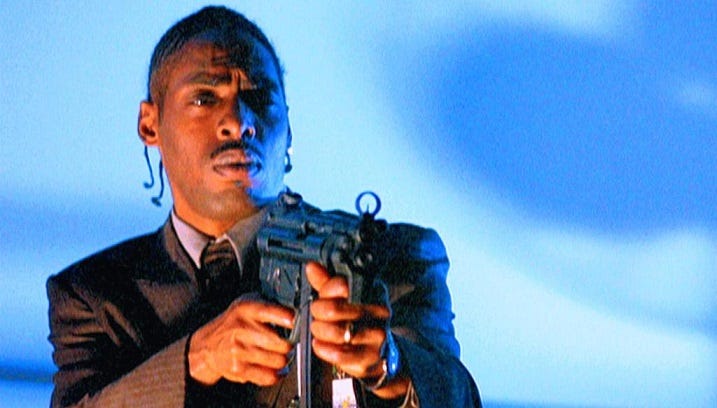
Dejection from rejection: “The film was a complete failure. It was released on video and I went back to my TV studio, only to quit a few weeks later. I couldn't do anything good in Florida. So I decided to go to Los Angeles with my brother. For the first time in my life, I experienced unemployment. I finally found myself some occasional odd jobs; inventing special effects for commercials, making weapons for Friday the 13th and The Beastmaster. It lasted more than a year. Since I worked in large workshops far from the studios, I never set foot on a set! Then I got fed up. Unemployed again. Without a car, a four-year-old child on my hands, I assure you I was not proud. Everyone back home advised me to come back to Florida: Okay, you left, you tried, it didn't work out. Don't get stubborn, come home; you can start again your old job. If you want, we'll even pay for your return ticket.”
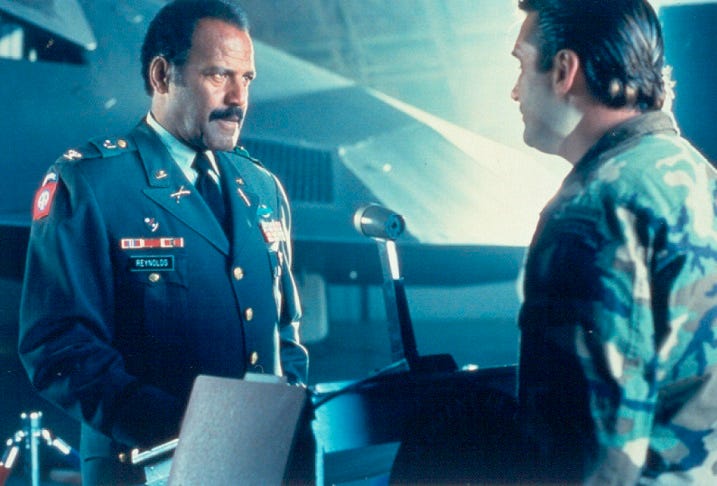
The turnaround: “That's when I seriously thought to start implementing ideas. To finally be autonomous, independent. I thought about it, and the idea of Scalps came to mind, a story of kids killed by a vengeful spirit after having desecrated Indian graves. The film cost practically nothing, which did not prevent problems. We had made a financial commitment with a laboratory in Baltimore, and we sent them our films to be developed every day. So far, nothing unusual. Except that our director of photography was not really up to the task. When we saw that the first reels were completely overexposed, we understood that he knew nothing, what is called nothing, about lighting. He was improvising! We, of course, fired him on the spot and replaced him the same day. With competent technicians, Scalps could have been a much better film. You can imagine our astonishment when a company - 21st Century - rushed to buy it not only to distribute it in theaters, but also to finance its blow-up on 35 mm! It didn't bring me a single dollar, but oh well. The film was released, and with a superb poster to boot!”
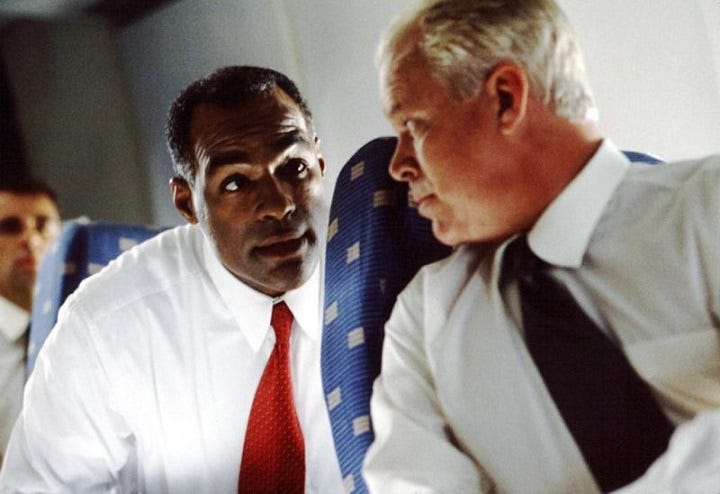
Afterwards: “Back to unemployment. Then I landed in an editing lab. I was in charge of the rushes. It was horribly boring, but it paid off. During that time, I shot Biohazard. I shot it in twelve days, and on Panavision, if you please. It all started the day I went to Venice to visit Roger Corman's studios; I had stumbled upon a spaceship set, the one from Android. A large room, a long corridor and luminous dashboards. Before even thinking about Biohazard, I first rushed to build a semblance of a screenplay, recruited a few extras and made Flashdance-style costumes to make the trailer for what would become Prison Ship. Then, I rented costumes from Metalstorm and Galaxy of Terror, borrowed weapons from Spacehunter: Adventures in the Forbidden Zone, used the sets from The Lost Empire, and bought a minute of Battle Beyond the Stars for the intergalactic battle scenes. I shook this cocktail from Corman productions hard, and that's how Biohazard was born. Squeezed into a rubber suit made especially for him, my five-year-old son played the monster. It was a very small budget, but the result was not lacking in allure. 21st Century distributed it, and it had a more than honorable career in video.”
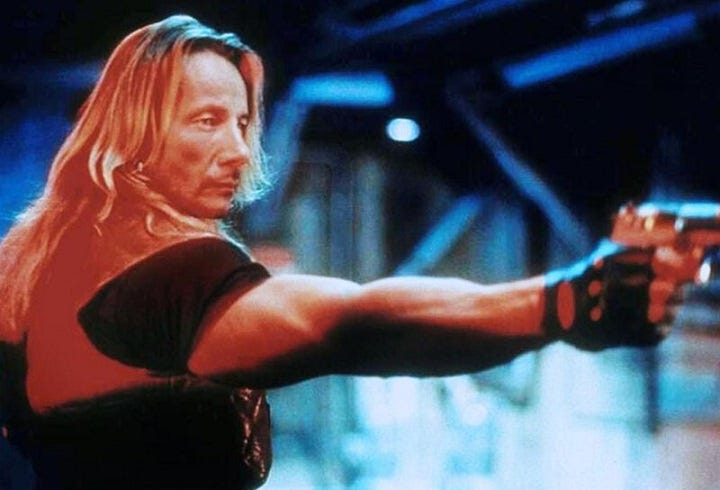
Makeshift and improv are bed fellows: “A little later, one of my interns, who was a student at a film school, told me about a set, still intact, of an Indiana Jones-style advertisement for a brand of blue jeans. I very quickly wrote three pages on the legend of an embalmed Egyptian princess, and I shot a one-and-a-half-minute trailer on the set of the commercial. I showed it to a friend of mine, who promptly sent a copy to Transworld, which had just distributed Biohazard in three states. The trailer was well received, and Transworld produced The Tomb. The script was finished in 10 days, preproduction in 13, and shot in 15. Do the math for yourself: the film was conceived in a good five weeks, and it made me enough money to live for a year without working. But I didn't rest on my laurels. I immediately signed a contract with Jack B. Harris for Prison Ship.”
The Tomb (1986) cost: “About one hundred and ninety thousand dollars, including $45,000 in various fees.”
Prison Ship (1986): “$175,000, but all invested in the film. I cast John Carradine who was already in the credits of The Tomb, and I indulged in my usual little cooking. So I borrowed a monster created by Ted Bohus for The Deadly Spawn, costumes from Metalstorm, the Land Rover from Logan’s Run, and shots from Buck Rogers, Battlestar Galactica, Battle Beyond the Stars and Dark Star. I organized all that around the script and the scenes that I had prepared myself, and Prison Ship was born. The result was so exciting to Transworld that they decided to mix it in Dolby stereo! As for me, I had achieved my goal of making a film with two bits of string and giving it the air of a super production.”
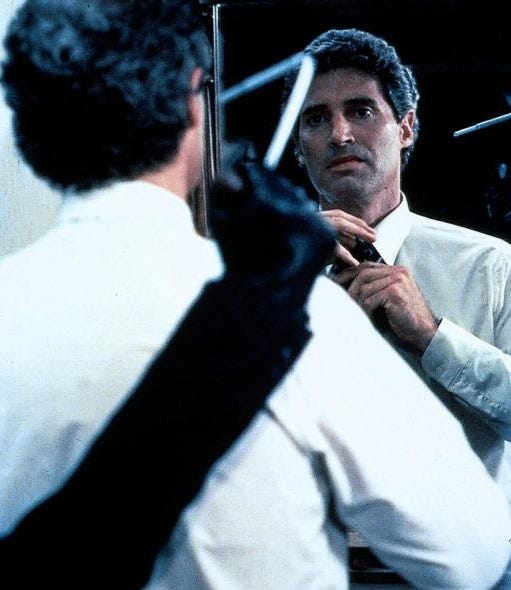
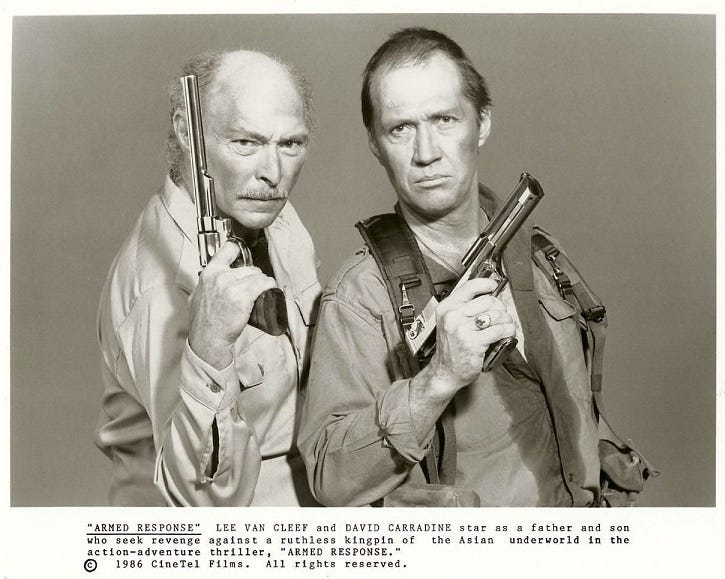
Two bits of a string like a bikini. Anyway, F.O.R. said: “After Prison Ship, I was supposed to make another film with Transworld. I had signed a contract, but I didn't hear from them again. At the same time, Cinetel contacted me. Since I wanted to work above all, I went to see them. They asked me: “What do you want to do?” I told them I wanted to make an action film. They showed me a script that they themselves didn't think was very good and offered to improve it in my own way, which I did. It was Armed Response. When things came together, I was shocked: coming out of a film that cost a $175,000, I suddenly found myself at the head of a production worth a million and a half dollars! On the third day of shooting, we had to shoot a scene outside of a bar. When I arrived on location with my car, the place was full of No Parking signs. Deflated by the surprise, I didn't know what to do. I couldn't park!”
Inflated surprise: “I went to one of my assistants and asked him: "Where do I go now, since we can't park anywhere?" He looked at me funny: "What are you talking about? This whole street is for you! Park your car wherever you want!" I couldn't believe my eyes or my ears. Parking was prohibited so that we could shoot our film in peace. That's when I saw cables strewn across the ground; I followed them and came across a convoy of five or six neatly lined up caravans, themselves surrounded by freight trucks and fire engines. And all these people worked for me! I was the highest authority on the set. I went without transition from a small crew where I knew everyone to a veritable army of 56 complete strangers. It was unsettling. Anyway, everything went very well, the film was released in a circuit of a hundred theaters and made a lot of money.”
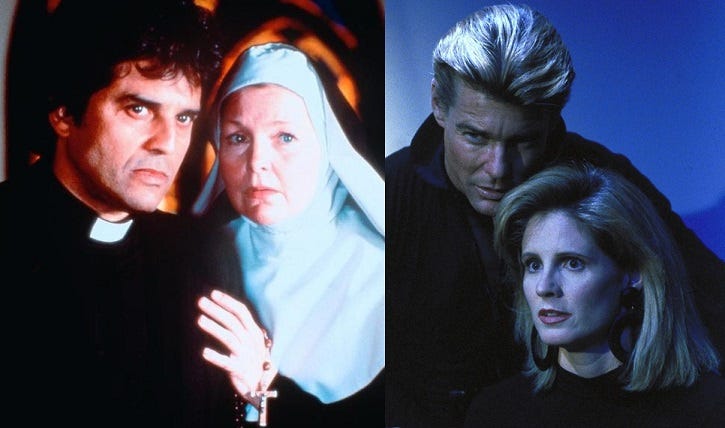
As for whether he was literally enriched by the experience: “No. I didn't touch a single dollar.”
Detour: “I was depressed. But then Transworld came back and I went straight to Commando Squad. One day when we were shooting on location in caves, I said to one of my actors - "You know, we should come back here and do a movie set in caves. Cannon is just making Journey to the Center of the Earth. We should do something like that and shoot it here in these caves. We'd just have to change the camera angles and the lighting." So I wrote a forty-page script while we were finishing Commando Squad. On the last Thursday of filming, while we were shooting in these beautiful locations, I wrote another six pages. Then I asked the crew to stay on location on Friday to do some lighting and camera tests for Commando Squad. The following week we decided to embark on The Phantom Empire for a week of preparation, a week of shooting and the movie was wrapped in one go. I used Christmas costumes for the monsters, hired Jeffrey Combs, Russ Tamblyn, Sybil Danning and Robby the Robot, rented the Land Rover from Logan’s Run again, and voila!”
Fred was asked (via translator Bernard Achour) if he was slowing down his work pace, to which he said: “Yes. I'm just trying to raise money so I can move on to the next level. New World Pictures, Paramount... Who knows? I want to believe that I've been doing my job as best I can for two years now. A lot of directors are content to direct one film a year; last year I made four and produced one; this year I've directed two and financed another one. I really need a vacation.”