
Nom de Plume

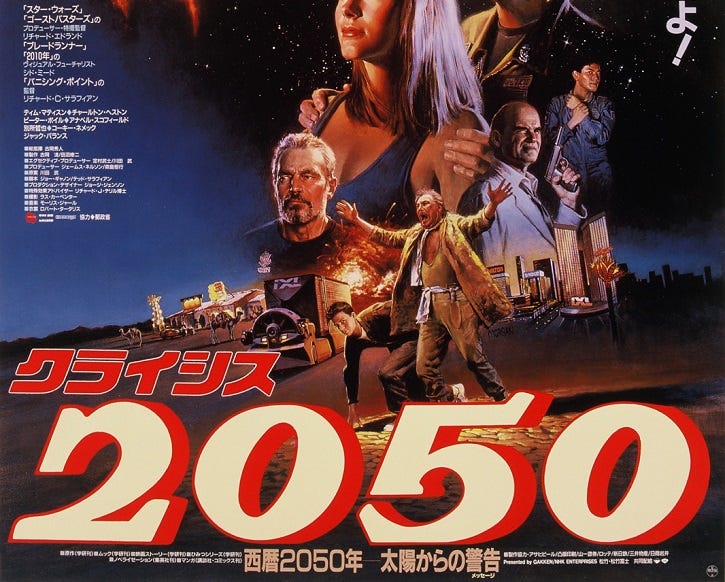
Alain Smithers should be the new Alan Smithee. In the case of Solar Crisis (based on a Japanese novel called Crisis 2050), Crispan Bolt was the nom de plume of screenwriter Tedi Sarafian. His father, director Richard C. Sarafian, was credited as Alan Smithee. Joe Gannon also had a hand in what I like to call the play for the screen. In the March 1994 issue (#88) of a French magazine called Mad Movies, the film was referred to as Starfire. Reporter Vincent Guignebert wrote: “The hallucinatory special effects of truth barely conceal the nullity of this big Japanese production dating from 1989 and whose filming was subject to many tensions. We can measure the extent of the damage here, and in April on TF1 Video.”
Vincent sets the scene, flashback-style: “Cannes Film Market, May 1991. The usual fantasyophiles meet at a screening of Starfire, a big science-fiction production according to the program. As sometimes happens, the trailer precedes the film itself, and in front of a stunned audience, special effects shots of astonishing perfection parade. Space shuttles and resplendent rockets, incandescent planet, cavernous voiceover, intense soundtrack... After two or three Z movies swallowed with a heavy heart, we rejoice: Starfire seems to have a response!”
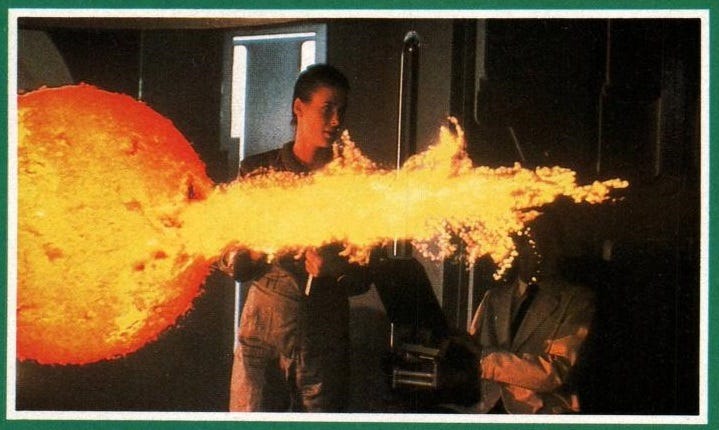
The main presentation: “It doesn't take more than a quarter of an hour for the first journalists and buyers to leave the room, leaving their colleagues in front of what must be called a turnip…with money, for sure. A mega-turnip, then! The story has some potential, however. Only about fifteen minutes of sensational special effects, larger than life, survive this script, which would have deserved to be simplified. The Jurassic Park of Space Opera, in short. The rest is shared between gloomy discussions aboard the Helios ship and the desert settings of Earth where the characters do what they can - almost nothing to avoid comparison with the post-apocalyptic Italian Z movies. A radical boredom for a masterful flop.”
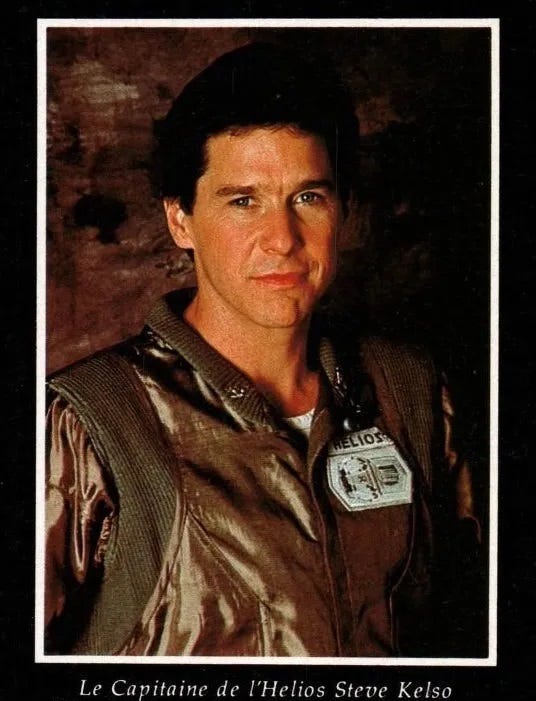
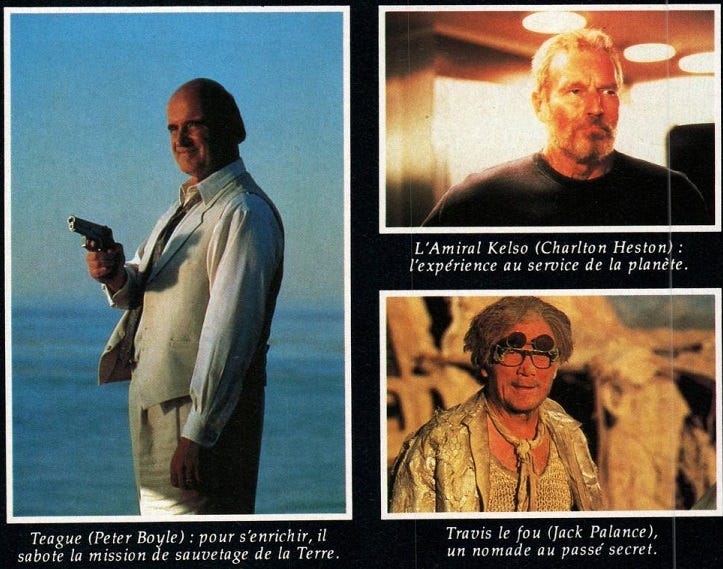
The motley crue: “Cutting-edge special effects by Richard Edlund (Star Wars), a cast of has-beens for the genre (Charlton Heston, Jack Palance, Peter Boyle), a Japanese production (the Gakken conglomerate, the NHK TV channel, Nippon Steel), a masked director (the veteran Richard C. Sarafian): Starfire is a real mess!”
The proof is in the pudding: “The proof is that it is now called Solar Crisis and will not even have the honor of a theatrical distribution in France. In the United States, Solar Crisis was released so confidentially that the figures are impossible to find, and continues a sad career on video. Likewise in its parent country, Japan, where a more eventful theatrical release did not reap the hoped-for benefits. We do not calculate the value of a film by its performance at the global box office, but still! How to destroy a viable project, this is what we wanted to discover by interviewing two of the main creators of Solar Crisis, namely Richard C. Sarafian and Richard Edlund. Without worrying about shocking, Jacques Pradel would say!”
Journalist Vincent Guignebert concluded: “Between Japanese producers ignorant of the rules of cinema in force, a respectable director lost in the adventure, and a brilliant specialist in special effects in whose hands a lot of money circulates, the sets of Solar Crisis are full of potential culprits. So, whodunit?”
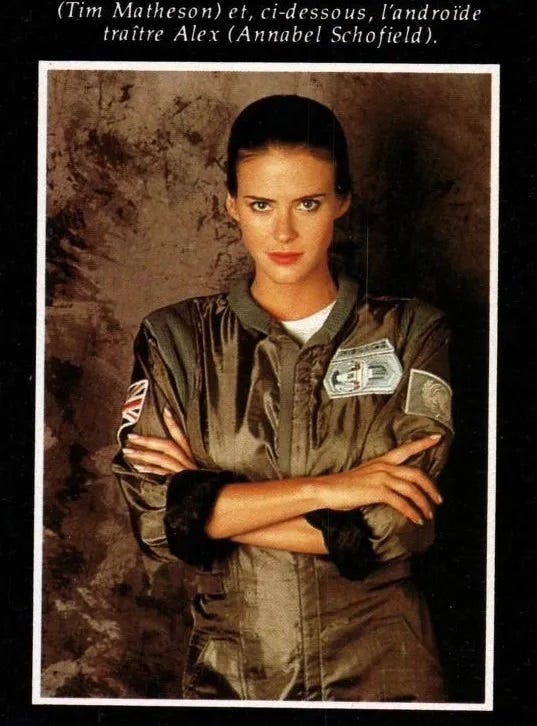
By the way, I wrote an article about Annabel Schofield on my WordPress blog (also called Pop Cult Master like my Medium page).
Back to Solar Crisis, director Richard C. Sarafian explained what attracted him to the project: “I had promised the Japanese producers that I would never talk about the film again, but hey... Originally, the subject of Solar Crisis went far beyond what remains today. As I saw it, the film had a spiritual dimension. The sun was shown as an integral part of our lives, like a divine image. I approached the theme of the connection between man and nature, of the survival of the human race of which the sun is the symbol. These notions being undoubtedly abstract for the Japanese mind, the producers removed all the subtleties from the film, without ever giving me the slightest explanation. However, the President of Gakken was rather a good guy. He was for the spiritual aspect of the film, wanted to do something important before he died. I listened to him and I was quite moved by what he had to tell me. But the communication stopped there. We worked on trust.”
That old chestnut is universal: “I later realized that by entering the Hollywood system, the Japanese goal - "to make an important film" - had become "to make money" - the budget was originally $16 million. $5 million of which was for special effects. In the end, they cost $12 million! A huge waste. I couldn't do much, I was all alone. John Huston once told me: "Despite the best intentions, sometimes you can't do anything but watch your project fall apart little by little." I finished the shooting somehow, then went on to 10 weeks of editing, a very short time for such a film, especially when the special effects don't arrive in time... What the Japanese were most interested in was that Solar Crisis be finished for the Emperor's birthday.”
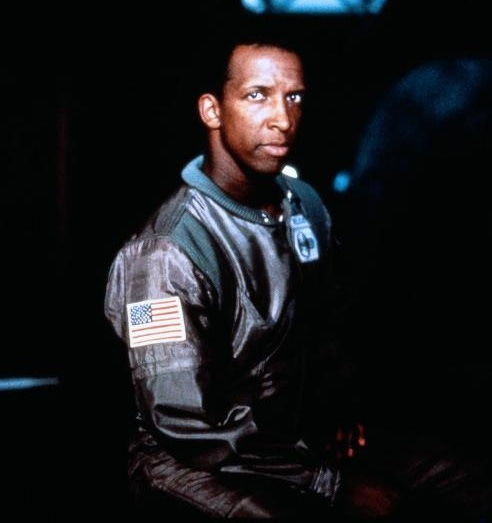
The official reason for the Alan Smithee credit: “I liked the film I had edited. But then the Japanese came along and, seeing the result, brought in a new director. The latter, Larry Marx I think, retouched close-ups and shot new scenes that are abominable. All the little stories, all the more intimate sequences were cut, and I didn't even get to read the retouched script. When I found out that the production had ordered these new scenes, I ran to the Director's Guild and asked for my name be removed from the credits. When the Japanese learned of this, they tried to buy my signature. I told them that a 6 or 7 digit number would not be enough. I was determined to leave Solar Crisis. One day, on the set, one of the Japanese producers whispered in my ear: "Could you reduce the bill a little?" Meanwhile, everyone was getting rich off their backs. Everything on the set was stolen, from props to plumbing parts, anything of value. It was a nightmare!”
Didier Allouch told Richard C. Sarafian that some people claim that Richard Edlund directed the film: “The Japanese are the ones spreading this rumor. They have a lot of respect for him. If only they knew... Apart from smoking his pipe and delivering his special effects, Edlund hasn't done much. Oh yes, he had just lost 2 or 3 important contracts and thanks to Solar Crisis, the sum allocated for the effects and the stolen money, he saved his company!” Honestly, do you think the special effects you saw in the movie were worth the $12 million spent? Edlund charged way more than he should have and didn't deliver the effects the movie deserved. The Japanese are too polite and didn't have the necessary knowledge of filmmaking not to swallow everything Edlund told them. Same for Maurice Jarre who asked for $600,000 to compose the music for the movie, actually an improvisation on his synthesizer. For the same price, you could have bought a philharmonic orchestra!”
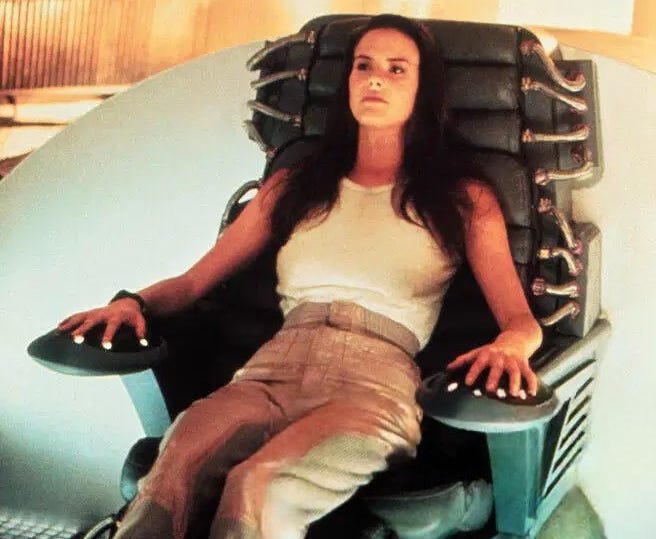
Gripes aplenty: “My big mistake was to have accepted the staging of Solar Crisis believing in the purity of the project. Of all that I have shot and that you will probably never see, there remains only one concept: a journey to the sun. It should have been an incredible audiovisual experience and it is not, not at all... I should have realized that I was not made for this system. Solar Crisis erased me from the Hollywood film club. I have not shot anything since. I should have stuck to the small films that I like.”
Rich C. Sarafian still acted in films, though.
From one D!ck to another - Richard Edlund. Having worked extensively for several years in television and advertising, Rick learned to produce, via Boss Film (ILM's direct competitor), the special effects that he had previously been paid for. Now managing the money invested in films, TV films and commercials, Ricky logically found himself to be the co-producer of Solar Crisis for which he may have signed his most impressive effects. As for how he got involved with the film, the man who could be known as D!ck Ed’ said: “It's simple. The Japanese Gakken executives watched about a hundred science fiction films and decided that the most visually stunning one was 2010. As I had done the special effects, they hired me.”
As for the film that was known as Crisis 2050 in Japan: “At that time, the project was really vague. Mr. Furoka, the President of the conglomerate, an 80-year-old man whose fantasy was to make a film in Hollywood, just wanted to develop a project around a trip to the sun. Apart from this idea, there was nothing, not even a line of script. Personally, I was a little perplexed about this trip to the sun. It's still a bit hot there! So I had to give birth to a series of spaceships capable of withstanding such temperatures. We were talking about special effects, and I already realized that the Japanese had put the cart before the horse. They imagined that special effects were essential. Which is not wrong. Failed effects in a science -iction film are a disaster. From there to start with the technical problems. In short, the producers launched a sort of competition among the scriptwriters to find the best possible story. The winner had to first work in the form of a novel. Then it was written for the cinema, rewritten and rewritten again...”
Sunshine without rainbows: “At the same time as the film, Gakken was developing a documentary and educational TV series on the cosmos, which used my special effects. Part of this series for the NHK channel was actually filmed on the sets of Solar Crisis where a TV crew worked alongside us with a different cast! There was also talk of shooting a film at the same time for theaters equipped with the Imax projection system, but fortunately that didn't happen!”
As for why he accepted Gakken's proposal: “What special effects specialist could resist a film about a journey to the sun? Even if Solar Crisis didn't have the distribution it deserved, it remains visually very beautiful. I believe that if the film had been distributed properly, we would have received an Oscar nomination. Solar Crisis needed a major director and a star to attract the attention of a major distributor. In our case, we had to finish the film for a set Japanese release date that corresponded to an event that I no longer remember. This rush caused additional expenses, and from an initial budget of 16 million dollars, we went to 26 million. A negligible sum compared to what we see on the screen.”
Here and there, it was reported that it cost between 35 and 43 million dollars: “This is ridiculous! The film cost $26 million.”
Didier Allouch wanted to know if the budget included the additional scenes, to which Edlund said: “Absolutely.”
As for how much of the budget was spent on special effects, “D!ck Hard” claimed: “About $10 million. That budget aspect of the film is interesting. When I was in Japan working with the first screenwriter, Gakken threw a big party for the launch of the film. The entire press was invited, and the executives announced that the budget for Solar Crisis would be $60 million. I knew they would never allocate that amount for the making of the film, but of course the news was picked up in the United States by Newsweek magazine, which compared the $60 million for Solar Crisis to the $20 million Steven Spielberg needed for Close Encounters of the Third Kind. Since the executives at Gakken had asked me to produce Solar Crisis, this announcement had the gift of annoying me: you don't announce $60 million when you only invest $16. So I got an extra $10 million.”
Ric was then informed that he was purported to be the director: “It’s wrong? Where did you read that?... Solar Crisis is a weird movie. The director asked that his name not be mentioned anywhere, there were a lot of arguments...”
Mr. Didier Allouch wanted to know more but this D!ck does not want to be rubbed the wrong way: “Look, every movie has its dirty laundry, and sometimes we don't want to take it out of the closet.”