
Mémoire

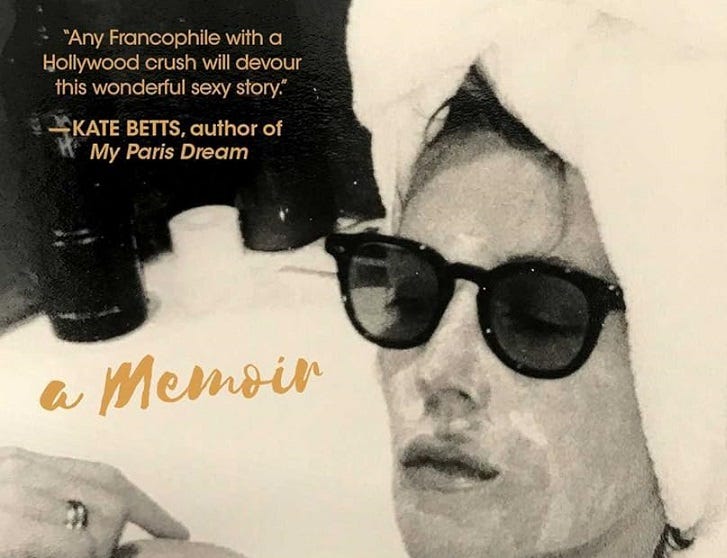
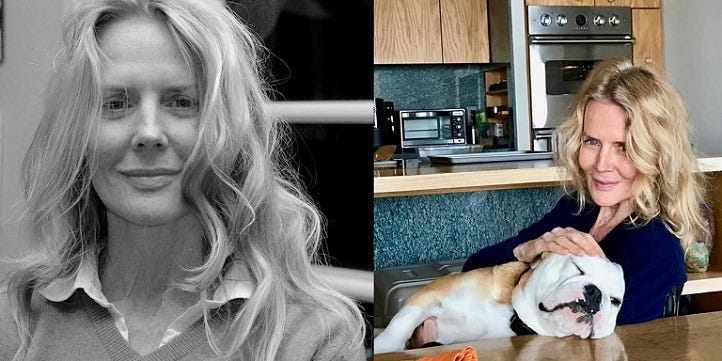
Titled Mistakes Were Made (Some In French). Published in 2017, the author is actress Fiona Lewis. She has worked with so many famous people like Brooke Shields, Peter Fonda and Meg Ryan to name a few. Fiona Lewis gained a glowing testimonial from Naomi Watts for her memoir. Even David Mamet complimented the book. I don’t want to spoil the book for those who have yet to read it, but I will indirectly advertise its goodness by lifting some interesting facts from when she was interviewed for the May 1998 issue (Vol. 6, No. 12) of a magazine called Femme Fatales. This was not a French mag but an American one.
Referring to Jacqueline Bisset and Roman Polanski, Fiona Lewis said: “I was friends with Roman. Jackie did Cul-de-sac with him. A French producer was in town and said ‘I'm looking for somebody who looks 12 and can speak fluent French.’ Well, I just happened to look extremely young and speak fluent French. In those days, especially in France, the attitude was ‘Of course you can act! Everybody can act!’ It wasn't like now. Nobody will pick you off the street and put you in a movie.”
She also mentioned Sharon Tate, albeit much later on: “I went and did this little movie in France. It was about a bunch of teenagers and I was one of them. After that, I considered myself an actress, even though I had done no acting. Roman then said ‘Here's a part in my movie. Do you want to play the maid?’ I didn't realize what a big deal it actually was to be in a Roman Polanski film. He was very big then. Sharon was in the film. We were all friends. That was my first British picture.”
This refers to The Fearless Vampire Killers (1967): “We took the story and its production very seriously. Roman is truly brilliant. Because he's an actor, what he would do is play everybody's parts. If there was a scene with four people, he literally would do all four parts to show what each character was like - and he would be brilliant. With no experience whatsoever, I just copied what he did. He said ‘Do it like this,’ and I said ‘Okay.’ It was fabulous.”
What she said next about Roman reminds me of why he deprived himself of the chance to work with Bruce Lee (an offer to direct The Silent Flute was rejected): “Even now, I'm sure - although I haven't seen him in years - that he has more energy than anybody I've ever seen on a set. When I first met him, he spoke only a few words of English. He spoke only French. Of course, he learned it in about three weeks!”
Back to Sharon Tate (who Bruce Lee worked with on The Wrecking Crew): “Sharon was a natural. She was so extraordinarily beautiful, and couldn't have been sweeter. But the woman who played her mother was enormously fat. I remember she had a smell that was horrible. She was sweet, but she was not a clean person.”
From sweet to sour and back again: “Jack MacGowran was so sweet and polite. He said to me - whispering - ‘My dear, I think you should take a few lessons.’ So he sent me to this method acting school which was like ‘Excuse me?’ English actors don't believe in method acting. I was willing to try. I remember, for the first week, all we did was pretend to be a tree. After a week, I said ‘You know, I'm sorry. I'm just not getting anywhere. Whatever it is, I'm not getting it.’ In fact, I probably should have stayed on but, anyway, that was the extent of my training.”
Dr. Phibes Rises Again (1972): “Robert Fuest was wonderful. He was improvisational, loose. He was fun and enthusiastic. I didn't know enough, as an actress, about what a director was supposed to be, but he certainly made me feel good in my inexperienced days. He's definitely an artist.”
There is a sobriety parable in here somewhere: “He was also crazy. They were all crazy. It was a crazy group of people. Vincent Price, of course, was the saviour. I remember, on the first day, he said to me ‘Oh darling, I just do it for the costumes. I love them!’ His life was a ball. He was so much fun to be with! I ran into him six years later at a premiere and he hadn't a clue of who I was. Even when I mentioned the film and my name, he still hadn't a clue. I think there were so many films that he just couldn't recall particulars!”
There’s definitely something to be said about how performers, regular and X-rated, medicate themselves with toxins to get through something, especially if they’re nervous. Even if they’re not working in harrowing circumstances, they may be trying to escape past memories. When talking about working with Oliver Reed on Blue Blood (1973), Fiona Lewis couldn't recall singing in character. She did, after all, say: “We had an incredibly good time on that movie. It was hysterically funny every night. We lived in some village that probably never recovered. Heavy, heavy drinking went on every night. Oliver was at his peak drinking at that time. His favourite thing in the pub was unscrewing the light bulbs and eat them down to the wire.”
The Fury (1978): “I must have gone up for that part about eight times. In fact, there was a whole giant r@pe scene with Andrew Stevens that we had to act out on the floor of Brian De Palma's office, obviously not unclothed, which was sort of a nightmare. When you haven't actually got the part yet, it's a bit much to go through.”
More injuries, more insults: “I remember the r@pe scene - which was taken out, thank God!, it was too grisly - where I had to literally collapse like I had been hit over the head. It was a little painful: you're falling, smack!, onto the floor. At about Take 38, you're really p!ssed-off because you're covered in bruises.”
Innerspace (1987) starring Dennis Quaid, Martin Short and Meg Ryan: “Joe Dante is not a great actor's director. He didn't know anything about lighting a woman. That went out the window in Hollywood about 25 years ago. In all these movies, nobody knows how to light women. What's very sad is that no one thinks it's important.”
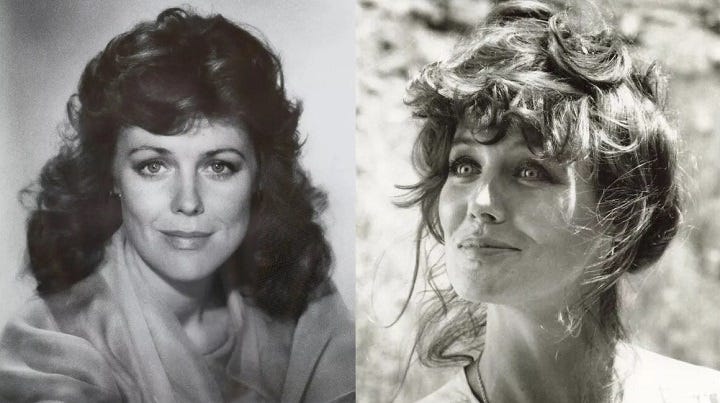
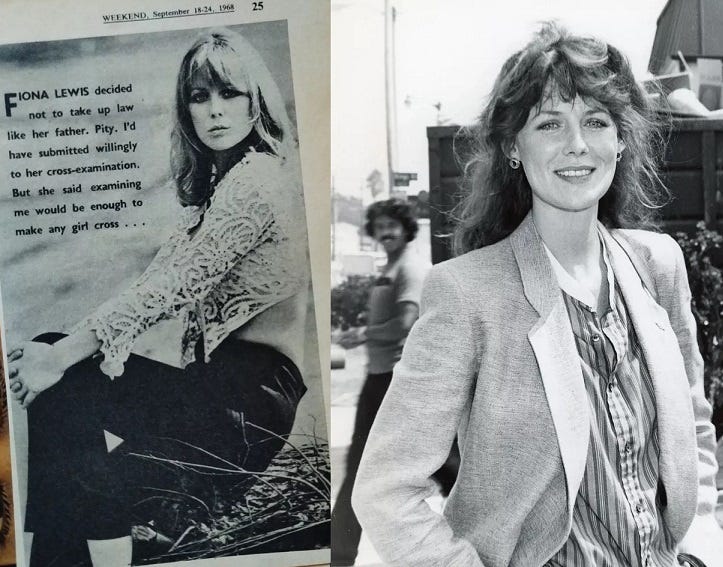
About the above collage, the way that Fiona Lewis looks on the right reminds me of a model and actress who followed her in footsteps - Kelly LeBrock. Kelly’s father was French-Canadian. Also, her first husband used to live in France and even dated Fiona’s best friend: Jacqueline Bisset. Anyway, Fiona also worked with Roger Daltrey on Ken Russell’s Lisztomania (1975). She thinks that Ken was a better director than Joe Dante: “Joe Dante was very much a technocrat, so the movie was all about that. He has no point of view as a director. People like Polanski and Russell were original. They had life experience to draw from. Dante has no life experience.”
Ironically, Fiona’s lack of experience in one area proved to be her undoing: “I think my problem was that I didn't really take acting, as a profession, seriously enough. Like in any other profession, you have to work extremely hard to be good. Basically, my heart wasn't quite in it. If I was doing it now, I would do it very differently - work harder and take my craft much more seriously. I was a very nervous actress, not very comfortable. It was not something that came naturally to me. I really didn't focus effort on becoming a great actress. You can't concentrate on being a star. You have to concentrate on being good.”
Once again, I’m reminded of Bruce Lee. This time - his obsession with being a super actor instead of a super star.
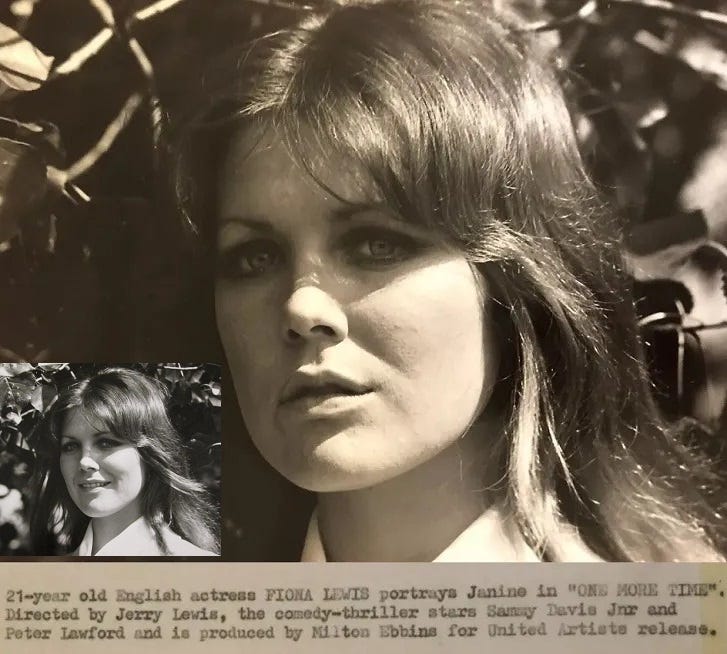
The sepia photo is not her best but the caption on the back interests me because Fiona’s character is credited on IMDB as “mourner at funeral” despite the fact that her character’s name is mentioned in the film. In fact, Fiona wasn’t credited in the film itself. In the Femme Fatales article, she talked about her transition from actress to screenwriter. Regarding becoming the author of her first book, she alluded to the “write what you know” rule: “What I knew was having an affair with a married man, the dilemma and all the old problems. I was either going to write that, or a book about growing up with a friend of mine in London during the '60s.”
About Between Men (1995): “I decided which one to do first, and made a conscious decision to make the book about Hollywood. I wanted to get the real stuff about the business in it because even though you read a lot about Hollywood, few authors actually get it right. I wish I could write like Barbara Cartland and Jackie Collins, but I'm not really interested in their kind of writing. I don't want to get up every morning and write about sex and shopping. I'm interested in relationships, friendships, how people survive them and how, most of the time, they don't. I'm glad I read all the classics before I wrote a book. It gives you a grounding. You have to have that. It's the same with acting.”
The allure of Hollywood: “The trouble with the business is it's very addictive and once you're in it, it kind of takes over. There is always that hope of something breaking through. The rewards are enormous if it does break, so you stay in. Los Angeles attracts the sort of people looking to escape their backgrounds and become something else. Certainly, when I first came here, I was, in a way, trying to escape myself.”
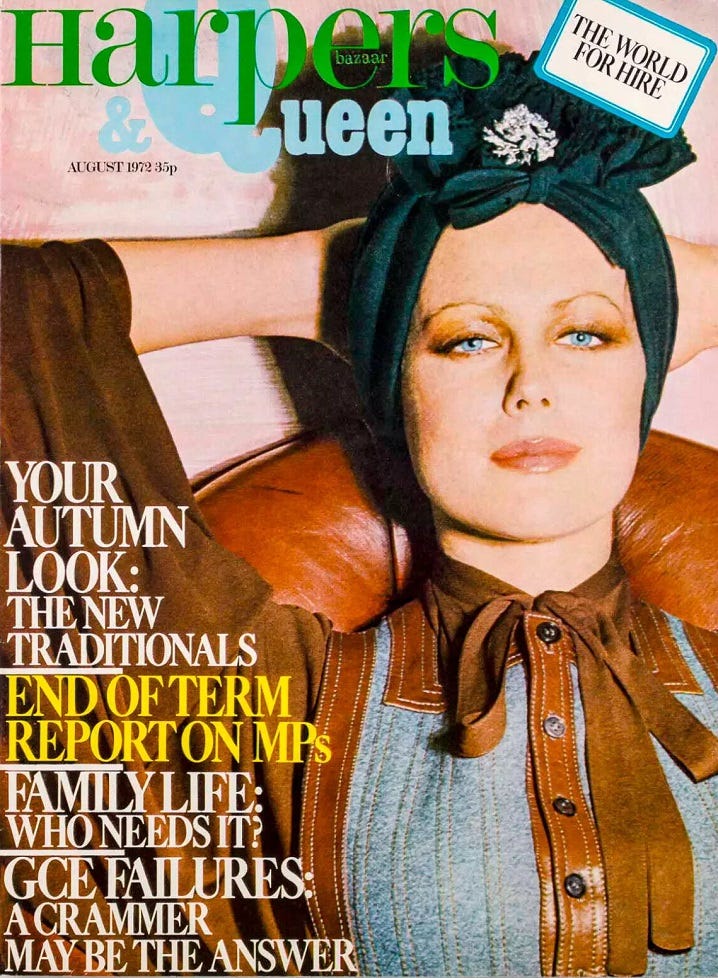
Fiona was photographed by Norman Eales. Her hat was designed by Christian Dior whereas her blouse and top were designed by Jean Muir. As for her second novel, it remains unpublished. It was to chronicle the life and love between two friends over a 20 year period.