
Madder Than a Fox

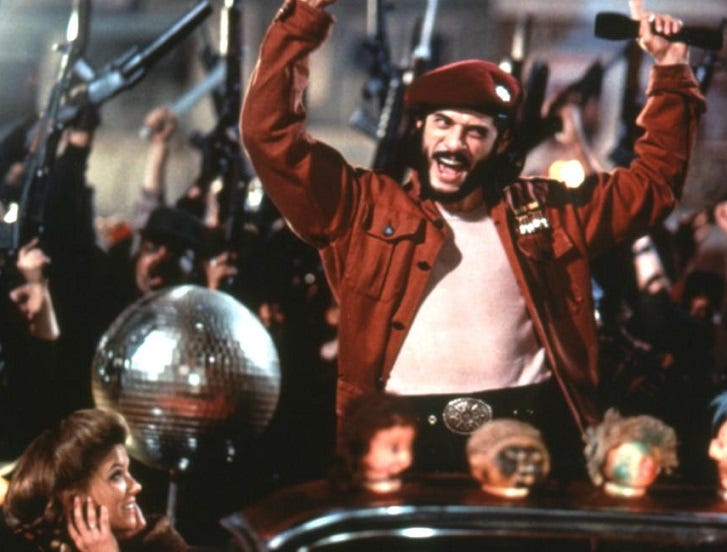
Kurt Russell and John Carpenter didn’t do an audio commentary for this film. In the November 1996 issue (#104) of a French magazine called Mad Movies, Carpenter was interviewed about Escape from L.A. by Marc Toullec. The director knew how to be subversive with politics: “To rally the public to the cause you are campaigning for, you have to entertain, to be fun. I am much more so than in the past, precisely because it was a question of prescribing a pill that some find difficult to swallow. Filmed without humor, like a social assessment in the first degree, the film would have been much darker. To a certain extent, it still remains a little. Too much for many people. We must above all not take Escape from L.A. too seriously. In terms of satire, I often refer to Luis Bunuel's The Discreet Charm of the Bourgeoisie, a film that makes you laugh out loud, although some still believe that it is not a comedy but indeed a drama.”
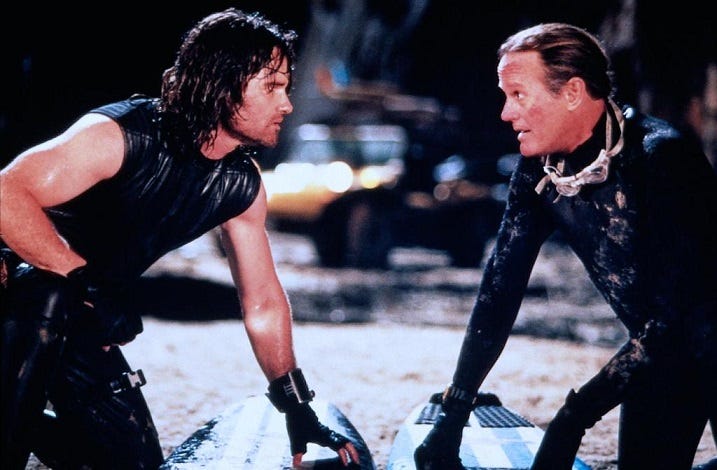
Mixed signals: “I am not particularly pessimistic about American society, even if the film seems to convey the opposite opinion. It is, after all, only fiction, only a show. We operated simply, taking pieces of the current situation in the United States to transplant them into the future, exaggerating them. We only observed, took what makes up our daily life in Los Angeles, the concerns of its inhabitants... It was within reach; we only had to bend down to pick up the ideas. The main one consisted of reversing the situation compared to New York 1997. There, Manhattan is the prison. In Los Angeles 2013, it is quite the opposite. Los Angeles is a land of freedom, certainly dangerous but a land of freedom all the same, while the rest of the country finds itself at the mercy of an authoritarian, repressive power. You can have a blast in Los Angeles, not anywhere else in the country. Plus, it's a big difference from New York.”
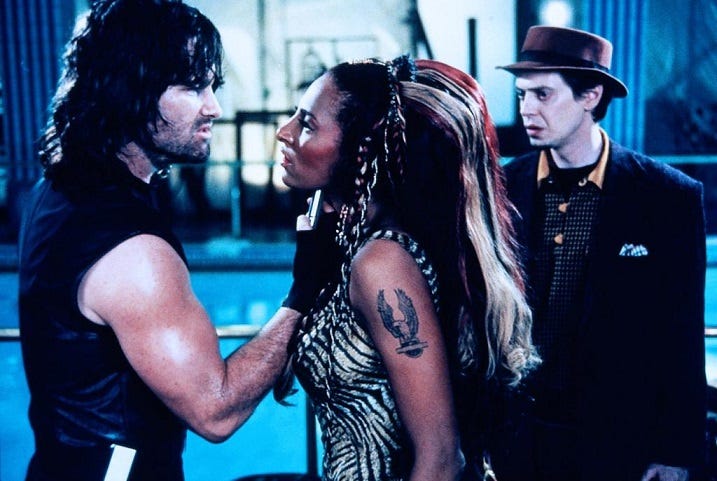
Projection of projectiles: “Escape from L.A. does not attack a particular political party, we are hitting everyone. In the character of the President, you can recognize Bob Dole, but there is also some Pat Buchanan, some Bill Clinton in him. Plus a Canadian politician who wanted to be elected for life. It was Kurt Russell who told me that after seeing it on television! The film, more than serving up soup to the Republicans or Democrats, simply says that the country is currently abandoning freedom in favor of order. A step towards fascism. A choice that scares the hell out of me.”
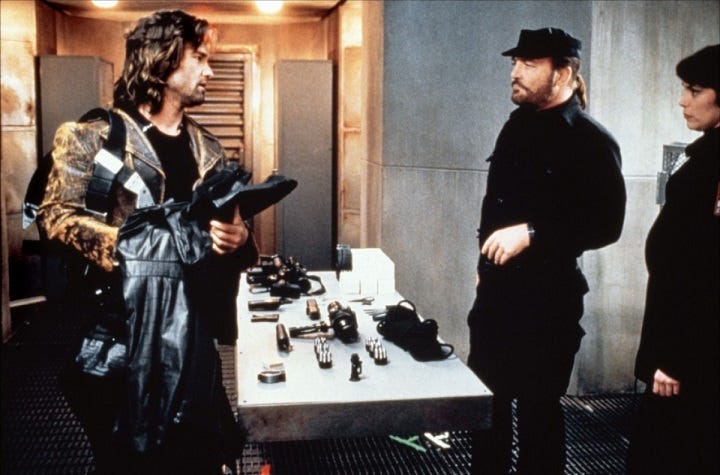
Crossed wires: “It is not humanity that Snake Plissken is destroying, but technology. The technology that shapes us, that transforms us into consumer-sheep. A process similar to that of the canons of beauty. Because you are told how you must physically be to succeed, to please, you must pass through the hands of a cosmetic surgeon. In Hollywood more than anywhere else. This conformity disgusts me! We are all becoming slaves to technology as some of appearance. Computers, the Internet and the rest are supposed to multiply the possibilities of communicating. The opposite is happening. As for the industry, she should create jobs, she lays off arm round. With the industry, it's a bit of our society dying out. In Europe, you are very lucid about the direction the things. We are not. We have all the trouble in the world to make a difference between what is important and what is not.”
The germ of the sequel: “It was only at the beginning of the 90s that Kurt Russell had the idea. Various disasters had just struck Los Angeles - an earthquake, fires, floods... There were also these riots. So many seeds for a good story. On a daily basis, Los Angeles is an incredibly dangerous city. It really is not a good place to live, so much violence is omnipresent. We are all on borrowed time! And why don't we pack our bags? What could possibly be holding us back? I was interested in addressing these themes. And then, I must admit, Escape from L.A. offered me the opportunity to shoot a big budget for a big studio. The capitalist in me responded. I'm a real capitalist and very conservative about money. I like making money and I like making movies. Kurt Russell got me back on track. He was the one who initiated the project.”
Hesitance: “At first, I wasn't keen on the idea of making a sequel, especially since a first script dating back to 1986 had not satisfied anyone. Writing a sequel is always a very delicate thing. It's a battle between the temptation to make a photocopy of the original, the desire to move towards something radically different and to stick to the model while bringing new elements. I learned through the Halloween sequels that the public always wanted the same film, always wanted to see the same thing but presented differently. The big question that was bothering us was: Can you watch Escape from L.A. without having seen Escape from New York? We answered it by presenting Snake Plissken as if people had never heard of him. If they had, this new exposé of his life could only enrich his personality.”
Carpented is asked if he had any problems with the major studio as per usual: “Not at all. Paramount mainly wanted to reunite the team of Escape from New York. That interested them more than anything. Producer Debra Hill, Kurt and I agreed on the direction of the story, the studio had no reservations about the script. They even gave us their support, led by Sherry Lansing, the boss. For them, it was mainly a fun, very entertaining story, which featured an irresistible hero, whose return everyone had been demanding for years. So Paramount gave us a budget of 50 million dollars with this single instruction: "Don't spend a dollar more!" When it came time to edit, our relations did not deteriorate, unlike what often happens. Three days after the last turn of the crank, we had a rough cut that was close to 3 hours. It's part of a filmmaker's job to bring his film down to a usable, reasonable length. You have to know how to choose the essential and cut the rest, not keep everything you shot just because you shot it. Now, with the director's cuts released on laser disc, you get long versions. This will probably be the case for Escape from L.A. Ultimately, the film is my best experience within a Hollywood studio.”
I’m reminded of Sigourney Weaver in Alien: Resurrection (1997): “I love basketball. I'm even addicted to it, the kind of person who never misses an important game on television. Kurt, on the other hand, knows nothing about it. I played this sport! The basketball scene required hours of rehearsal, dozens of ball throws. A sequence that was much harder for Kurt than for me.”
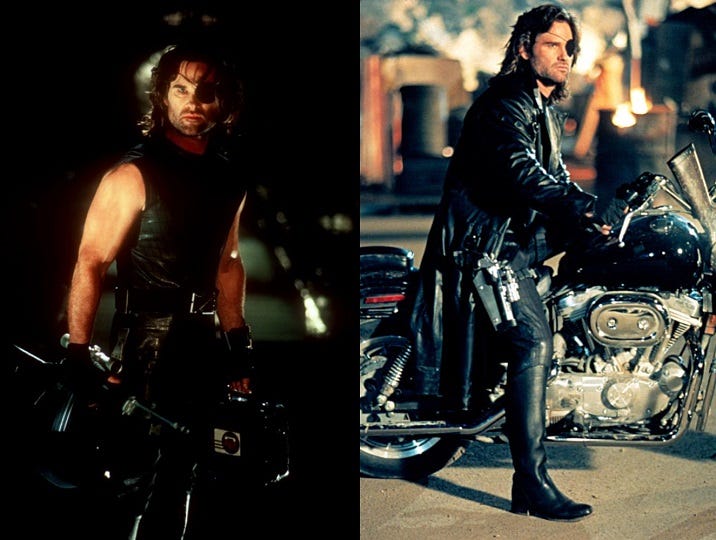
Patriotic patron: “I also love Los Angeles. A paradox when you've seen Escape from L.A. For nothing in the world would I move anywhere else. I was born there, my house is there. On screen, I attack Los Angeles because I love it, because I'm afraid of what it could become. There's even a part of me that clings to Hollywood. Things aren't as simple as they seem. Escape from L.A. is a bit like a tough nut to crack. Maybe it's only plastic surgery that makes me angry. I still can't get used to it even though I'm around it every day. I can't accept that people would use scalpels to change their appearance.”
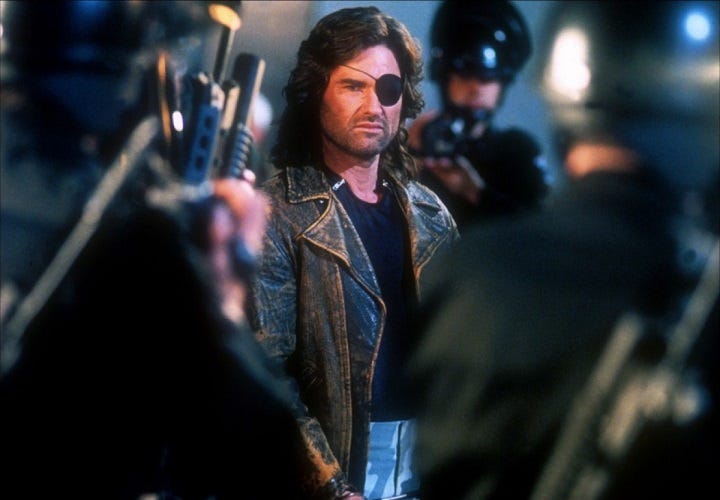
In the interview that was included in the issue of Mad Movies, Kurt Russell speaks of character whose importance was paramount: “He is so hard, cold and cynical that some Paramount executives did not approve of us. They told us “But this guy rejects society in the most visceral way possible.” We would answer them “Have you seen Escape from New York?” To which they would retort “Yes, but times have changed. There is no question of softening him, however. It was imperative that the Snake Plissken of 1980 be the one of 1996.”