
Jolie Motarde

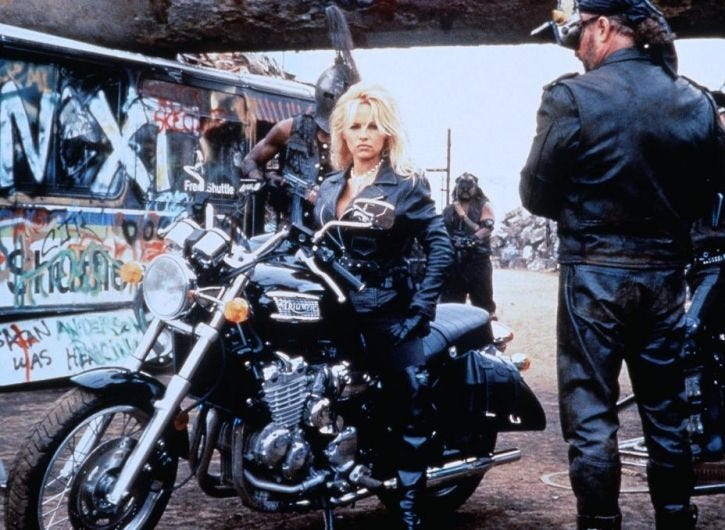
This is French for pretty biker. Chris Warner, who conceived Alien vs. Predator, was the creator of the Barb Wire comic book. He was interviewed for the July 1996 issue (#102) of a French magazine called Mad Movies. Comic book expert David Guélou was the translator for journalist Damien Granger. Chris Warner talked about the origin of the title character: “I wanted to create a female action character first and foremost. Barb has changed since her original conception. She was originally set in a much more cyberpunk, science fiction universe. I pitched Barb Wire to Dark Horse in the early ‘80s. I was very busy and didn't have time to develop the project. Then Dark Horse started creating a new line of superhero comics, so I modified the character a bit to make her fit better into this already established universe. Barb is very different from the action heroes you can find today. She has character, propels herself into the heat of the action. She's not a woman torn from her daily routine to face perilous situations. I wanted Barb to be a kind of female Schwarzenegger. I found this idea interesting and funny, in the sense that it presented a lot of opportunities for a film. Barb is an intense character, very strong. And even if the comic is a little more superhero-oriented, it was easy to erase the elements referring to it because Barb Wire does not have superpowers - she does not need them!”
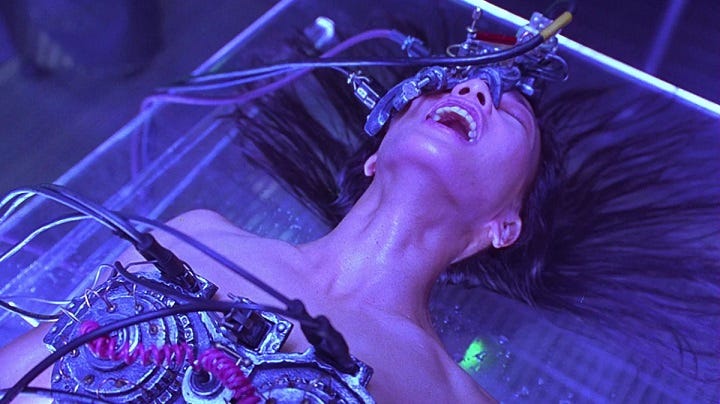
His verdict about the film: “I think it's good, very funny. It's not a hundred million dollar blockbuster, but the result is honest, even surprising. Pamela Anderson is extraordinary, both in the action scenes and in the character's overall attitude. At first, I was a little afraid when you create a comic strip and it falls into the hands of a person who is going to be brought to reshape it, you shouldn't generally expect a miracle. But all things considered, including its modest budget, Barb Wire pleasantly surprised me. The director who finished the film, David Hogan, has a very visual style, perfectly suited to a comic book character like Barb Wire. Coming from music videos, he tends to constantly innovate. His staging reminded me a lot of the way I go about cutting a comic book: the contrasts, the changes of angle...”
Apart from Barbara, none of the protagonists of the comics, mainly monstrous villains (e.g. Motorhead and The Machine) are in the film: “I think it would have been difficult to include so many imposing characters in the script. For a film, we only have two hours, which does not allow, unlike a TV series constantly introducing and developing new characters. Plus, with all these characters having superpowers, the focus would have been diverted from the real star of the film, Barb, and the special effects required would have blown the budget. I really think that the decision to focus the story entirely on Barb Wire was the only one that made sense.”
Chris Warner’s role in the film: “Mainly costume design. That's how I met Pamela Anderson. I showed her some sketches inspired by extravagant fashion magazines that she immediately liked. I started working on new designs again, and then someone else was hired to finish my work. The film came together very quickly and I couldn't afford to be involved in it, even though I would have liked to. I was involved in other projects at the time that didn't leave me the time to invest in the production of Barb Wire. On that film, time was a big factor and it was difficult to get everyone together at the same time.”
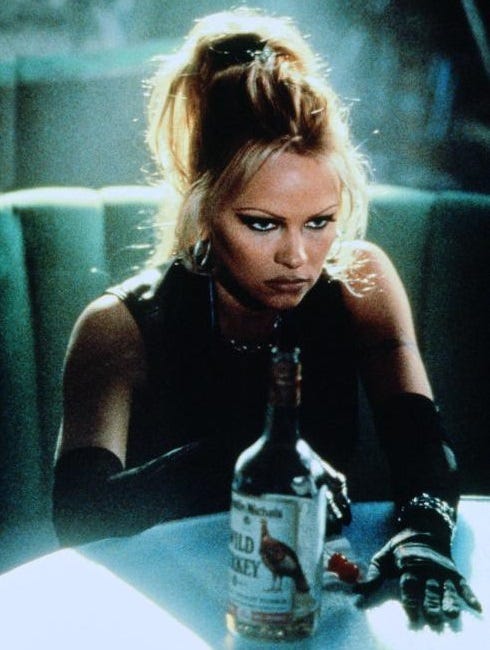
Ideal casting for the main character: “I didn't really have an idea, because I didn't see any actress who could handle an action scene while remaining attractive. I think Pamela is the best you could dream of. There are of course more experienced actresses, but they don't have the look. Meryl Streep, for example, is a better actress, but I can't see her wearing the costume the same way as Pamela, pulling out the guns while being sexy! At first, having only seen Pamela in Baywatch, I didn't really know what she could bring to Barb Wire - a character much more lugubrious and rock'n'roll than her sex symbol image. I actually realized that Pamela and Barb had a lot more in common than one might have thought. On screen, Pamela is perfect, she leads the action very effectively. Unfortunately, the public does not seem to think the same way, given the lack of success the film had in the United States. The spectators tended to take Pamela for a stereotype, to cast an unflattering view on her. Her image of a sexually aggressive woman has undoubtedly dissuaded a lot of people. Men, for example, must have hesitated to bring their wives or girlfriends!”
The quick process of this comic book being adapted for film: “There are several factors. Dark Horse Entertainment is a comic book publishing company as well as a film production company in relation to Harry Gordon productions; so they get the rights very easily. Dark Horse likes to work with their creators, in order to see what kind of product is likely to be made into a film. There was The Mask, created by Mike Richardson, TimeCop - another concept of Mike - then Barb Wire, which I wrote, and maybe soon Black Cross, which I still own the rights to. Comic book characters are easily adaptable to film because the visuals are already established, the characters developed and the situations explored. By opening a comic book, producers can already get a concrete idea of the result on screen, which is not the case with an original script. I think there are plenty of things to do around comics, especially nowadays where certain special effects that were not feasible a few years ago, or too expensive, are now affordable. The public constantly wants to be impressed, visually surprised. The world of comics offers them these possibilities.”
His opinion of film adaptations of comics in general: “Some I really liked, others not. In my opinion, Batman is a success. Barb Wire works well as expected. However, if I had a little more control, the film would have been different. This is true for any adaptation as soon as the creator is involved. With a bigger budget, those responsible could have played the spectacular card more. But Barb Wire remains a good adaptation, faithful to the character. The same goes for The Crow, which shows enormous respect for the work of James O'Barr. In my opinion, this is essential for the success of a film adapted from a comic book. It is also very comforting to see the respect that Hollywood shows today towards the authors. This was not the case a few years ago. Too bad the public does not follow. Barb Wire has neither the past nor the popularity of superheroes such as Batman or Superman. In addition, the film was rated R and not PG-13 as originally intended, which deprived it of the audience it was intended for, those under 17. In America, politicians point the finger at Hollywood and accuse it of being the main cause of moral decline. They have therefore adopted, wrongly in my opinion, a cautious attitude in order to protect a certain young people who do not need it; it is regrettable.”
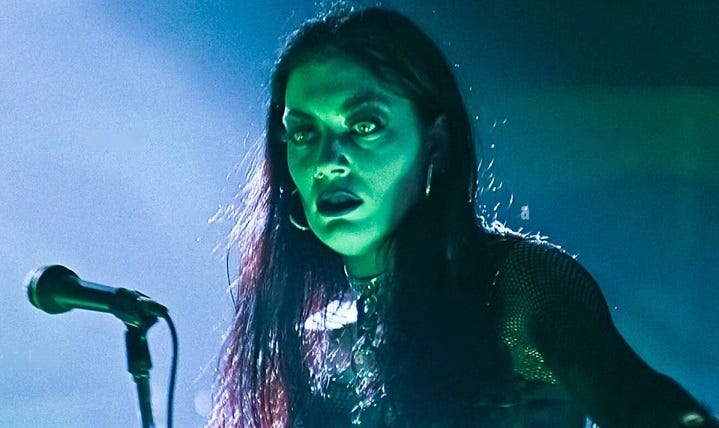
In the July 1996 issue of Mad Movies, nothing was said of the fact that fellow Playboy model Anna Nicole Smith had recently starred in an action movie called Skyscraper. Unlike Barb Wire, this one went straight to video. The original director of Barb Wire, Adam Rifkin, had previously made a movie that might as well have gone straight to vid. Starring Charlie Sheen and Kristy Swanson, The Chase was such a low-thrills affair that it could easily have been consigned to video shelves like another 1994 film with a similar concept - Fast Getaway II with Corey Haim and Cynthia Rothrock. If the companies behind Barb Wire wanted a reliable B-grade director, they should have gone for Albert Pyun. Failing that, they could have gone for someone who did rather well with low-budget female-driven thrillers - Michael Schroeder, who had directed Angelina Jolie in Cyborg 2: Glass Shadow (1993), and Courtney Taylor in Cover Me (1995).
Back to Adam Rifkin, he had directed Traci Lords in a film that was originally called The Nutty Nut. In Hollywood, you’re judged by your last film…and this film was not only shelved for a few years but released on video in 1995. You can naturally see the correlation between directing Traci and Pamela Anderson. In other words, sex sells. In all fairness to Traci, she was probably the better actress. I think that the best choice for the role of Barbara Kopetski was Bridgette Wilson, who was coming off hot off the success of Mortal Kombat in 1995. For Mad Movies, Adam Rifkin was quoted as saying: “I love the idea of building a completely different universe, of transporting the spectators into another dimension. Barb Wire will be the combination of Roy Lichtenstein's paintings, Dr. Seuss' books and Sam Peckinpah's films. And what young male director doesn't dream of directing Pamela Anderson?”
After a week of filming, the producers fired him on the spot. According to David Hogan, the replacement director: “They watched the rushes, didn't like them at all. They got really angry. The producers didn't want the Barb Wire started by Adam Rifkin. Too serious, too hard, too pessimistic. The executive producer called me on the phone on Friday. On Saturday, we met and I signed the contract right away. By Monday morning, I was shooting. I reshot most of a sequence previously put together by Adam Rifkin, that of the appearance of Big Fatso - the godfather of Steel Harbor transported by the bulldozer. The makeup of the first actor, Tone Loc, was absolutely not realistic in close-ups. We hired Rosey Brown instead.”
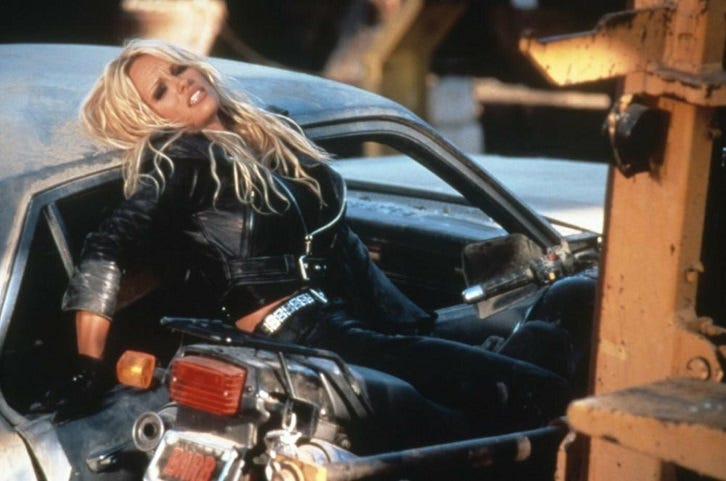
I suspected that it was too easy for David Hogan to come on board: “I would never have accepted if Brad Wyman had not been a long-time friend. Ironically, I had already been contacted for Barb Wire, even before Adam Rifkin was hired. I met with the producers and explained my vision to them. They didn't like it at all. Since I didn't like the script, I didn't insist. It was only later, when things went wrong, that I was asked to make the film according to my sensibilities. On my own initiative, I wouldn't have rushed into it. Out of a list of ten projects, I would have chosen Barb Wire only as a last resort.”
Despite not having directed a film, David Hogan had the credibility of being a second unit director of a recent comic book movie: “Regarding Batman Forever, I mainly worked on the car chase scene, when, in particular, the Batmobile drives vertically against a wall. Very generous, Joel Schumacher allowed me to take charge of the sequence almost entirely. Frankly, the aesthetic aspect of Barb Wire was dictated to me by my experience on Batman Forever.”
David can’t help but compare: “Adam Rifkin wanted to give Barb Wire a monochrome tone. On the contrary, I was looking for strong colors, sparkling, colorful images. A very comic strip aspect that came to me quite naturally, because of my collaboration on Batman Forever. I must also admit that The Crow and Nikita influenced me aesthetically speaking. The most complex thing in adapting a comic strip to the screen is capturing its tones, its images. Should I commit to something totally disconnected from reality like Warren Beatty's Dick Tracy? Should I focus on more realism like The Crow? A wide range of choices. Even if we don't do Shakespeare, it's still about remaining credible.”
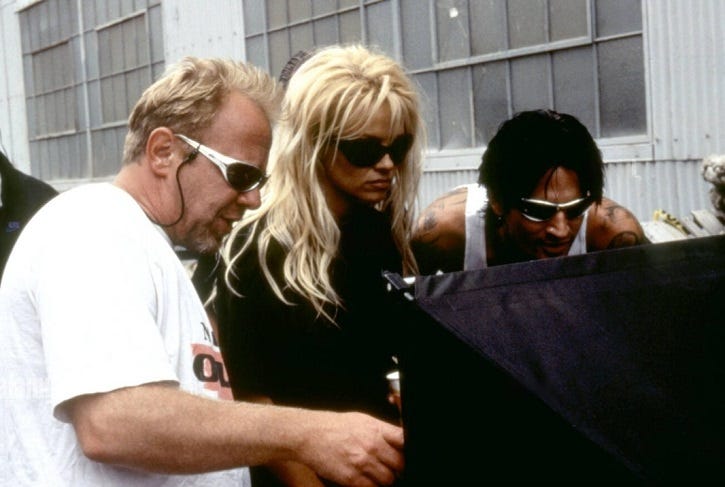
David addresses the fact that the film is a remake of Casablanca (1942): “I didn't notice it immediately. When it was pointed out to me, it was already too late to change anything. I don't like this script. Given the deadlines, the rush, it was impossible to rewrite a single line. I had no choice but to put it very scrupulously into images, without being able to change anything. Something horribly frustrating, believe me. I would have loved to turn everything upside down on Barb Wire. The story, the costumes, the opening sequence, a few actors... I would have preferred the film to be more comic strip-like, less violent, funnier, even more action-oriented.”
David should probably have listened to his gut because he was desperate to wash his hands like a person who has been asked to clean up a crime scene: “Shooting this film was anything but fun and glamorous. A nightmare that almost drove me crazy. The shooting was trying. The editing got away from me and the release was a real disaster. It's simple, no one in the United States came to Barb Wire. Maybe it was due to the time, a week before the highly anticipated Twister.”
Someone sures like to play the blame game but pointing the finger results in a cursive finger being shown to you: “First of all, we only had a budget of 14 million dollars. Not 20 like the people in Polygram's public relations say. We had to stretch every dollar, meticulously storyboard every action scene, including the tiniest inserts. I filmed these sequences over a whole month, shooting them one after the other without any respite. On Batman Forever - yes, I had a blast. Everything was perfectly organized, the actors arrived on time, knew their lines... Nothing like Barb Wire. A lot of the problems stemmed directly from Pamela Anderson, despite herself however. She was still suffering from her miscarriage, her relationship with her husband was not at its best, she was working on Baywatch at the same time. We had to make arrangements around her schedule, her hospitalization. We spread out our 35 days of shooting from June to the end of December 1995. Pamela was not available and the other actors had other commitments to honor, we were really in an incredible mess. Temuera Morrison went to The Island of Dr. Moreau in Australia, Udo Kier to Prague for Pinocchio... What a mess! Terribly frustrating to work in these conditions. With Barb Wire, I learned what not to do on film. My best memory: the last day of shooting.”
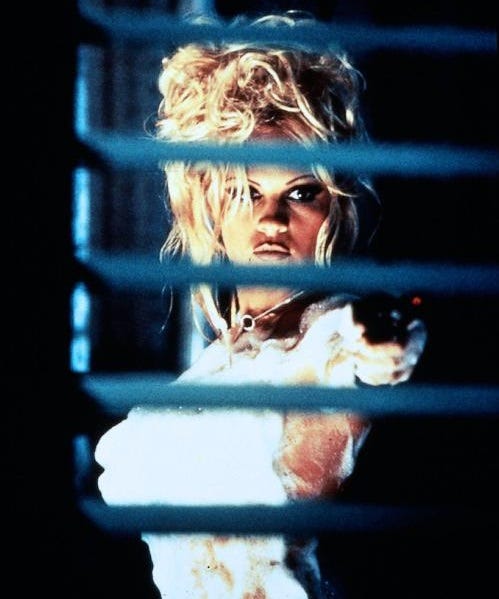
The big boss of Dark House, Mike Richardson, said: “When you look at the covers of Chris Warner's comic book, the resemblance between Barb and Pamela Anderson is obvious. Pamela had the look, the demeanor, the physique and the ability to bring her to life. One of the problems with trying to transpose a comic book hero to the screen comes from the latitudes that the artists have. They can exaggerate the poses of the characters to infinity, which is not the case for a filmmaker with his actors. But Pamela manages this feat of strength.”
The star said: “For the needs of Barb Wire, I learned to ride a big motorcycle. I crashed several times, but, over the falls, I learned to fall without hurting myself. I also took kickboxing lessons. Easy, since Baywatch had already led me to Karate lessons. I also learned to use automatic firearms. But that wasn't the hardest part, by any means. I performed my own stunts strapped into a corset that made my waist 17 inches. I ran on stiletto heels and my wardrobe was pretty skimpy. I was constantly afraid that something in my gear would fall off during a busy sequence.”
Producer Mike Richardson defended her: “I know all the speculation about what happened on set. Totally wrong. In fact, Pamela Anderson fell ill following complications from a previous miscarriage. Despite her health problems, she continued to work.”
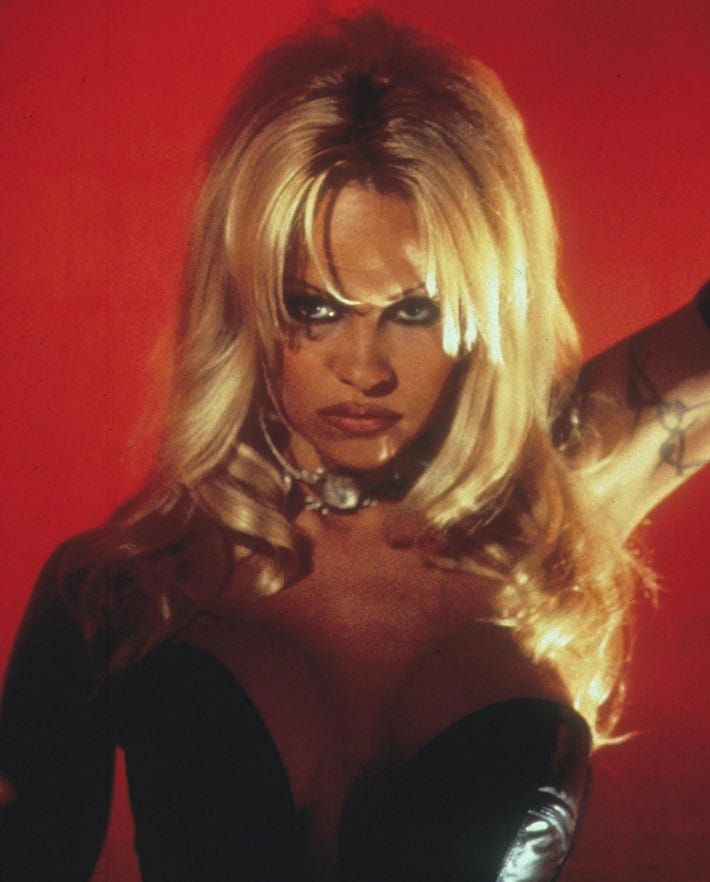
Chuck Pfarrer was given credit by the French for remaking the Humphrey Bogart classic, but not Ilene Chaiken…who is only given basic credit for the end of the article in the form of a basic cast/crew listing - much like the many online film critics who seem to forget that IMDB exists. Seriously, it makes it difficult for film historians to find info when film reviews take up so many of the search results. It’s amazing that Barb Wire was bankrolled when you look at how Tank Girl bombed in early April of 1995. Barb Wire began filming in late April.