
Giallo Fever

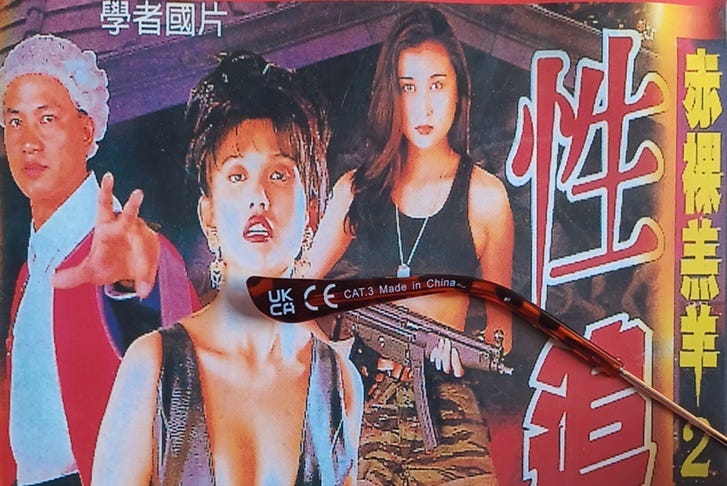
Category III is the Hong Kong equivalent to NC-17. The above film is R*ped by an Angel (1993) a.k.a. Naked Killer 2 in Britain where it was rated 18. The BBFC (British Board of Film Classification) removed eleven minutes, including mutilation by chainsaw. One of the first films to be rated Category III wasn’t even that offensive. Starring Chow Yun-Fat, Triads: The Inside Story (1989) lacks the extreme violence and sexuality that became synonymous with the rating. In some cases, all it takes for a film to be rated Category III is to feature Triad rituals, but this film shows the protagonist discouraging the recruitment of minors. He is even shown to be complying with the police, and helping the wounded seek medical treatment. The director, Taylor Wong, later directed a film that was more worthy of the Cat III rating. The Chinese title of Sentenced to Hang (1989) is more symbolic: The Strange Case of the Three Wolves. The film was a modest hit that enabled Taylor Wong to make Girls Unbutton (1994).
Taylor sometimes directed for Wong Jing. Another such colleague is Billy Chung, whose Love to Kill (1993) makes Sleeping with the Enemy (1991) look like a PG film. One of Wong Jing’s favourite actors starred in a Ringo Lam action film that miraculously avoided being given a Cat III rating. It’s symbolic that Full Contact was released in 1992 like Split Second because Chow Yun-Fat and Rutger Hauer had their hair cut in a way that was meant to distant themselves from how they looked in the eighties. 1992 was when audiences got to see Chow in Hard-Boiled. In theory, director John Woo should have been given carte blanche to make the bloodiest action film possible. After all, he wasn’t unencumbered about the running time exceeding two hours. However, the film was rated II-B. By comparison, Godfrey Ho’s Lethal Panther (1991) was rated III but doesn’t quite reach the dizzying heights of Woo’s last masterpiece.
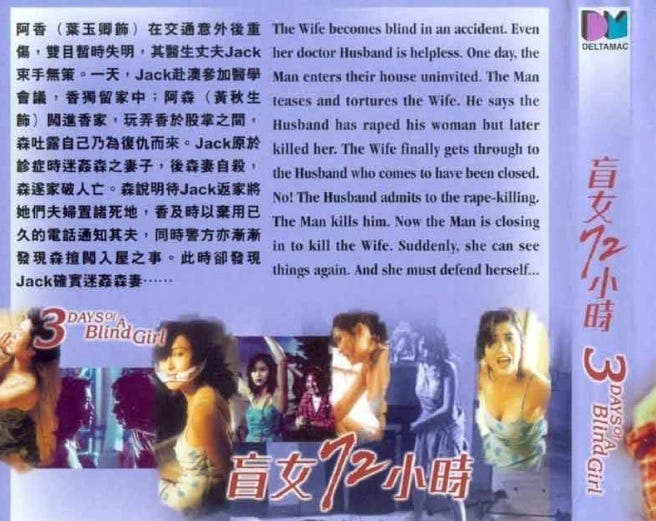
Running time is an interesting issue that is never taken into consideration when people criticize films for having plot holes. Editing can be responsible whether it be due to censorship or screening schedules. Passion Unbounded (1995) was ruined when Jackie Chan decided to have Carrie Ng’s role in Thunderbolt (1995) left on the cutting room floor. The screenwriter of Passion Unbounded, Joey Cheung Jo-Ngai, proved to be a talented writer when you see her other 1995 release - Passion 1995. This was rated II but was a Naked Killer reunion with Clarence Fok directing Simon Yam three years later. Chan Wing-Chiu’s 3 Days of a Blind Girl (a.k.a. 72 Hours of a Blind Woman) was a 1993 release that could easily have been III-rated going by the synopsis, but it was only rated II, and its duration is less than 90 minutes. It’s shocking when you consider that Wong Jing’s The Last Blood (a.k.a. 12 Hours to Die) is rated II-B for being a violent action movie. What the above synopsis doesn’t tell you is that the female protagonist, played by Veronica Yip, is served a meal containing the contents of her dead dog.
Veronica experienced an unlikely change of fortunes. She went from being in sleazy films to respectful films at the same time that Loletta Lee experienced a vice-versa trajectory. It’s a testament to this Freaky Friday turn of events that both actresses retired in 1996, although Loletta came back as Rachel Lee for a venerable director i.e. Ann Hui’s Ordinary Heroes (1999). This makes it ironic that Veronica only returned for I Love Hong Kong 2013 (a follow-up to the first sequel titled I Love Hong Kong 2012). Simon Yam escaped relatively unscathed from Category III films to the extent that he got to land roles in films starring Angelina Jolie (2003’s Lara Croft: Tomb Raider – The Cradle of Life), Keanu Reeves (2013’s Man of Tai Chi) and Orlando Bloom (2017’s The Shanghai Job). In a 1994 documentary called Cinema of Vengeance, Simon Yam admitted that he was forced to appear in certain films due to “friends” (a polite way of referring to the Triads). I should note that Simon was not subtitled since he can speak English, as seen in Tongs - A Chinatown Story (1986).
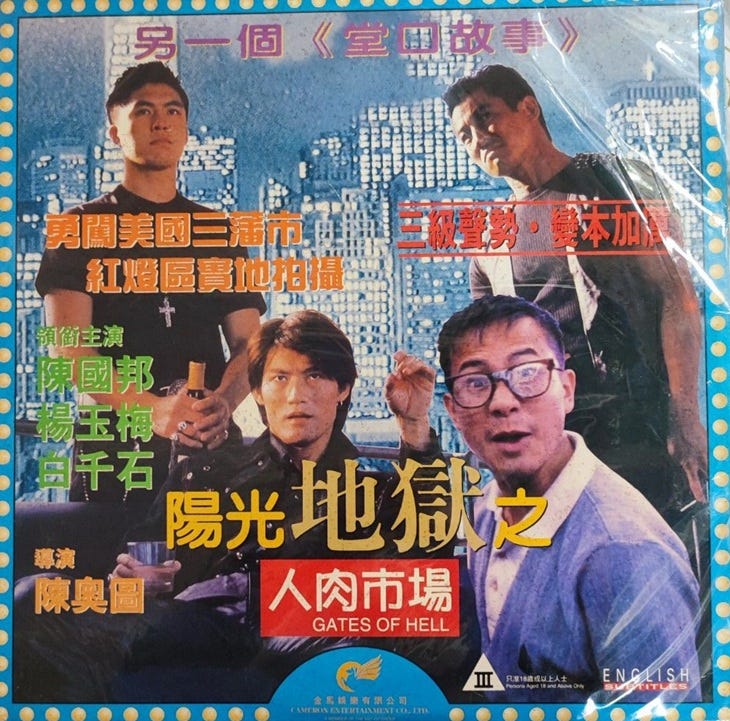
It would have been quite something to see Simon star in Gates of Hell (1995). Unlike the 1986 film by Phillip Chan, it doesn’t take place in New York. It takes place in San Francisco. Considering that it’s more of an erotica than a horror film, a better title would have been Pearly Gates of Hell. The heart of the premise concerns a couple who are caught up in a rivalry between the Italian mob and the Chinese mafia that involves wanting to seize the p*rn video market. Since p*rnography is the hook of this film, the story should have taken place in the San Fernando Valley. There is an old Chinese proverb about how beauty attracts trouble. Jealousy attracts trouble as well, and I can imagine that this figured highly in the mind of Dick Wei during the making of Horrible High Heels (1996). Billy Chow’s character doesn’t last very long since Billy stole Dick’s thunder in the second half of the ‘80s when it came to working with Sammo Hung and Jackie Chan. The film is also called Bloody Shoe. You won’t look at Red Shoe Diaries in the same way again.
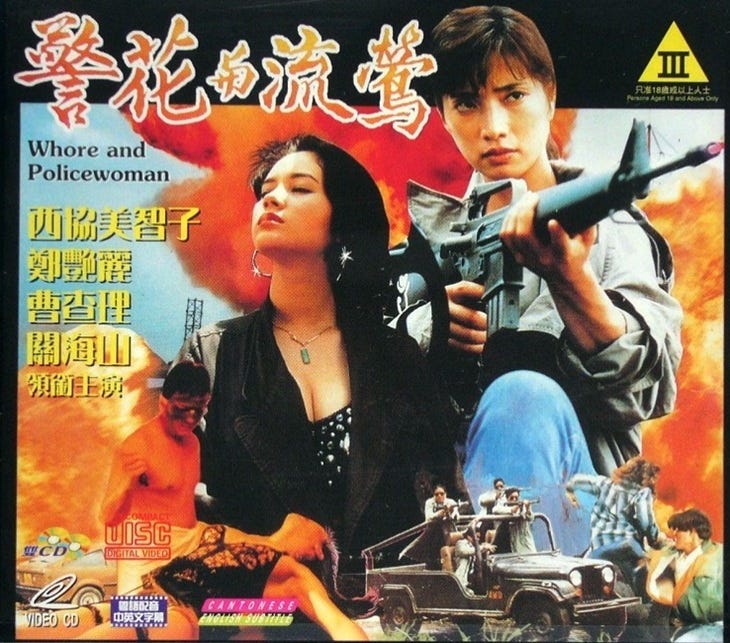
The issue of colour is important. If a Cat III film is mostly violent, the logo should be red. If it is mostly sexual, it should be pink. If it’s equally violent and sexual, it should be blue. One thing that could never achieve equality is casting Veronica Yip and the unrelated Amy Yip in the same movie. The issue of who gets top billing (and thus who gets called the sexiest) would have resulted in a damp squib instead of a ceasefire. Reading Cynthia Rothrock’s 2026 memoir about her Hong Kong film career confirmed my suspicion that she won’t talk about City Cops (1989). It’s not a Cat III film but it features a martial arts actress who later appeared in many of those productions i.e. Michiko Nishiwaki in Widow Warriors (1990), Witchcraft Vs Curse (1991), Big Circle Blues (1992), Hero Dream (1992), Passionate Killing in the Dream (1992), Fatal Seduction (1993) and Whore & Policewoman (1993). Back to City Cops, Cynthia Rothrock and Michiko Nishiwaki were heavily doubled in their final fight by Jack Wong Wai-Leung and Xiong Xin-Xin respectively. Those seeking a martial arts p*rno would be wisely advised to watch Royal Sperm (1999).
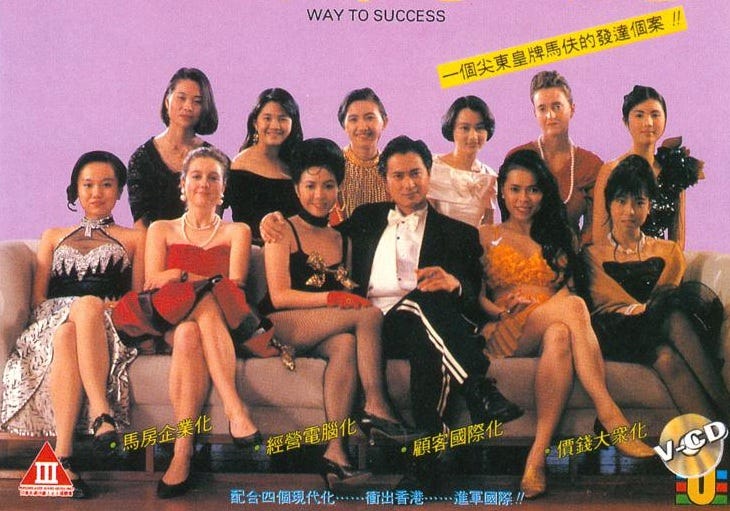
Hong Kong cinema is not known for its mockumentaries but Key to Fortune (1992) is an outlier. It’s about the sex industry. It’s out-of-left-field for composer James Wong to be the host. It should have been someone like Wong Jing, Charlie Cho or even Eric Tsang. The mock doc eventually veers into darker territory, quite literally when a black man is refused by a sex worker because she doesn’t have enough vaseline until her madam delivers a toothpaste brand called Darlie (this was previously known in English as Darkie but still known in Chinese as Black Person’s Toothpaste). Otto Chan, the director, should have expanded the narrative scope by turning the film into a found footage horror film about a perverted stalker whose death by Triads is used as a cautionary tale for the watershed audience. The closest thing to this is The Peeping Tom (1997). Nonetheless, Otto Chan later produced a straight-up comedy about prostitution called Way to Success (1993). The poster is one of the few times where white women were used as sex magnets for a Hong Kong film.
This leads to the issue of a French film-maker who got involved with the H.K. film industry. Pierre Reinhard directed two III-rated films: Paris, Mon Coeur (1992) and Face D’Ange (1994). Pierre was the cinematographer of a III-rated film called 7 Days in Paris (1993). John Liu was a martial arts actor who lived in France for several years, and he ended up being arrested in Barcelona for sex trafficking minors circa 1991. This was the same year when Tony Leung Ka-Fai co-starred in an erotic French drama called The Lover (released in 1992). Since the love interest is a minor, the film had to be rated III. Even Chu Ga-Wang’s My Wife’s Lover (1992) is imbued with French characteristics. Naked Killer (1992), produced and written by Wong Jing, feels French with the use of the accordion and high-tier fashion. Back to Pierre Reinhard, his emergence into the world of Hong Kong films was foreshadowed by Pierre Rissient making a French film there in 1975. Titled Alibis, It featured a supporting role from Betty Ting Pei. She was Bruce Lee’s mistress, which might explain why the film was known as One Night Stand after it premiered in 1976.
With more sex and kink, the film might have proven to be more marketable and memorable. So many Category III films were based on true crimes that it’s a wonder that nobody in Hong Kong thought about making a biopic depicting martial arts actor Michael Chan Wai-Man. While nobody wanted to kick the hornet’s nest about his involvement in Bruce Lee’s life, there’s no reason why John Liu couldn’t be regarded as fair game unless there was a concern about which bugs would be exposed when turning over rocks. In 1993, there were two films based on the same story i.e. Legal Innocence and Remains of a Woman were about a flight attendant whose body had been dissolved with hydrochloric acid in May 1989. Dr. Lamb (1992), about a taxi driver, was unflinching in its ripped-from-the-headlines depravity. Suburb Murder (1992) was less gory but no less uncompromising with its portrayal of men r*ping a white woman. Like how Taxi Hunter (1993) was less profitable than Dr. Lamb, it was awkward when The R*pist (1994) was less profitable than the similarly themed Red to Kill (1994). Even though Hong Kong cinema had female prison films, they never depicted lesbian gang-r*pe or even tribbing for that matter.
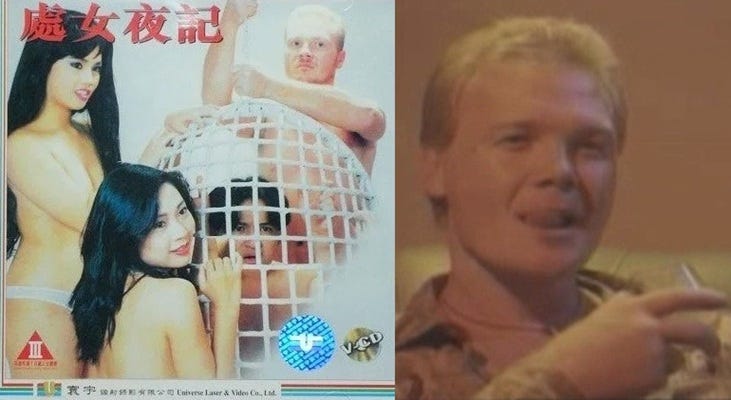
Considering how many Hong Kong films that were made in the Philippines and Thailand, it’s a surprise that no-one made a horror film like Cannibal Holocaust (1980). For some reason, jungles should be all about action instead of torture like in Erotic Journey (1993). In Hong Kong, yellow fever could equally refer to being obsessed with blonde hair. In Escape from Brothel (1992), a pre-Buffy Sophia Crawford fought Billy Chow in the buff (with bush). Her friend, Yukari Oshima, had been roped in to appear in Devil’s Love (1992), Devil Girl 18 (1993) and 1/3 Lover (1993). Even Mark Houghton, a blond Brit, got to have sex scenes in My Virgin (1993). Perhaps someone should have made a film about a woman who goes undercover as an adult actress in order to be a bodyguard for a woman whose father paid a private investigator to keep an eye on her. In the golden age of Hong Kong cinema, it wasn’t unfathomable to cast a non-trained actor just because you liked the look of them. In the case of Sophia Crawford, it’s not like she was a member of Equity. When a former Kung Fu star, Lo Meng, had a sex scene in Ebola Syndrome (1996), it was less to do with working up the nerve than wanting to prove his mettle versus Sifu Houghton.
Jackie Chan’s Crime Story (1993) would have been the highest-grossing Category III film had it not been for Stephen Chow’s Flirting Scholar (1993). Jackie’s film was based on a 1990 crime that was also depicted on screen via a screenplay co-written by Wong Jing i.e. Go Sin-Ming’s Kidnap of Wong Chak Fai (1993). I think that the latter, starring Kent Cheng, would have made for a far more provocative experience had it been revealed that the millionaire staged his kidnapping so that he wouldn’t have to lose his money to taxing. Why not? Jackie’s movie had a Hollywood ending where the millionaire was saved, but that didn’t happen in real life. In movies and in real life, people talk about owning Swiss bank accounts, and preserving their embarrassment of riches on the Cayman Islands. If you think that Hollywood stars are tax cheats, Hong Kong stars couldn’t afford to do that since they never earned residuals due to the lack of a union. It’s no wonder that a Hong Kong actress would marry a millionaire outside the profession.
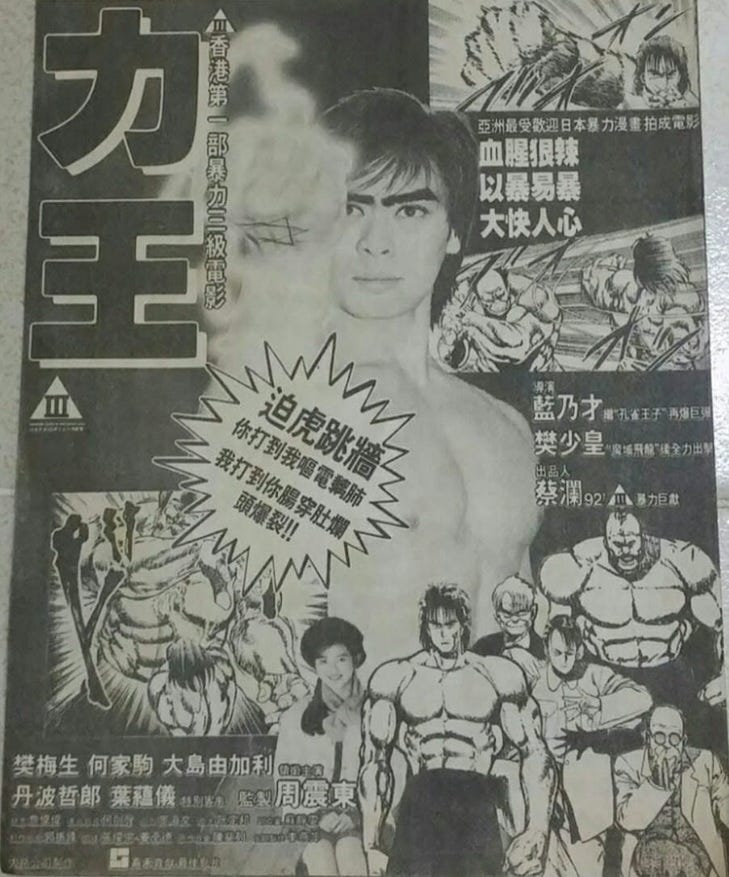
While so many actors have tapped the asses of actresses, the subject of sexual body horror had remained untapped in Category III cinema. Elvis Tsui’s bald head turning into a glans is the tip of the potential. If Tom Savini could be hired on Till Death Do We Scare (1982), there’s no reason why Rob Bottin couldn’t do an erotic version of The Thing (1982) in a way that resembled an anime like Wicked City (1987) or Legend of the Overfiend (1989). While he had a rule about making films with no swearing or sex, Jackie Chan swore many times off camera as well as indulging in many sexual escapades. City Hunter, his 1992 collaboration with Wong Jing, could have benefited from being a Category III film since it was based on a manga about a sex maniac. Then again, Story of Ricky might have changed their minds after it was released to little fanfare two months before City Hunter began filming. Both men have been accused of using the casting couch, so perhaps The Legend of an Erotic Movie Star (1993) is as close to an exposé as we’re ever going to get.
The yardstick for derelicts is a professional snuff movie. Death row convicts should be cannon fodder for action movies. Jackie Chan’s The Protector (as directed by James Glickenhaus in 1984) contained coarse language and nudity. Sammo Hung produced a film, Into the Fire (1989), which was rated Category III because of the foul language. A martial arts slasher was unmined potential in the world of Hong Kong. Dreadnaught (1981) and The Super Gang (1984) had only scratched the surface. The star of the latter, Bruce Le, premeditated this with his cameo in a giallo titled Pieces (1982). Literally playing with fire when facing an arsonist would have made for a fine premise in the world of a martial arts movie. In the world of Category III, villains sometimes succeed in burning children to a crisp like in Run and Kill (1993) and The Underground Banker (1994). Jackie Chan almost made a movie about a fireman, but it wouldn’t have topped what Hollywood pyrotechnic experts did for him during Police Story Part II (1988). Maggie Cheung and Michelle Yeoh resisted dressing up like Bond girls in Police Story III: Super Cop (1992).