
Garçon Manqué

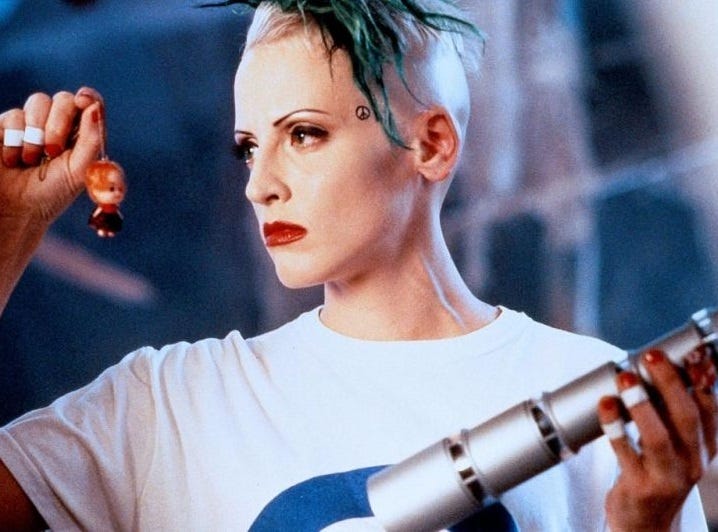
This is French for tomboy. In the July 1995 issue (#96) of a French magazine called Mad Movies, director Rachel Talaley and star Lori Petty talked about their comic book adaptation: Tank Girl. It came out in the same year as another MGM production: Showgirls. The Paul Verhoeven film was less of a flop. As for Tank Girl, Rachel said: “Four years ago, while I was filming Freddy's Dead: The Final Nightmare, my daughter-in-law gave me the comic book. A nice Christmas present because, as soon as I began reading it, I thought it would be a hell of a thing to film. I spent a year trying to acquire the rights, another two years writing the script and finding financing. The comic is incredibly British in tone, very hard. The reason I managed to sell the project to Metro Goldlwyn Mayer/United Artists was thanks to a young, hip executive at the studio. She liked the idea so much that she helped me climb the ladder to the decision-makers, a bunch of old guys in their 60s. They said: "My God, what is this thing?" I had to be cunning, selling the film as "a cross between Nikita and Mad Max" to convince them. The marriage of Roadrunner, Ren & Stimpy and Wayne's World is a more accurate definition. Until John Calley, the new boss of the company, took over, Tank Girl almost never saw the light of day as a film, especially since companies like Steven Spielberg's Amblin had already turned it down.”
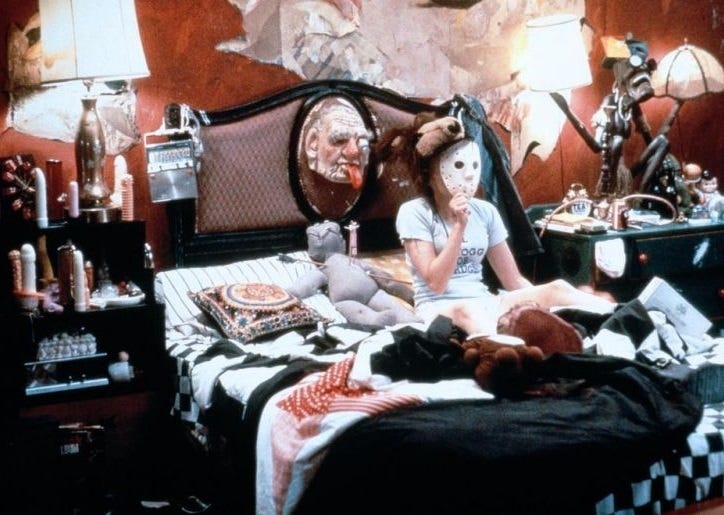
Rachel describes the appeal: “This is a comic strip that hits you in the face, like a punch. It's punk without really being punk, while being more so! If I had oriented myself towards a faithful adaptation of the stories of Alan Martin and Jamie Hewlett, Tank Girl would have suffered from the measures of censorship. I therefore had a gigantic challenge to take up: to preserve the spirit of the character without watering it down, without transgressing the limits of what was acceptable in American cinema. While it was easy to give substance to the heroine, it was much less easy to draw a linear plot from a non-narrative comic strip. With the producers, we discussed at length the violence, the use of drugs. It was necessary to limit the bloody excesses, but, in any case, I had already taken this initiative at the very beginning of the writing. It was the very intimate relations between Tank Girl and Booga, her humanoid kangaroo friend, which posed the most problems for me with my interlocutors at MGM/UA. When they read my first draft, they looked at me dumbfounded: "What? You're completely crazy!" I had to get Booga to be accepted as a character in order to keep him in the plot. But things went wrong much later. I was forced by the studio to cut out a sequence from the edit showing, after lovemaking, Tank Girl and Booga smiling at each other. One guy said to me: "That makes me uncomfortable." "Normal," I said. My answer convinced no one.”
Mare Toullec via Didier Allouch informed Rachel that the pace is so quick as to seem suitable for MTV. Rach said: “To faithfully adapt the comic strip, I absolutely had to restore its visual energy by adopting a fast pace in the editing. But I don't think that Tank Girl is a feature-length music video. Nothing is left to chance; each image has a purpose, a narrative utility. But because the music plays a major role, you immediately have the impression of following an MTV program. I must say that the syncopated rhythm of the film also comes from the cuts and arrangements requested by the production and the distributor.”
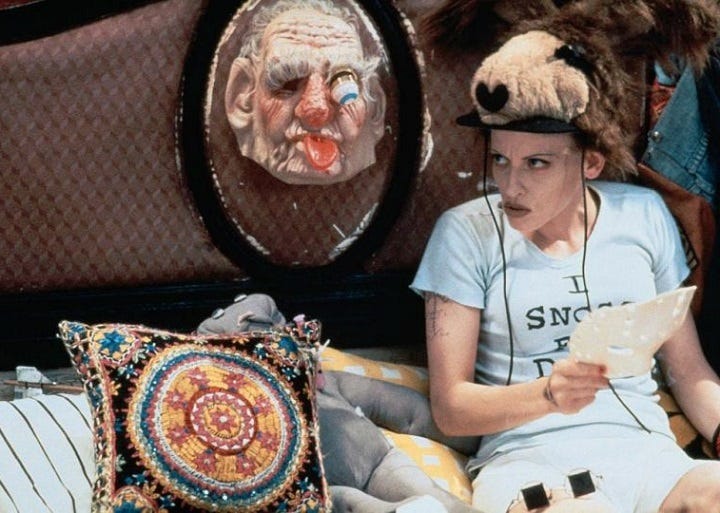
The original lead actress (who was British): “Emily Lloyd almost did the movie, but she didn't fit the character as closely as Lori Petty. She is the spitting image of Rebecca Buck. She is ready for anything, including the most dangerous stunts. She finished the film exhausted, covered in bruises. She is funny, sexy, strong. An ideal combination. No one else could embody so accurately this heroine who is, in fact, a normal woman just a little more cheeky and courageous than the average one. Whether Tank Girl is a feminist film, I do not know. I did not want to introduce a message. But it is true that the spectators adore this character so horrible with the men, who nevertheless continue to love her.”
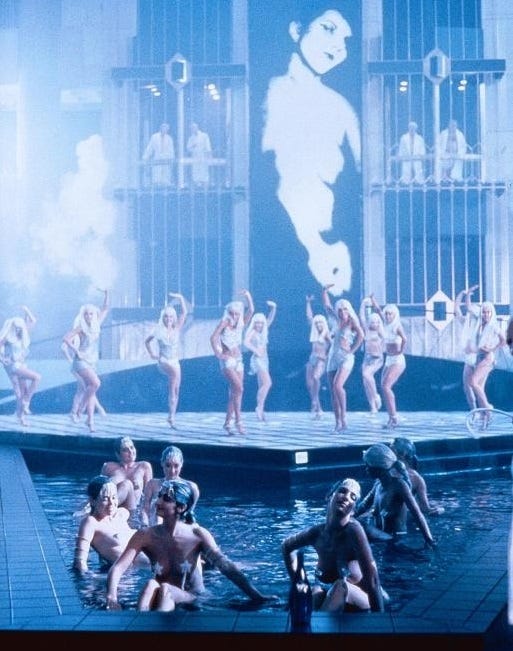
The incorporation of animation: “Jamie Hewlett, the cartoonist, hates emptiness. He fills his panels to the maximum without ever leaving a single blank space. Very often, Jamie places the tank, the jet and the submarine in the same drawing. On screen, this would require crazy special effects and a monstrous budget. It was faced with this impossibility that I had the idea of integrating some of the animations. The studio was not too keen on this option. They pretended that I would never be able to insert the pages. That was all it took to convince me otherwise. In fact, the very essence of Tank Girl is to break all the rules. And the more I acted like her, the more I felt good, in agreement with the film. You think it's getting serious and, bam, you're faced with an old-school musical comedy sequence. A few dance steps after the action! In Tank Girl, we make fun of everything. Including the darkest future of humanity!”
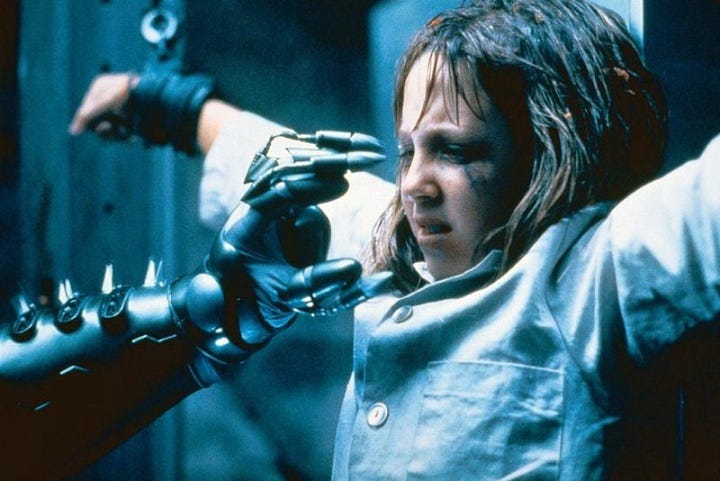
The corporate suits: “The studio people were not unaware that I would deliver an unusual film. They were half-worried, half-enthusiastic. Logical that they were between fear and veneration. To achieve such a production, so atypical in the Hollywood system, is almost an exploit. I had to fight for every minute of footage, fight against preconceived ideas, shyness. Everything was so complicated on this film. From the search for financing to the shooting in the New Mexico desert where the temperature easily rose to 40º in the shade. Despite the predictable difficulties, the originality of the subject and finding technicians was easy. As soon as a film breaks away from the Hollywood routine, everyone wants to be part of it. Even Stan Winston! I was a little reluctant to send him the script. A two-time Oscar-winning special effects specialist could not decently pay attention to the creation of creatures as crazy as kangaroo men. Well no, he fell in love with her! Every humanoid kangaroo involved having three operators around him. So, when they were all in the shot, it was necessary to camouflage twenty-four people who no longer knew very well which tails or ears they were animating! Epic.”
Less tank but more girl: “I agree with you. There are some good sequences missing with the vehicle for several reasons. First, the story itself hardly justified it. Second, the budget prevented us from doing it. On set, it was yet another pair of sleeves; the tank broke down half the time, got stuck in the sand all the time. We were in a bad mood, covered in dust. Even though the tank doesn't get the space it deserves in the film, the comic book fans didn't hold it against me. I expected its most hardcore readers to hate the film because it didn't go as far in anarchy, sex, and violence. In fact, the reaction from the fan club on the internet was excellent! I didn't expect that.”
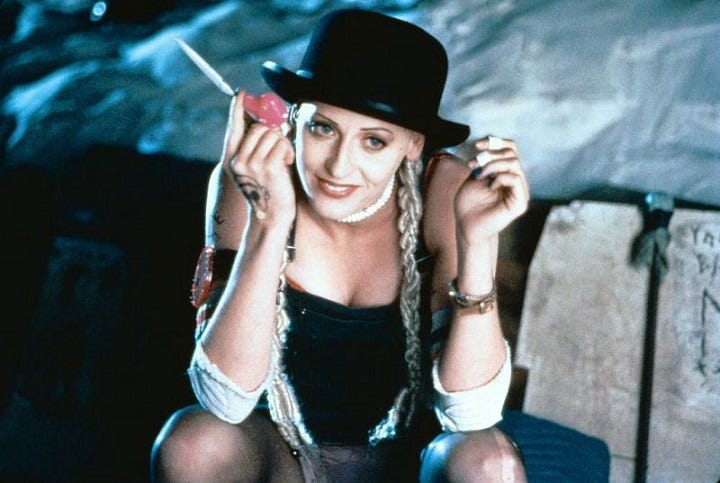
It’s Lori Petty’s time to shine. She compares: “The character in the comic strip is much more vulgar, comical, outrageous. She walks around naked, cutting off her boyfriend's arms and legs... So many things that are impossible to show on screen. Rachel Talalay already had a hard time convincing producers to invest a few million dollars in the project. You can't transpose strips to a three-dimensional universe without imposing choices, changes to the original work. It's not necessarily a question of censorship, but of point of view. Like me, Rachel Talalay, was more oriented towards pure comedy, delirium. In my opinion, Tank Girl is a raging madwoman, a daring one who stinks, drinks, and makes love. She represents the complete opposite of the playmate, the antithesis of glamour. The absolute anti-fantasy or the absolute fantasy, depending on your tastes. I particularly appreciated her fierce independence, her way of being, of thinking, like preferring death to the slightest compromise. This is particularly visible when Keslee brandishes a gun at her under her nose. She responds to his threats with: I won the game, because he has little other resource than to eliminate her, which means abdicating!”
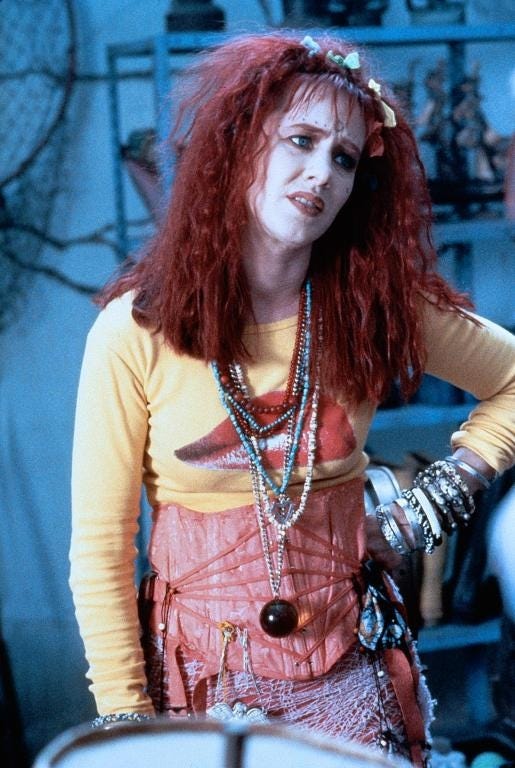
First impression: “When I first read the script, I thought, "Oh my God, that Tank Girl is me!" Okay, obviously, I don't really have the same devastating sense of humor, but I recognized myself in some of her lines, in her outgoing behavior, her boundless energy. The more I played her, the more I resembled her. Over time, of the shoot, I was really becoming Rebecca Buck. You can't just go out and get into a character like that, with the snap of a finger, in an instant. Once you're in it for a few weeks, wearing her clothes and makeup, you end up falling under her influence. I'm not crazy or schizophrenic, but I have to admit that Tank Girl has encroached on my behavior quite a bit. That said, I'm different in my everyday life, even though fantasy is very important to me.”
Her previous roles did not result in the preconception of her ability to play Rebecca Buck: “I got the role by convincing the producers that I was the right woman for the job. Through determination. I wanted more than anything in the world to play this girl. Why? Because she offers an incredible range of character traits! Generally, you have to be either sexy, crazy, or dangerous. Or prudish, cruel, vulgar, nice... Tank Girl gave me the opportunity to be all of that at once. I couldn't decently give up the role to another actress. And, in desperation, the producers hired me. They probably couldn't find an actress who would so easily accept being dirty, chewing on such filthy vocabulary. And also filming in such appalling conditions, in a desert where you were really dying of heat. In Tank Girl, anything goes. Comedy and science fiction free you from the constraints, from conventions. It's a film without barriers, without limits. Priceless for an actress. I made it first to please myself, for me, not caring whether it would please the general public or not. I made Tank Girl for those who appreciate the presence of a little crude humor in the middle of a deluge of action and special effects.”
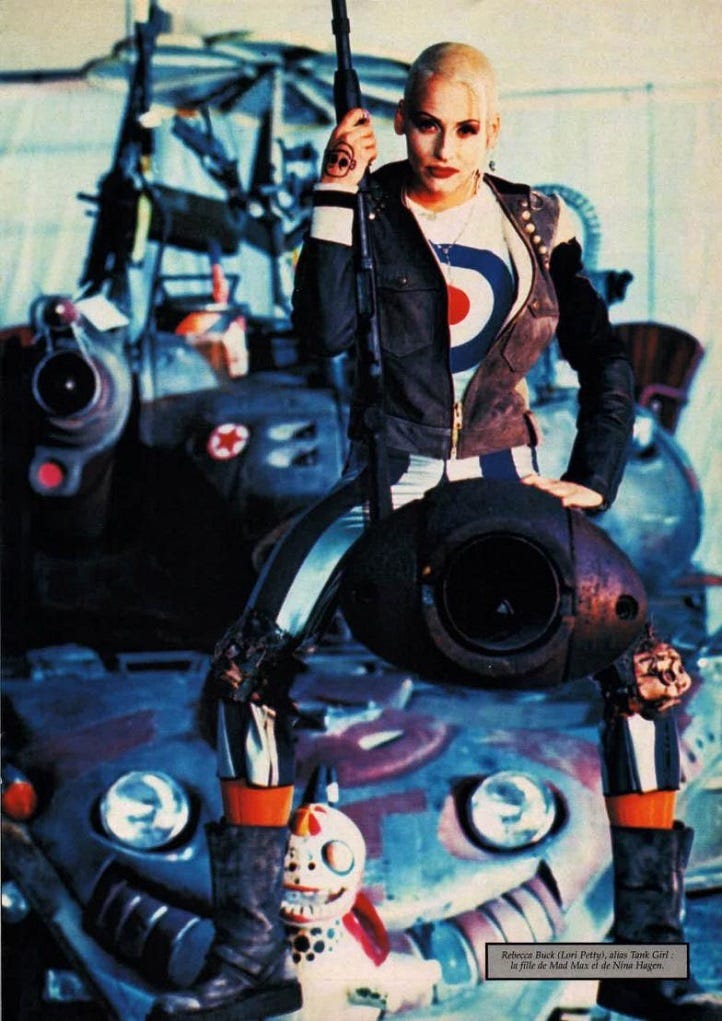
Final thoughts: Prior to the release, Lori Petty was already established as a military figure thanks to In the Army Now (1994). Unfortunately, this was more Stripes (1981) than G.I. Jane (1997). 1995 later marked the release of Sylvester Stallone’s futuristic comic book movie, Judge Dredd. It’s especially significant because Lori was fired from Sly’s Demolition Man (1993).