
Game Plan, Exit Strategy

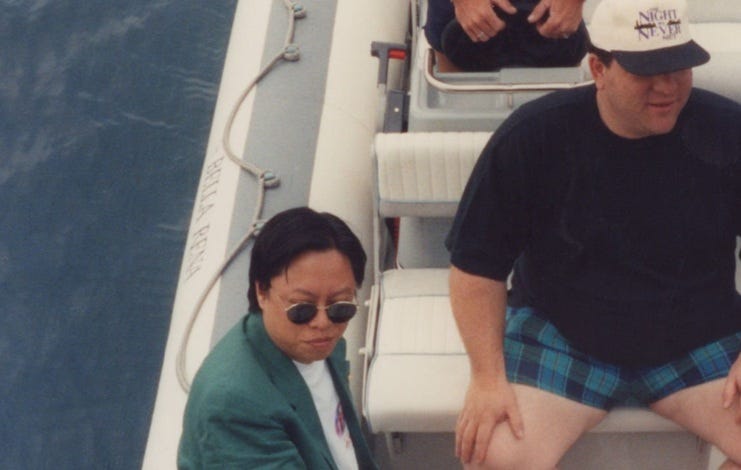
Miramax Books published Hong Kong Babylon by Fredric Dannen and Barry Long. When it was released in 1997, it was notable for not having an index or a bibliography. Instead, credit is given to the people and corporations who provided photos. One of these corporations was Miramax since they were in the business of distributing Hong Kong films. The U.S. cover of the book essentially advertises Miramax’s re-release of Jackie Chan’s Police Story III: Super Cop (a 1992 Stanley Tong film co-starring Michelle Yeoh). The book provides details of retail providers along with a generous serving of recommended reviews from many film critics. This serving is also self-serving as two of the reviewers were Jimmy Ngai (who had written Chinese subtitles for many Hollywood movies) and Law Kar (an actor who was directed by Shu Kei - the Chinese man in the above 1993 photo).
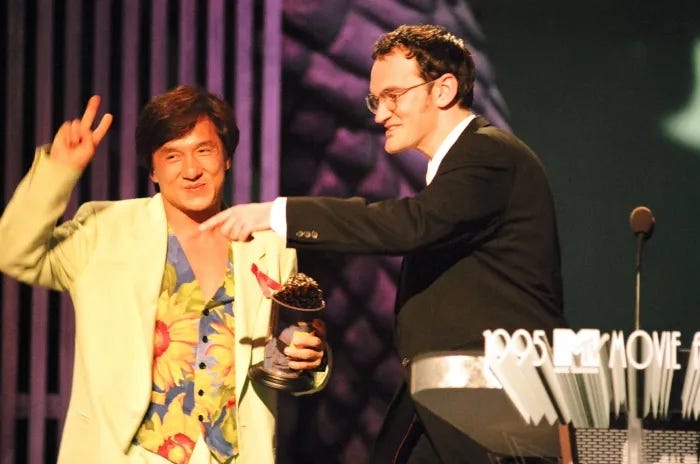
If you can understand the idea of a short film that is proof of concept for a feature film then you can understand a book that is a fleshed-out version of an article. The basis of Hong Kong Babylon was an article with the same title for The New Yorker. Fredric Dannen’s article was published on July 31, 1995. With the help of Miramax, Quentin Tarantino launched a distribution company called Rolling Thunder Pictures. This happened in July 1995. By the time that it was the summer of 1997, RTP stopped re-releasing old films when Miramax stopped short of extending the contract. On June 13, 1997, a magazine called The New Republic had published a Fredric Dannen article called Partners in Crime: Gangs of Hong Kong. This was ten days before the Hong Kong Babylon book was released. It’s easy to write off Fredric Dannen as a corporate shill, but he appeared to have a genuine interest in Chinese culture as evidenced by his November 9, 1992 article for The New Yorker: Revenge of the Green Dragons.
This 1992 article much later served as the foundation for a 2014 American film of the same title that was directed by Hong Kong film-makers, Andrew Lau Wah-Keung and Andrew Loo Wang-Hin. One of the executive producers was Martin Scorsese, who remade Lau’s Infernal Affairs (2002) as The Departed (2006). It’s fitting that Infernal Affairs was co-directed by Alan Mak Siu-Fai, because he was disregarded when Andrew Lau was singled out to direct a Richard Gere film called The Flock (made in 2005 and co-produced by Andrew Loo). The Chinese man in the cover, Shu Kei, was not just a director, writer and producer; he was a publicist, translator and distributor, which would suggest that he had a big part to play in Harvey Weinstein’s dealings with the Chinese film industry (whether it be Hong Kong, Mainland China or even Taiwan).
In the acknowledgements section of Hong Kong Babylon, two of the people thanked need to be singled out. First if not foremost is Scott Greenstein, a Miramax attorney who previously served at Viacom’s Legal Department. His nickname was the third Weinstein brother. On July 3 in 1997, a week after the publication of Hong Kong Babylon, Scott left Miramax. The second significant person acknowledged in the book was Gerald Posner, the author of Warlords of Crime: Chinese Secret Societies (1988). With his 1997 book, Fredric Dannen was more “at liberty to say” about the Heung brothers i.e. Jimmy and Charles were definitely gangsters as well as producers. In April 2024, Gerald told me that the lawyers at McGraw Hill had limited what he could write in the eighties about the Heungs.
Although Fredric Dannen’s statement of intent was to provide a broad overview of modern Hong Kong cinema, there is not a section on Stephen Chow - a comedy actor who had broken the local box office record on a few occasions. Also, Stephen was one of the main collaborators of a film-maker who was interviewed for the book - Wong Jing. Ironically, Miramax later released Stephen’s Shaolin Soccer (2001). Furthermore, it’s strange that actor Tony Leung Chiu-Wai was not interviewed despite the other Tony Leung (Kar-Fai) being interviewed. Chiu-Wai was in Wong Kar-Wai’s Chungking Express (1994), which was released in U.S. cinemas through Quentin Tarantino’s Rolling Thunder Pictures in March 1996. It’s only in the fourth chapter, Recommend Viewing, that Fredric Dannen had explained his personal involvement in writing the book. But he betrays himself by proclaiming to be a journalist instead of a film critic.
I’m not alone in thinking that the plot summaries of Hong Kong Babylon could have been jettisoned in favour of the deleted interview material that Fredric referred to in the introduction for chapter two. A true fan of Hong Kong cinema would have at least come out with an improved second edition. If one could make the case that a plot summary is akin to a blurb on the back of a VHS release, hence Miramax’s agenda, the reviews could have been removed since readers should not be spoiled. Wong Jing had got special treatment over Jeff Lau and Johnnie To because he had directed Jet Li and Jackie Chan. Gordon Chan had directed both men (for Fist of Legend and Thunderbolt respectively), but he had not directed Chow Yun-Fat. In 1996, the latter was already contracted to star in a Hollywood film, The Replacement Killers, co-starring Mira Sorvino - Quentin Tarantino’s girlfriend at the time.
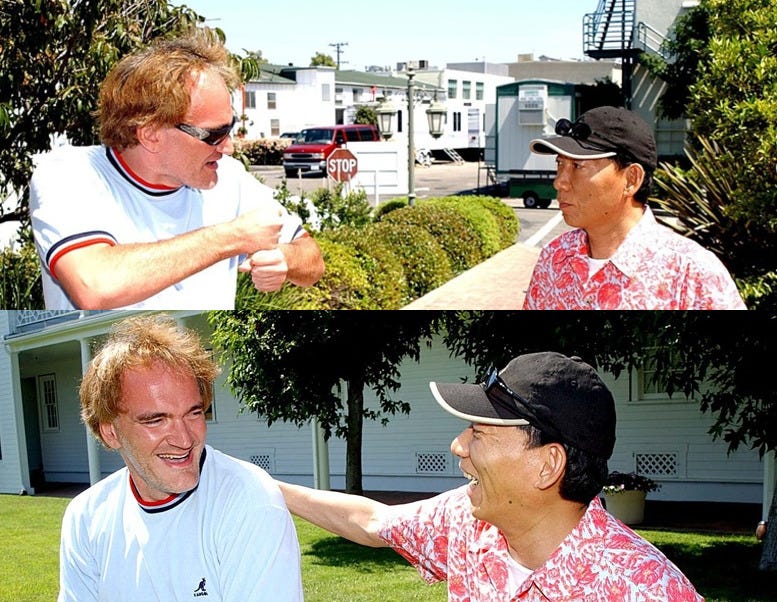
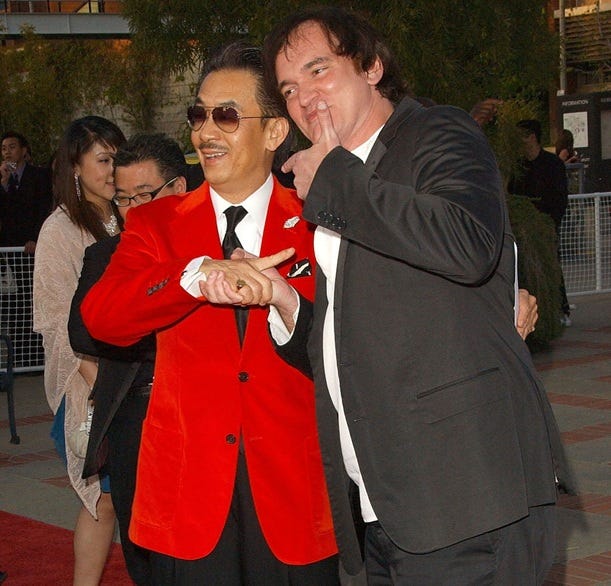
When production was underway in 1997, Chris Tucker went from acting in Quentin’s Jackie Brown to starring alongside Jackie Chan in Rush Hour (1998). In July 1997, a subsidiary of Miramax called Dimension Films re-released Jackie’s Operation Condor (1991) in U.S. cinemas. Because Rolling Thunder Pictures collapsed, Quentin couldn’t re-release Jet Li’s Fist of Legend in cinemas. It’s just as well because Yuen Woo-Ping’s choreography on The Matrix (1999) wouldn’t have been seen as revolutionary, and people would have been disappointed upon seeing Jet Li’s American films. The above photos with Yuen Woo-Ping were taken in May 2001. This was the year before Yuen choreographed the fight scenes in Quentin’s Kill Bill. On October 10, 2001, Miramax re-released Yuen’s Iron Monkey (1993) in U.S. cinemas so as to capitalize on his success with Ang Lee’s award-winning Crouching Tiger, Hidden Dragon (2000).
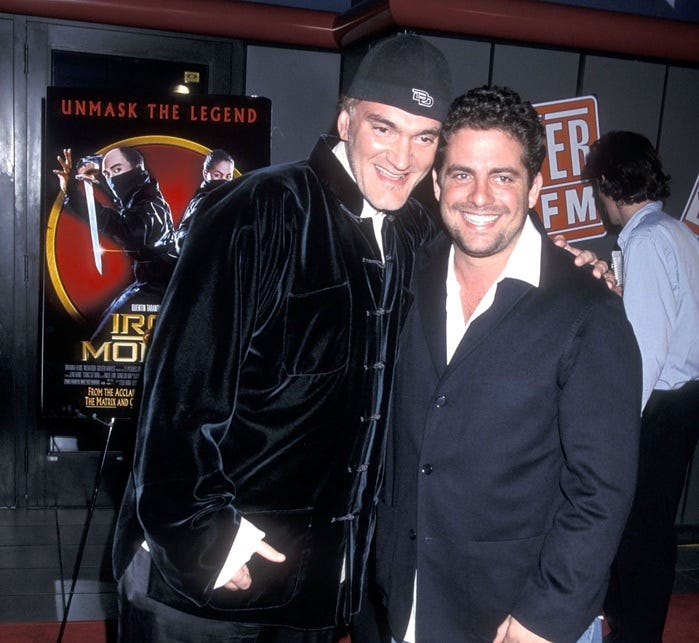
The director of Jackie’s Rush Hour, Brett Ratner, attended the Hollywood premiere of the re-release as did the star of Iron Monkey - Donnie Yen. Other attendees included martial arts actor Wesley Snipes and Billy Zane, who had just worked with fight choreographer Ching Siu-Tung on a pilot called Invincible (which was set to air in November 2001). Two of the executive producers were Mel Gibson and Jet Li. Back to the Iron Monkey premiere, RZA didn’t attend but he did get to attend a special screening in New York on the day before. Previously, he attended a press junket with Donnie Yen and Quentin on October 2. RZA is one of Quentin’s friends, so he later acted in Miramax’s Derailed (2005). This is not to be confused with the 2002 film starring Jean-Claude Van Damme.
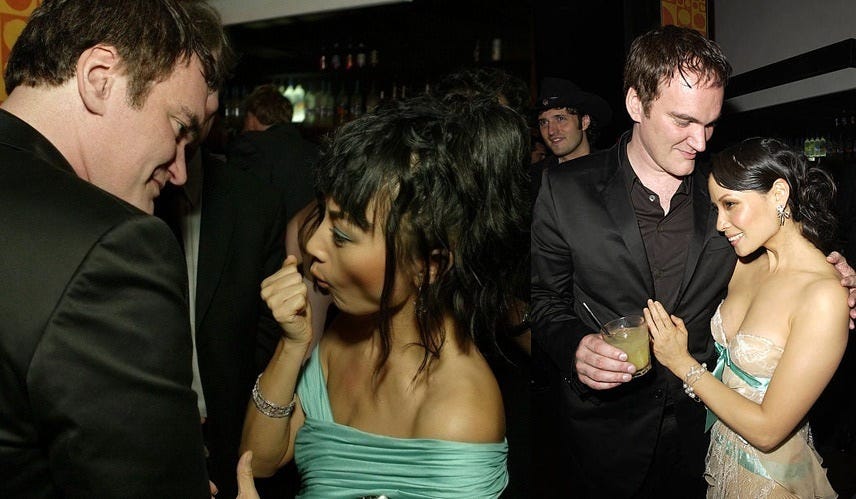
When Quentin attended the premiere of Miramax’s Kill Bill: Vol. 2, he was seen with two Chinese actresses who were born in 1968. On the left below is Bai Ling. She had acted in several Mainland Chinese films before she moved to New York in 1991. On the right is Lucy Liu. She was born and raised in New York before she made her debut appearance in a Hong Kong film - Andrew Lau’s Rhythm of Destiny (1992). RZA later directed her in The Man with the Iron Fists (2012). While Lucy never did any more H.K. films, Bai Ling made her H.K. debut in Three…Extremes (2004). Since then, she has acted sporadically in Chinese films whether it be Taiwanese, Mainland Chinese or H.K.
In October 2008, filming began on Inglourious Basterds. Maggie Cheung played a character who was ultimately removed from the film. I would much rather have preferred her to remain in the film over Mike Myers, whose corny comedy takes you out of the experience. His propensity for cheesy comedy is what ruined So I Married an Axe Murderer (1993). To watch the film is to witness a trial run for what he would later do with Shrek (2001). As for Maggie Cheung in Inglourious Basterds, it looked like she was in the running for some kind of collaboration with Miramax as far back as 2007. That year, Maggie attended a “Cinema Against AIDS” event that involved The Weinstein Company.
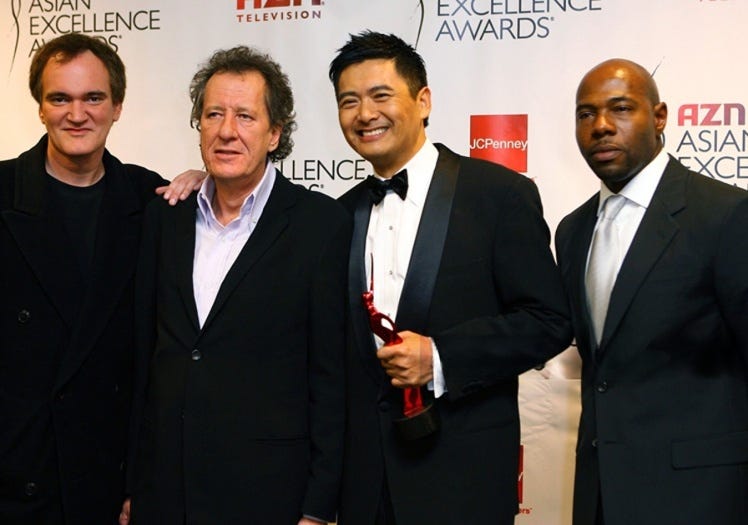
This transpired on May 23. Precisely seven days earlier, Quentin Tarantino attended the 2007 AZN Asian Excellence Awards in Los Angeles. The relevance being that the director of The Replacement Killers, Antoine Fuqua, had reunited with his star: Chow Yun-Fat - someone who had been in three ‘80s films with Maggie Cheung (two of which had involved Wong Jing). It was surprisingly gracious of Chow to allow himself to be photographed in the same vicinity as Quentin, seeing as how Quentin blamed Chow for the box office failure of the film that co-starred his girlfriend at the time i.e. Mira Sorvino (who can speak Mandarin).
Six months before the filming of Inglourious Basterds commenced, Tarantino could be seen with George Cheung (below) at The 2008 JCPenney Asian Excellence Awards in Los Angeles on April 23. Although he was born and raised in Hong Kong, George had only been in three H.K. films. First, there was The Master (a Tsui Hark film that was shot in the U.S. around 1989 and 1990), then there was Fury in Red (a 1991 Phillip Ko film featuring an Asian-American actor named Conan Lee), and finally there was The Adventurers (a 1995 Ringo Lam film that was partially filmed in America).
When Inglourious Basterds was screened at the Cannes Film Festival, it was on May 20, 2009. Michelle Yeoh attended, which was bittersweet considering that she had been in five H.K. films with the actress who was absent from the film. One of the films that Maggie Cheung did with her was Wong Jing’s Holy Weapon (1993). The final H.K. film that both ladies did together was Mabel Cheung’s The Soong Sisters (1997). Quentin Tarantino still showed his support for H.K. films by attending the Cannes screening of Johnnie To’s Vengeance on May 17, but H.K. cinema had lost the commercial momentum that would have come from seeing Maggie in a film that also had the likes of Brad Pitt and Diane Kruger (who attended Cannes in 2007 like Maggie did).
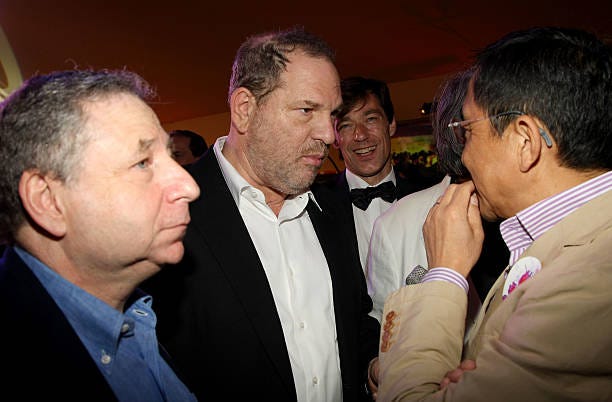
To prove that he was fighting the good fight for H.K. films, Harvey Weinstein attended the “100 Years of Hong Kong Cinema” party that was held at the Carlton Beach on May 16, 2009 in Cannes (as seen below). No matter how many H.K. movies that he released through Miramax, Dimension and Dragon Dynasty (a DVD label), Harvey undid all that hard work by not forcing Quentin to leave Maggie Cheung in (especially when you see all the other stuff that was left in).
When an actor has their role left on the cutting room floor (or erased from a digital databank), it’s akin to being fired from a film. People no longer associate the actor with the movie. Any business deal that was being made on the promise of the actor’s involvement then falls through. It’s because of this that Maggie reluctantly returned to the world of H.K. films with her cameo in Hot Summer Days (a February 2010 release). The last time that she did a cameo in a H.K. film was in 2046, but that was a prestigious film directed by Wong Kar-Wai.
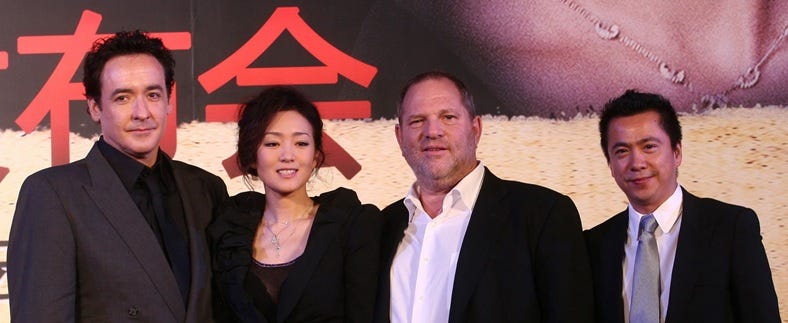
Maybe this explains why Chow Yun-Fat did not attend the Beijing premiere of Shanghai, which was produced by The Weinstein Company. Despite being one of the stars, it would appear that Chow refused to be photographed alongside Harvey despite it being a good photo op when you see who he was deprived of standing next to i.e. John Cusack and Gong Li. Then again, Chow had already been photographed in their company in 2008 on two distinct occasions - an April photocall in London and an August press conference in Bangkok. The film had flopped.
Perhaps Quentin Tarantino had to atone for his sins by performing an unusual act of contrition - teaming up with Tsui Hark to present John Woo with his award: “The Golden Lion For Lifetime Achievement” at the Venice Film Festival on September 3, 2010.