
Folie à Deux

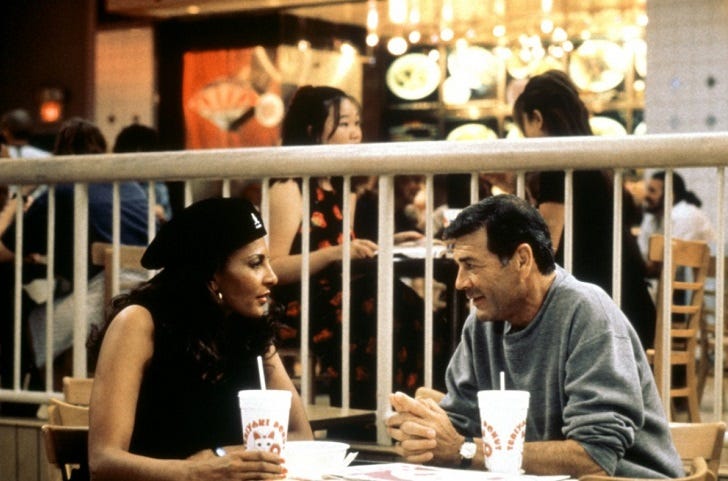
Not Joker 2, but Jackie Brown (1997). In the February 1998 issue (No. 72) of the French Impact magazine, Pam Grier was interviewed. About the genre, she said: “Most women see Jackie Brown as a love story. Men? It depends... Jackie Brown is about two people who respect each other's sensibilities, who like the other to reveal their own doubts, their own insecurities. I don't think they love each other that much, though. When Jackie Brown kisses Max Cherry, it's to thank him for not keeping the money. She thanks him for his support with a kiss. It's not a romance. It could be if Jackie didn't cross certain boundaries, if she got on the right side of the law. What is there between Jackie Brown and Max Cherry if not respect and a form of love. I think you can love someone for who they were to you. Max Cherry does a lot for Jackie Brown.”
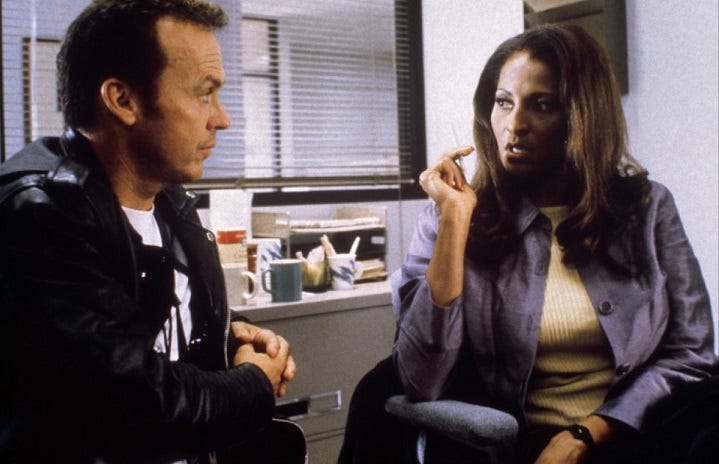
Sowing the interracial seed: “I met Quentin Tarantino at the auditions for Pulp Fiction. In his office, he had pinned up posters of my films from the 70s. I suspect he put them there to impress me. I didn't believe him when he told me he didn't have time to remove them from the wall! I found that charming. If I didn't get the part, it's mainly because Quentin had already hired Eric Stoltz to play my husband. We had to play the drug dealer couple. Impossible because my personality was absolutely not compatible with Eric Stoltz's. No one could accept the fact that he was giving me orders, dominating me. So it's not a bad thing that I didn't get the part, even if Quentin wanted me to play a character very different from my traditional roles. Quentin wanted me to be “unprecedented.” When I saw Quentin again a year later, he simply told me that he was working on a new project. A year later, at a new meeting, he admitted to me that he had just written a role just for me. The character of Jackie Brown. What a great script! Honestly, I still didn't believe it.”
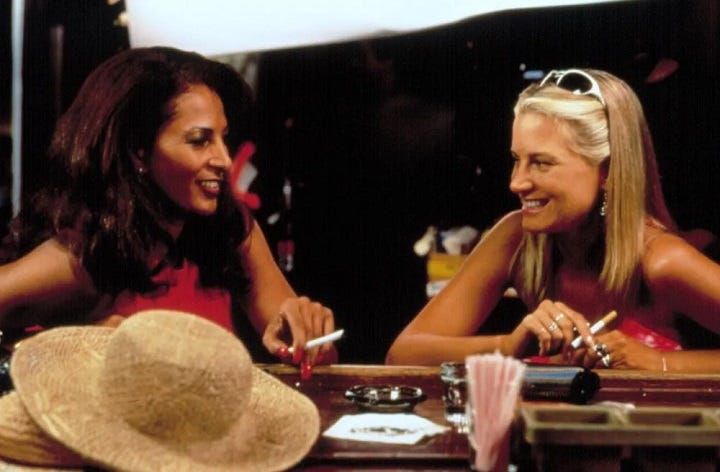
At what frame of mind did she enter the production: “In a very negative state of mind. The day before the shoot, my boyfriend and I yelled at each other constantly. The worst thing that could happen in my private life happened a few hours before my career took off! There is nothing worse for distracting you, for causing memory lapses. Suddenly, the pleasure I should have taken in filming Jackie Brown suddenly evaporated. You can't even imagine how hard it was to get over that. All the harder because my dog died the same day. I really thought I was going to succumb to a heart attack, the pressure was so unbearable.”
Reaction: “Quentin Tarantino often told me: "You're so good!" I didn't take his compliments very seriously until the day of the shooting of the balcony scene with Samuel Jackson. I was ready, I knew my lines. Not Samuel, since this scene was not scheduled that day. We were half a day early. I asked my partner if he wanted to shoot it. He hesitated. When he hesitated, I replied that I knew Jackie Brown by heart, that I was prepared for any eventuality. I told him again: "I work with Quentin Tarantino, Sam Jackson, Robert de Niro, Bridget Fonda, Robert Forster and Michael Keaton, and you think I can afford not to know my lines?" Sam then decided to shoot. Quentin asked him to settle down in a quiet place to memorize his lines. Shortly after, he came back on set, announcing to everyone that if I knew my lines, there was no reason why he shouldn't know them too!”
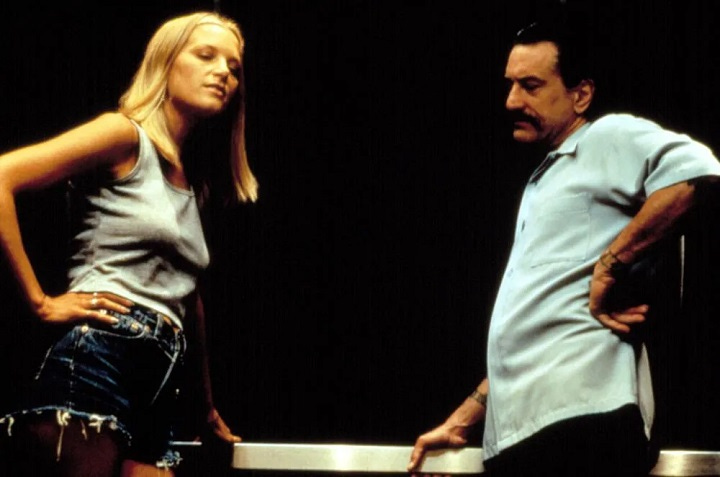
The relationship that develops between Jackie Brown, and Max Cherry: “On the walls of Max Cherry's apartment, there are no photos of women. Nothing bears witness to any past passion, to a lasting connection. There is no woman in Max's life. It is clear that women scare him. Maybe he has been so emotionally hurt that he no longer wants to put his hand in the fire, for fear of burning himself again. I sincerely think that Max is addressing Jackie Brown in veiled terms. He says to her: "I am afraid that I cannot love you, or that you cannot love me." This is something that I feel very strongly in the relationship that develops between them. Quentin puts this truth on screen. All of Jackie Brown is born from his observation of everyday life. Like this drug dealer living in a luxurious apartment who takes in an ex-convict who cannot even afford decent clothes.”
About the controversy sparked by Spike Lee: “The day after his inflammatory statements against Jackie Brown, I met Spike Lee on the plane back from the premiere of the film. And I was the one who invited him! He pointed out to me that people used the word "n!gger" too often in Jackie Brown. I told him that was how it was every day, in real life. But he continued to be angry with Quentin. To which I pointed out that it was entirely possible that Samuel Jackson had improvised all those "n!ggers," that they weren't necessarily in the script. Spike Lee admitted to me that he hadn't read it. So he was attacking without knowing. Just like a politician. As an artist, Spike Lee has no right to attack another artist in those terms, to censor him. Moreover, he has always known that the word n!gger is in the vocabulary of black people. He cannot forbid the entire population of Brooklyn from using it. Samuel Jackson is said to have replied like: "How do you want me not to say n!gger? That would be hypocritical! How can I deprive myself of it when all my brothers on the street use it all day long?" Spike has since calmed down: he has not spoken about Jackie Brown in the media. Listening to him, I had the impression that only black people have the right to make films about black people. That Ang Lee should only focus on Asians. That Steven Spielberg should not have made The Color Purple and Amistad! I would love to see a Spike Lee film about Japan!”
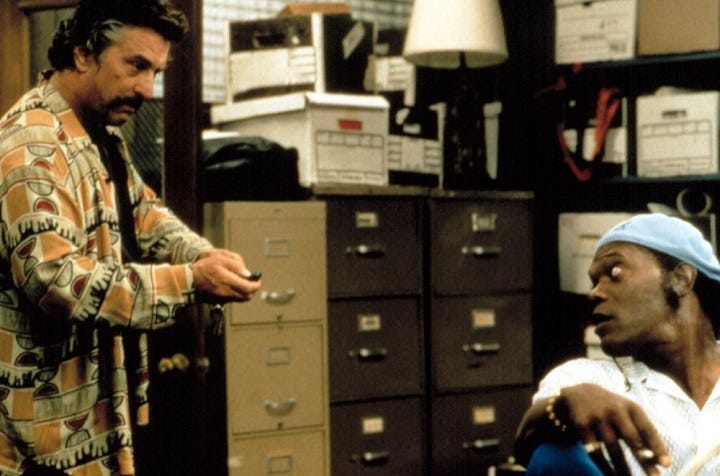
Robert Forster was also interviewed in Impact. Referring to 1990: “Seven years ago, I got a phone call from a producer. He said, “Bob, I just bought this incredible script written by a young guy. His name is Quentin Tarantino and his project True Romance. There's a part for you!” So I read the manuscript and realized that Quentin really liked me for having worked out such a mafioso character. While I was getting ready to play him, this producer sold the script for True Romance to a much larger organization. From William Lustig's hands, the project went to Tony Scott's. To play the role that was intended for me, he hired Christopher Walken.”
Another blow to the gut moment: “A year or two later, I get another call. My agent says: “I got you an audition for Reservoir Dogs. It's a young guy named Quentin Tarantino who's directing.” He believed as hard as he could that this opportunity was right, so I went to the audition. My role was that of the old gangster, the patriarch. After reading the dialogues, Quentin confides in me: “Listen man, I’ve seen all your movies, I like you, but this character is really not for you.” No problem, I'lI come back one of these days with something! No news from Quentin for five years, until the day I met him in the coffee shop where I have my breakfast every day. We catch up on each other’s news. He then confides in me that he is working on the adaptation of Elmore Leonard’s novel, Rum Punch, and advises me to read the book that later became Jackie Brown. I read it. Five months later, I find Quentin sitting in my reserved seat in this coffee shop. He passes me the script, ask me to give him my opinion as soon as possible. I read it and it's extraordinary. Really, Quentin gave me the chance to start a second career.”
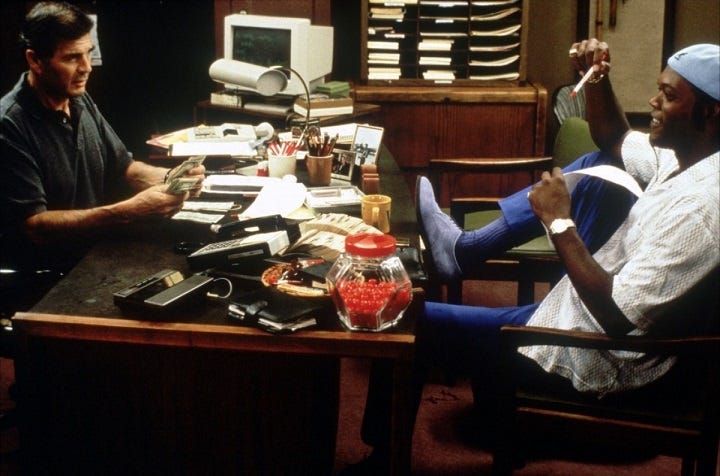
If Robert knew from the start that Quentin considered him for a big role: “When I read the script for Jackie Brown, I wasn't sure that Max Cherry's character is really meant for me. I couldn't believe it. I was afraid that Quentin was going to offer me a more modest role. As I was making progress in discovering Jackie Brown, the more I realized that there was no another role that suited me. A little paranoid, I thought my appearance was going to be short as I didn't detect it in the script. When I realized that Quentin wanted me to play Max Cherry, I understood that this was a chance extraordinary to seize. We do not miss an opportunity like that. Especially when you are an actor for thirty years. Thirty years divided between a first act, a good start for five years, and a second, a tumble on twenty-five years. Jackie Brown is a third an act that I really didn't expect anymore.”
Max Cherry is not Tarantino's hat tip to all the characters that he played before: “Max Cherry pays homage to the great film noirs of the 40s and 50s. He is a typical type. He is a man who, when necessary, goes down dark alleys in order to save a woman he is crazy about. If this woman then oversteps the bounds of the law, he will not follow her even if he continues to be crazy about her. He will not go to the other side with her because he is an upright guy. Right from the beginning of Jackie Brown, Max Cherry finds himself almost on the other side. This poses a big problem for him and his whole strategy is precisely to never cross a certain line. Max Cherry directly refers to Humphrey Bogart, Robert Mitchum. To a few characters also played by Jean-Paul Belmondo in the ‘60s. In cinema, this tradition of guys always ready to rescue women who are not really decent has been going on for a while now.”
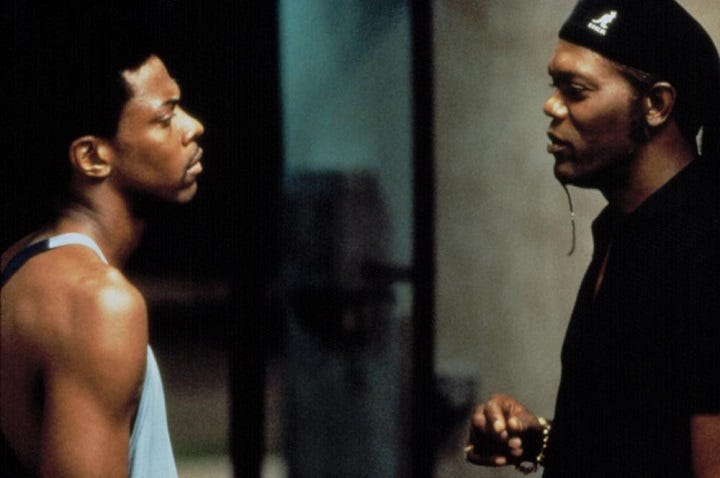
There is a bit of the real Robert in the character of Max Cherry: “To a certain extent, yes. When I teach drama, I always tell my students that what they accomplish in life, they have to give to the characters they play. My behavior in life is pretty much like Max Cherry: In one scene, Jackie Brown asks him how many cases he's worked on. He says 15,000. A lot. I haven't done that many movies, but I'm at a point in my career where I've done a few. I've been an actor for a long time. As long as Max Cherry has been a bail bondsman. Like him, I've done crappy jobs. Crappy parts in crappy movies. Like Max Cherry, I've always done the best I can. Which gives me the right to claim that I'm honest. I don't have to apologize for anything. I've had my ups and downs. During the downs, I worked to raise my children, to feed my family. I accepted to make duds. Bad films that I interpreted to the best of my ability. Always the best possible. I'm not ashamed of anything. In that sense, I'm a lot like Max Cherry. My career, my failures gave me a certain something that allowed me to identify with him.”
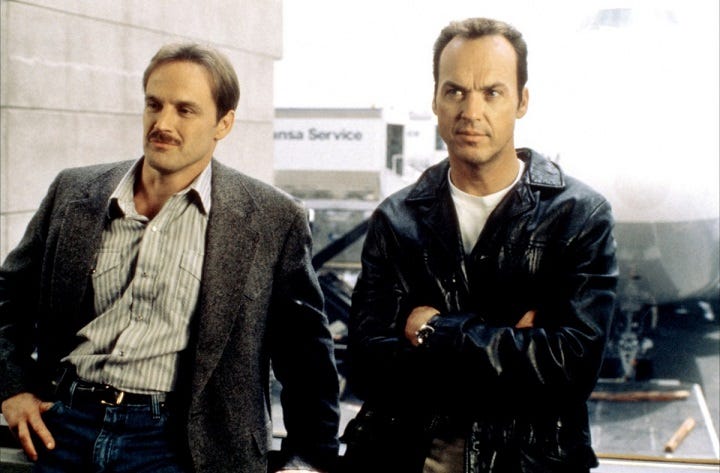
Quentin is not that much of a motormouth when he directs: “Much less than in the press! He leaves little room for improvisation. Quentin writes great dialogue. It's my job, not to twist it to my advantage, but to bring it to life. Quentin very rarely asks you to add a word to what you already have in hand. From time to time, he replaces one with another at the last moment. He says "Throw away the old one, try this one instead." He is constantly composing the film in his head and the actors are the vehicles for this composition. Sometimes, he intervenes discreetly to better surprise you. It happened in the scene where I am in the same car as Samuel Jackson, towards the end. Samuel Jackson says to me: "Now, we're going to your office. Is there something you want to tell me?" I answer "No", to which he retorts “Look at me, you son of a bitch!” Quentin whispered this line in Samuel's ear on the set, without me hearing it. I must have reacted spontaneously to this initiative. He is good at this little game that forces you to always stay in the game, to remain lively. Quentin makes the task considerably easier for the actors. He loves us and we feel it. He uses all possible means to ensure that you reach your best level. I understand why actors plot to work with him. There were some, and not the lesser, who were cunning to steal the role of Max Cherry from me. All of Hollywood coveted him, but Quentin resisted all pressures.”
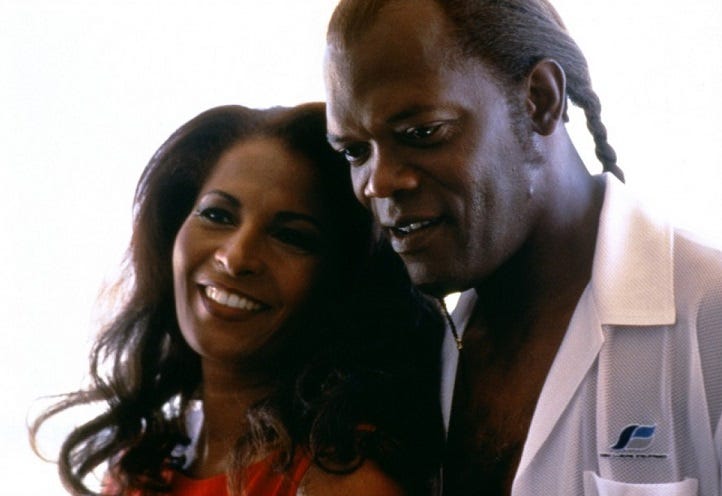
Back to the star: “I first met Pam Grier on the set of Original Gangstas. We didn't have any footage in common, but I thought she was so beautiful that I immediately wanted to kiss her. I resisted my urges! Two years later, I read the script for Jackie Brown, and I noticed a scene where I had to kiss Pam Grier. Sometimes dreams come true. Quentin Tarantino warned me not to fall because Pam has a great husband. I naturally enjoyed putting my lips on hers. Too bad we only did two takes! Two takes? What a misery. Quentin sometimes goes up to ten. Ten takes for those few seconds would have been no problem for me!”