
Fantasy Mission Farce

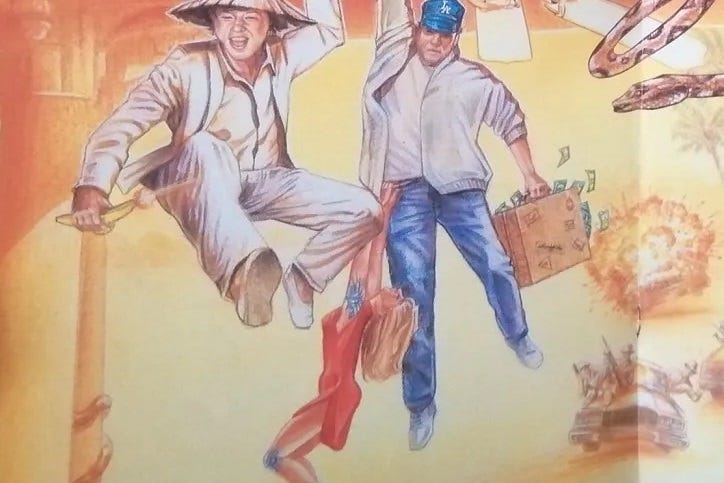
This is the Rush Hour that never was. The twist is that Jackie Chan’s character in Singapore Sling was like Chris Tucker except that he was going to play a comedian. The illustrated American reminds me of Dennis Quaid but older; the closest actor to that description in the late eighties was Peter Jason. Before I continue, I would like to thank a Twitter user named RK9192 for the promotional booklet that he posted. The best Jackie Chan historians are the ones from Japan instead of Hong Kong (with the exception of people who actually worked on Jackie’s films). Historians like JatakeJjj and narukoiehan will show you a treasure trove of goodies. To find more Japanese tweets, you can look up Jackie’s Japanese name: ジャッキー・チェン
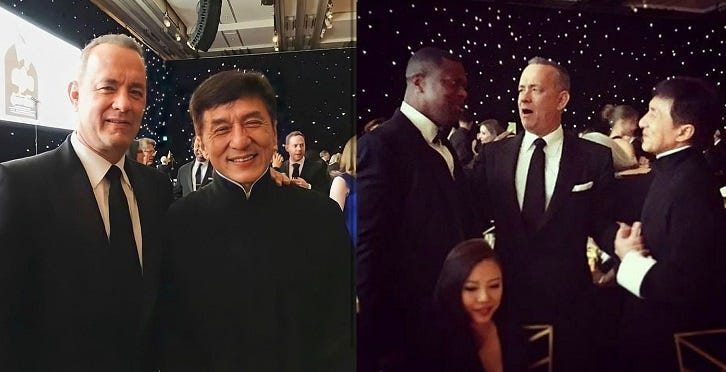
In a June 2002 book called 100% Jackie Chan: The Essential Companion, there was an early 1995 interview by Mike Leeder where Jackie was asked about Singapore Sling. JC said: “That one! (laughing) Golden Harvest wanted me to do another American film, but a more light-hearted one, an action comedy. They were throwing names like Tom Hanks and Chevy Chase around as co-stars, but nothing was ever confirmed; and truthfully I don’t want to make any more American films, because the two I’d done before, The Big Brawl and The Protector, not only didn’t do well in America but they also didn’t do well in Asia. Western audiences seem to like my Hong Kong films more than my American ones, so for now I make my films as Hong Kong international films!”
In Renée Witterstaetter’s 1997 book, Dying for Action: The Life and Films of Jackie Chan, the project was covered in a section called The Disappearing Dozen. The summary was: “An action comedy to be directed by Richard (Lethal Weapon) Donner starring Jackie and either Tom Hanks, Jim Belushi or Randy Quaid. Status: It got far enough to have a name. It was quickly put on hiatus - in other words, according to those who have read the premise, happily forgotten.”
In 1998, James Hong directed a film called Singapore Sling but it was released in 1999 as Scandalous Behavior. Like the scrapped project for Jackie, the premise involves an American person stealing money from Asia before hightailing it to Texas. 1998 was the tenth anniversary of when the original JC project was mentioned in a Singaporean newspaper called The Straits Times. In a June 8 article by Jenny Lam, she mentioned the film in a list of projects that Golden Harvest had yet to churn out. She wrote: “Singapore Sling (in English) – An action-packed love story to be produced next March. A third of it will be filmed in Singapore. Starring Jackie Chan and some Hollywood big names (to be finalised), and directed by Mark “Oliver Twist” Lester.”
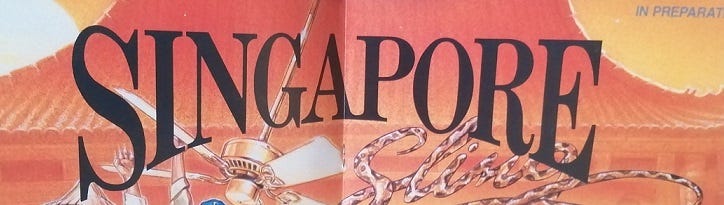
That’s erroneous. The director was a different Mark Lester i.e. Mark L. Lester. He already had a connection to Jackie in that Arnold Schwarzenegger’s Commando has an action scene in a mall which conjures the memory of the finale in Police Story (also 1985). Commando was filmed from April 22 to July 3 in 1985, but Jackie had already been filming Police Story way before April. A U.S. TV crew filmed Jackie, of whom was referred to as being 30 years old, and he turned 31 on April 14 in 1985. The programme was called Hawaiian Moving Company, whose host (Michael W. Perry) made a closing statement that Police Story would possibly be released in the summer of 1985. I should note that the producer of Commando, Joel Silver, is a major fan of Hong Kong action movies. For Mark L. Lester to be chosen as a director is fascinating because he later directed Brandon Lee for Showdown in Little Tokyo (1991). After that movie, Brandon starred in Rapid Fire (1992) where he incorporated key moments of action from Police Story.
Before Showdown in Little Tokyo, Brandon starred in a film called Laser Mission (1989). This reminds me of the fact that a Hong Kong producer (Tsui Hark) had produced an English language film called The Laser Man. This Film Workshop production was made in 1988 - the same year when The Straits Times publicized Singapore Sling. In 1988, Golden Harvest had attempted to make an English language version of Mr. Vampire but it was scrapped. In a late September 1988 article for a Singaporean newspaper called The New Paper, Hong Kong journalist Hope Barrett reported that Demon Hunters was cancelled after filming began. Suspiciously, this film was absent from the listing of coming attractions from Golden Harvest in the aformentioned June 1988 article. The budget was reported to be 30 million dollars. I would say “purported” because that’s a lot of money for a film starring Jack Scalia and Tanya Roberts, so Golden Harvest’s Raymond Chow was probably just flexing money that he didn’t have.
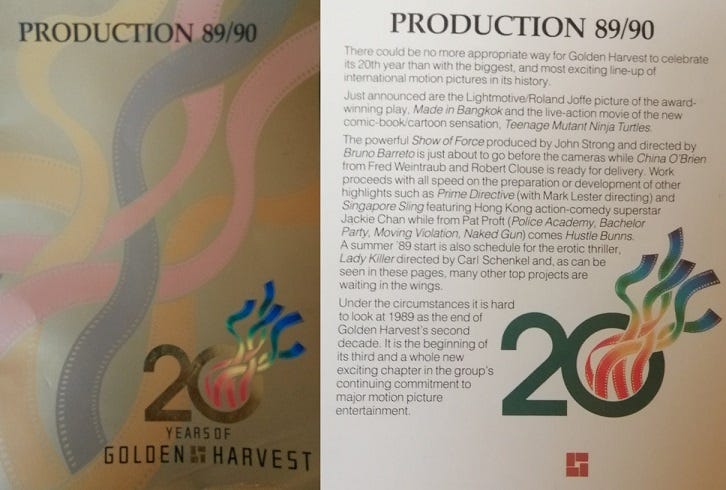
When you read the below treatment for Singapore Sling, it reads like someone who was inspired by a 1983 Taiwanese film that Jackie Chan had a supporting role in - Fantasy Mission Force. For Singapore Sling to be a “John Strong production” is confusing because he had produced a trilogy of B-grade cult movies: Savage Streets (1984), Knights of the City (1986) and Steele Justice (1987). Conversely, he is credited as a supervising producer on more classier productions - Heart Like a Wheel (1983), Summer Heat (1987) and Cop (1988). The latter was a March release starring James Woods, and it was a box office flop. This didn’t deter Golden Harvest from announcing another John Strong production in a 1989/1990 newsletter - A Show of Force. This was actually made but it was more of a thriller than an action movie. It had a truly pedigree cast of stars in the form of Amy Irving, Andy Garcia, Lou Diamond Phillips, Robert Duvall and Erik Estrada. Most intriguingly is that Joseph Campanella was in the cast because he had just finished acting in an English language film, No Retreat, No Surrender 3: Blood Brothers, produced by another Hong Kong film company - Seasonal.
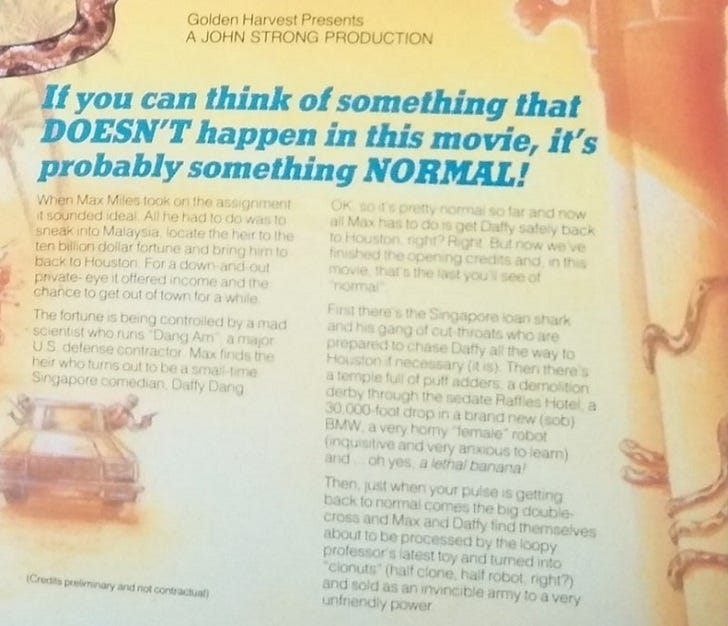
This is particularly relevant because the main character in Singapore Sling may have been named after Max Thayer, who co-starred in Seasonal’s No Retreat, No Surrender 2: Raging Thunder (1987). Fred Weintraub was the co-producer for Bruno Barreto’s A Show of Force but I don’t know if he was going to be involved with Singapore Sling. He didn’t produce Jackie Chan’s The Protector (1985) like he had for other English language films spearheaded by Golden Harvest, especially the films made by Robert Clouse i.e. Jackie’s Battle Creek Brawl (1980) and Cynthia Rothrock’s China O’Brien duology (filmed in 1988). Robert Clouse was betrayed by Jackie when the latter had rejected his pirate screenplay (Blood Island) so that he could do his own pirate movie (Project A). Talk about piracy! The below newsletter is questionable since most of those announced projects weren’t even made - Made in Bangkok, Hustle Buns, Lady Killer and Prime Directive (another Mark L. Lester no-go).
By 1988, Jackie may have already seen a 1986 action comedy by Mark L. Lester called Armed and Dangerous. It starred John Candy and Meg Ryan. One thing that doesn’t mentioned at all is why Golden Harvest never thought about making a film starring Goldie Hawn. Besides the annual newsletter, another way for the company to deliver news was through Jackie’s fan club. When Golden Harvest ceased their Golden Movie News magazine in 1983, there were still other magazines to relay info. For example, the March 1988 issue of Combat (a British martial arts magazine) contained an interview with Jackie where he spoke of his upcoming projects: Police Story Part II, Fireman Story (never filmed), a Burt Reynolds film with Phoebe Cates (ditto), and an American-style film with several international stars (likewise). Interestingly, Raymond Chow wanted Jackie to do a sequel to Project A (1983) after Police Story came out but Jackie didn’t want to do it because he didn’t have an idea for a story.
A sequel did eventually emerge in cinemas circa August 1987 but with Sammo Hung and Yuen Biao being absent from the cast. It was only after this that Jackie reunited with them for Dragons Forever but he didn’t mention it in the March 1988 issue of Combat (the film was released in Hong Kong circa February). Singapore Sling was not brought to the attention of the Combat readers but then neither was Miracles. In August 1988, Sammo was no longer a member of Golden Harvest because he didn’t like the fact that In The Blood was pulled out of H.K. cinemas in late July. In the June 1990 issue (#27) of a French magazine called Impact, Jackie admitted that he had sometimes thought about leaving Golden Harvest. Since himself and Sammo were not actually contracted to the company, they could have left to join D&B or Win’s. Like what happened between Bruce Lee and Lo Wei, Raymond Chow was the master of divide and conquer.
As for 1989, March was when Jackie began preparing Operation Condor. At this point, Miracles was finished but had yet to be released (i.e. June 1989). As for why he had decided to change gears from Singapore Sling to Operation Condor, the answer lies in Bruce Willis. When Die Hard came out in July 1988, it saw him playing with danger via glass like how Jackie did in Police Story. In November 1988, it was reported in Daily Variety that Joel Silver was going to produce Hudson Hawk for Willis. It could be argued that Jackie wanted people to not forget about his Asian Hawk character in Armour of God (1986). What’s weird is that Golden Harvest’s Raymond Chow didn’t encourage Jackie to do a sequel earlier on despite the predecessor being Jackie’s highest-grossing film at the time with a local haul of HK$35 million (surpassing the 34 million of John Woo’s A Better Tomorrow).
Not wanting to be beaten, Jackie initially wanted Johnnie To to be the director after The Eighth Happiness earned 37 million by the end of its run back in March 1988. It’s been said that Phoebe Cates wanted to co-star in Operation Condor but Jackie talked her out of it. I think that the experience of the U.S. actors on the aborted Demon Hunters may have affected Jackie’s judgement in working with Hollywood. In theory, this would have caused problems for Jackie’s desire to do a Kung Fu Western in the early nineties but Italy had a long history of cranking out films featuring Italians made up to be Americans (not just in their Westerns). Considering that Jackie’s films depended a lot on Japanese financing, it was a mistake not to do a film with Phoebe Cates because she was very popular in Japan. If the covers of Japanese magazines were anything to go by, Phoebe was one of the top five actresses i.e. alongside Diane Lane, Sophie Marceau, Brooke Shields and Alyssa Milano (who was in Commando).