
En Vogue

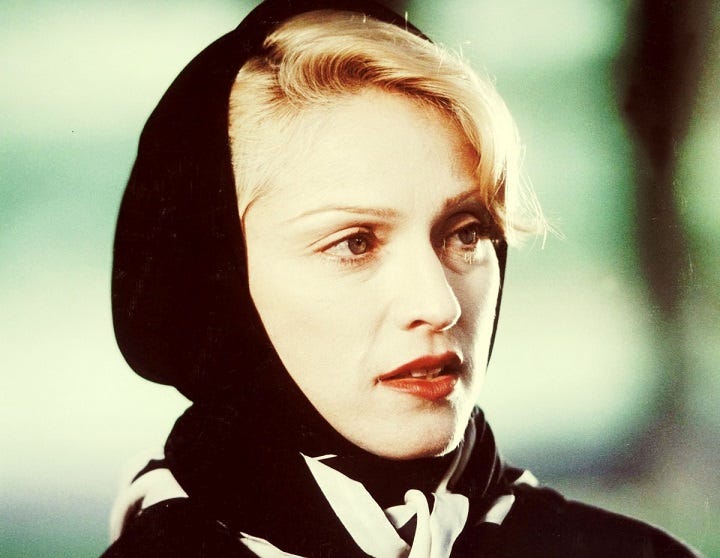
In France, Body of Evidence should have been called Ensemble de Preuves. Instead, it was just called Body. In the February 1993 issue (#43) of Impact, Marc Toullec wrote a two page article as part of a fourteen-page feature about femme fatale films. I will leave Marc to fill in the rest…
Madonna: the fatal weapon. Madonna is the piece of conviction in Body. The object of the crime: a body that kills in ecstasy. And more particularly rich and heartfelt men. It's not tomorrow that Madonna will interpret Little Red Riding Hood, or any Perrault tale. Unless, perhaps, a role of a slutty witch. Madonna, quite satisfied with shaking up puritanical America, with being destined for the flames of Hell by the most rigorous fundamentalists and sects, cultivates and takes care of her image. Through clips, records, her dirty book with hilarious texts and so-called "artistic" photographs, through her liberated and libertine declarations.
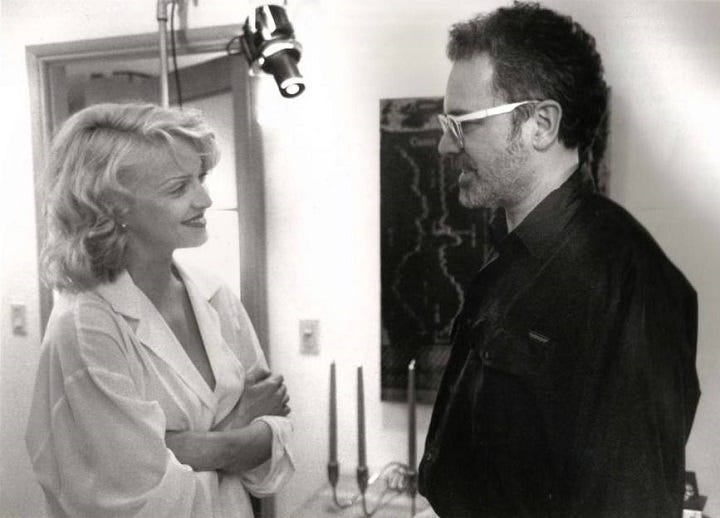
All that was missing was a film to affirm that the body also needs to express itself beyond hypocrisy, taboos, and the barriers of morality. Body is this sulphurous film, this vehicle for "Madonna" propaganda. Complexed by Basic Instinct and furious at having missed the ideal character of the praying mantis trapping the man, Madonna offers herself this Body. A film intended to be hot, a film where she can show off her body and her talents as an actress. And her glamorous interpretation of Breathless Mahoney in Dick Tracy required a more full-bodied version, tailored to adults. Because the comic strip on the big screen can be frustrating.
Editor’s notes: There’s a strange alternate reality occurring where actresses were contending or considered for both Batman Returns and Basic Instinct. Besides Madonna, there was Sharon Stone and Michelle Pfeiffer. It makes for an interesting guessing game to see what would have happened had Sharon and Michelle switched places. Perhaps this is where A.I. can prove to be truly useful.
Director Uli Edel said: “Body explores what lies behind the locked doors of each individual's psyche. I wanted to open these doors into the light, in a way that was both playful and full of generously offered breasts. But it's just an appetizer of suspense. Body is a classic femme fatale story, where the latter is accused of having killed her lover. The surprising point is that the body of the accused person is the murder weapon. Frank Dulaney, the defense attorney, is obviously very attracted to his client - Rebecca Carlson. Under the pretext of discovering the young woman's taboos, he exposes himself to some of his own demons that he had never suspected existed until then. From now on, he does not simply defend his client, but takes the defense of what is also a part of himself.”
Uli Edel is a director of delicate subjects (Christiane F. and Last Exit to Brooklyn). There is a lot of delicate stuff in Brad Mirman's screenplay, in the form of erotic sequences aimed at surpassing the relative audacity of Basic Instinct. Madonna thus indulges in sequences that hide nothing of her anatomy. The highlight of Body is cunnilingus in an underground car park, in a sordid atmosphere as Uli Edel likes them. It's all the more torrid because the actors don't use body doubles. For the rest, the singer professes a hard, sado-maso libido. Handcuffs, burning candle wax on her chest, handjob in a crowded elevator, suggested sodomy... The whole lot.
Editor’s notes: Jennifer Jason Leigh, the star of Last Exit to Brooklyn, co-starred in her own erotic femme fatale thriller - Single White Female. In fact, J.J. Leigh has been in many films where she’s been naked.
Uli Edel said: “We had to create everything from scratch because writers get very puritanical when it comes to describing a love scene. They get vague, imprecise and talk about 'wild love', 'making love', 'having a blast in love', rather than describing what's really happening. Brad Mirman, the writer of Body, gave us the keys to these sequences, but we had to give them their specificity. The love scenes between Madonna and Willem Dafoe are of crucial importance for the dramatic coherence of the film and the development of Frank Dulaney's personality. Body is a thriller but does not contain the usual bloody scenes, the traditional car chases. The action scenes are the love scenes between Madonna and Willem Dafoe.”
Uli Edel is German, Paul Verhoeven is Dutch. It's as if American directors fear overly explicit sex. Even the most timid Adrian Lyne (Nine and a Half Weeks, Fatal Attraction) is English. Europeans come to the aid of Americans who are lacking libido, incapable of getting rid of their prejudices. At this rate, Jean-Jacques Annaud should soon be expatriating himself to Hollywood, concocting a remake of The Lover. But Madonna has made sex her stock-in-trade for a long time, well before she threw her panties into the magma of her jubilant admirers. And that's precisely what she appreciates in Uli Edel - his way of showing physical relations without turning the camera away, of extracting an opaque, feverish, even dirty atmosphere from it. And often not very appetizing, especially when he describes the gang r@pe of Jennifer Jason Leigh in Last Exit to Brooklyn (1989).
Editor’s notes: Hong Kong film actor Tony Leung Ka-Fai starred in The Lover. It’s the closest thing to a French version of Lolita. As for Marc Toullec’s comment on Euro vs. U.S. directors, he has a point - Single White Female was directed by Swiss director Barbet Schroeder. Besides Last Exit to Brooklyn, J.J. Leigh played a r@pe victim in Flesh + Blood - directed by Dutchman Paul Verhoeven.
Madonna said: “I saw Christiane F. when I arrived in New York and I loved it. At the time, I didn't know who had directed it. A few years later, I saw and loved Last Exit to Brooklyn. When I found out that the same director had written both films, I became his biggest fan. On tour in Los Angeles, two years ago now, I organized a party and I put Uli Edel on the guest list. That's how we met. That night, I rushed to him to tell him that I really wanted us to work together one day.”
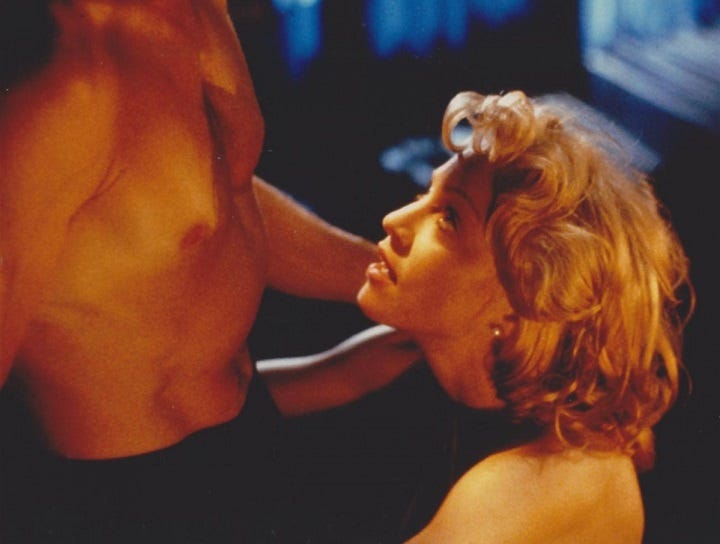
The result of this association between the singer and the director: an obviously hot film, but Body is above all a traditional suspense, in the vein of classics like Hitchcock's Stage Fright, Billy Wilder's Witness for the Prosecution, Otto Preminger's Autopsy of a Murder or, even closer to us, Richard Marquand's Jagged Edge. Suffice to say that the plot rebounds especially in the courtroom scenes, that the pleas of the defense and the civil party are as important as the loving embraces, if not more.
Editor’s notes: Julianne Moore didn’t get a mention in the article despite having a sex scene with Willem Dafoe. A few years later, she would be more daring than Madonna by playing an X movie performer in Boogie Nights.
Did Rebecca Carlson really kill Andrew Marsh? Prosecutor Robert Garrett accuses her of putting cocaine in the deceased's inhaler and then f#*king the sixty-year-old heart patient to death. The suspense remains intact until the end. But, beyond the key to the enigma, the intervention of key secondary characters (i.e. Jürgen Prochnow as a felonious doctor, Anne Archer as a jealous secretary and Frank Langella, the best of them all, as a courageous millionaire in the dock), Body is there to serve as Madonna's mouthpiece. Through Rebecca, she places herself as the victim of hypocrisy, tight asses and holy water frogs. In fact, with a few minor details, the actress Madonna embodies the real Madonna in Body. America did not appreciate this confessional moment since the film got a good rap for it. A shame.
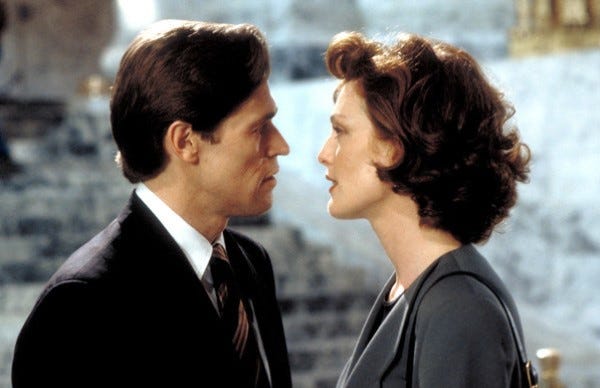
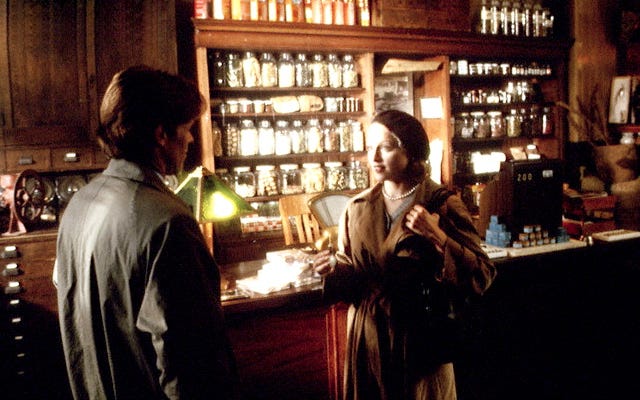
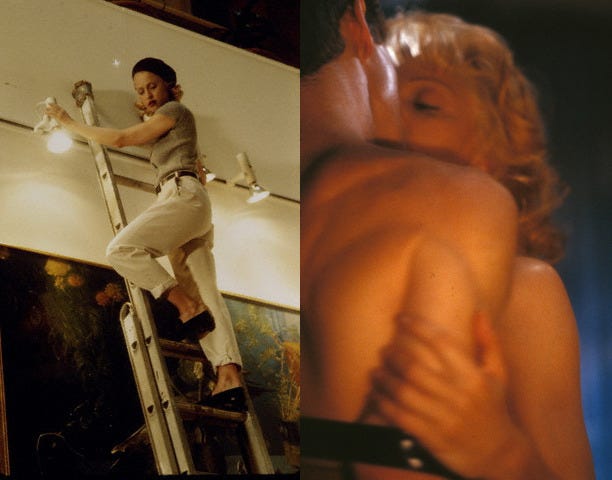
Editor’s notes: That’s the end of the magazine article. The below photo looks like it could have been Julianne Moore, who played Willem Dafoe’s wife. She claimed that Madonna was like a method actress during filming, which would mean that the sex scenes were unsimulated. If Julianne was replaced and recast as a consolation prize then it was only fair that she got to replace Jodie Foster in Hannibal (2001).
That’s it from Marc Toullec. Whenever I compiles pictures for an article, I tend to prefer film photographs over digital screenshots taken from DVDs or Blu-rays where images can sometimes look one-dimensional (such as the cartoony remastering of ‘80s Hong Kong films). Besides the Movie Stills Database, the best sites to find rare film stills are Česko-Slovenská Filmová Databáze, Kino Poisk and Kinorium. On Twitter, Hong Kong film archivist Mike Leeder remembered that Hong Kong video releases of American films would sometimes have sleeves featuring stills of scenes that were deleted including scenes that were reshot.
In the case of Body of Evidence, I’ve not seen a still depicting Madonna as a brunette. She’s, at most, a dark blonde in some parts of the film. In film-making, footage of a replaced actor can be reused as long as you can’t identify them. If Julianne Moore was not replaced then perhaps her character wanted to win back her husband by living vicariously through Madonna’s character by imitating her. Foreign countries can sometimes have exclusive photos such as a rare production photo of Eric Stoltz in Back to the Future being privy only to the Japanese.
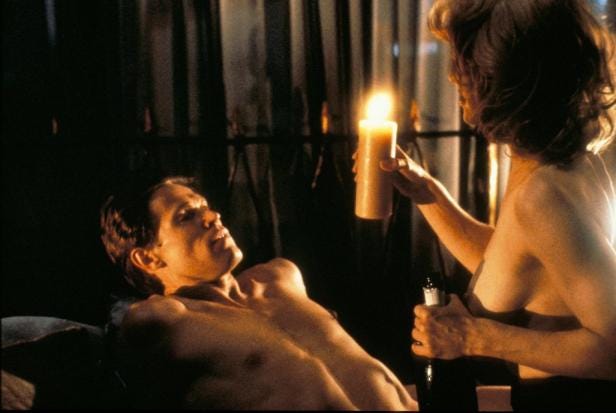
As for Body of Evidence, there is the below photo from a Japanese promo booklet. Even in Japan, the film was called Body. The promo booklet contained an interesting article written by Shunji Ito (art historian)…
Madonna has finally begun to present her "body" in a "naked" state rather than a "nude" one. I think that Madonna's "body" is meant to be "naked" to the last, and is trying to more directly and actually reveal her present self. The publication of the photobook "SEX" just before the release of this film also makes sense in this context, as it may come as a surprise to some, but Madonna had never appeared completely nude until the release of this photobook. The only exception to this are the nudes taken by various photographers in the late 1970s, before her debut, when she had been forced to become a nude model in order to make a living after moving to New York from rural Michigan.
Lee Friedlander's photo book NUDE, published in the United States earlier this year, features nude photos of Madonna from that time, capturing her muscular, stiff body in detailed images, including the fine hairs around her buttocks and waist, as well as the blemishes and moles on her body. Comparing the nudes from the late 1970s with those in the new photobook, something interesting emerges. The nudes from the late 1970s were photographs by famous men. Madonna was a "material girl," treated like an object, merely an element in the photographer's image. In contrast, "SEX" (as can be seen from the fact that it was originally intended to be titled Madonna's Sexual Fantasies), is a collection of images of Madonna's own frank sexual delusions and secret alter egos. This is a collection of "naked" images that embody all kinds of fantasies from SM scenes to lesbian scenes, 0rgies, r@pe scenes, m@sturbation scenes, and !ncest.
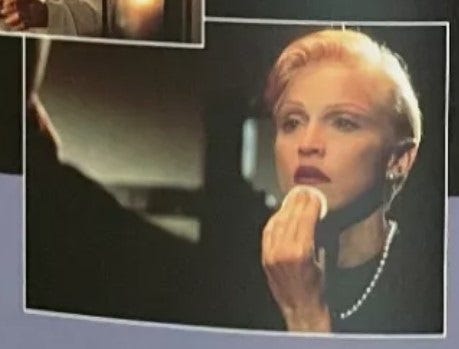
In SEX, Madonna challenges not only the viewer, but herself, the times, and society with her body as a naked mass of truth. The same can be said about Madonna's body in BODY. In fact, here, not only is the external nakedness of the body revealed, but also the internal nakedness of the heart. To repeat, Madonna's body in BODY is dynamic unlike the bodies she has portrayed in previous films and music videos. It is completely different from the bodies posing on posters and sleeves. Madonna's nude body is aggressive, transparent and full of tension. Madonna's direct vision, different from that of previous stars, is clearly visible.
Madonna created this new image of a star herself. So now her body from her debut days is a complete shadow, her excess fat has been stripped away, her porcelain-white skin is more transparent than ever, and she exudes a dignified strength. Her seriously sexy body, which symbolizes a strong will that does not bow down to anyone or give in to anyone, breaks through a certain membrane and threatens the viewer. Madonna is now trying to transcend the gap between body and image. Or perhaps the film is attempting to shed new light on a certain underlying flow of emotion that connects these two things, something we are unaware of but which shapes us as individuals.
While watching Uli Edel's BODY, I was reminded of something Madonna once said: “Slowly, over the years, I've revealed myself bit by bit, one piece at a time. Every time you think you've got me figured out, I show another side. I always try my best, that's why it works.”
In a sense, BODY is the climax of a secret strategy that Madonna has been gradually revealing herself to us for years. In this film, Madonna plays the heroine of a psychological drama, a mental interplay, to her full potential, unlike any of her previous films. Not only is the truth of her naked body shown, but the truth of her naked heart sparks. It is no exaggeration to say that the success of a courtroom drama always depends on whether the main characters can express conflict with the slightest movement of their eyes, changes of expression, or movements, and Madonna plays this role brilliantly.
The difference between "NUDE" and "NAKED" has been mentioned many times before. It has been pointed out that while "NUDE" pursues the formal beauty of the body and the image of a reconstructed body, "NAKED" shows an image of a naked body permeated with real physical nature and the atmosphere of the times. If so, then since your debut, you have been slowly revealing yourself.