
Dreadful Judgement

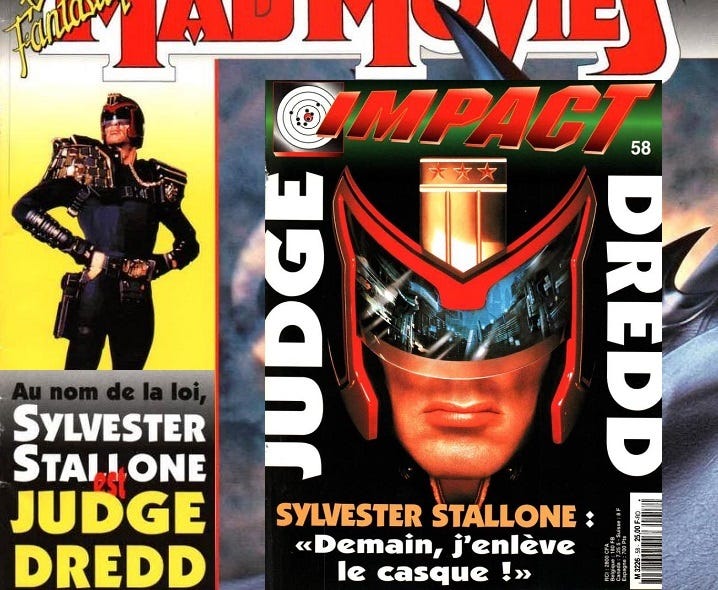
What looks like two competitors are actually two collaborators. The Mad Movies and Impact magazines shared the same leaders: Jean-Pierre Putters (publication director), Marc Toullec (chief editor) and Vincent Guignebert (editorial secretary). The trusty correspondents in Los Angeles were Emmanuel Itier and Olivier Albin. As for the staff in general, the common denominators were Didier Allouch, Marcel Burel, Julien Carbon, Guv Giraud and Jack Tewksbury. Even the thanks section sees more familiar names: Carole Chocmand, Nathalie Dauphin, Anne Lara, Laurence Laurelot and Aliette Maillard. The 96th issue of Mad Movies was released in July 1995 whereas the 58th issue of Impact was released in August 1995.
Action movies are supposed to be the bread and butter of the film industry but Impact was printed in 60,000 copies versus the 80,000 copies of Mad Movies, which covered horror, science-fiction, fantasy and miscellaneous cult movies. How they balanced the coverage on Judge Dredd was lopsided. Mad Movies had an eight page feature but Impact had a six page feature. Impact had interviews with director Danny Cannon and leading lady Diane Lane whereas Mad Movies had quotes from Sylvester Stallone and miscellaneous crew members. The August 1995 issue of Impact had one page featuring reviews from Marc Toullec and Julien Carbon whereas Mad Movies had none because it was imperative that the July issue didn’t affect the France release in August.
In Impact, Marc decried the film to be a mixture of RoboCop III (1993) and Lethal Weapon 3 (1992) whereas Julien Carbon denounced the film as being inferior to The Crow (1993) and Alien 3 (1992). Usually, a review was placed at the back of a feature or maybe midway. However, the reviews were placed at the front. This allowed for some comic timing since the next page was the beginning of the interview with director Danny Cannon. It may seem harsh but it was fair. There were better choices: Tony Scott, Marco Brambilla, Joe Dante, Stuart Gordon, Harley Cokeliss and David Fincher. Aged 26, Danny Cannon was the least experienced - more easy for Sly Stallone to pick on.
At the same time, Danny bit off more than he could chew when he turned down producer Andrew Vajna regarding the opportunity to instead direct Die Hard with a Vengeance. Danny said: “I almost wanted to make a drama of Ancient Rome. Judge Dredd could be Spartacus. In fact, Spartacus was our model, especially for the music. I explained at length to the composer, Alan Silvestri, that we had to approach Dredd as a gladiator rebelling against his condition and the power in place. Moreover, if you have an eye, you will notice that references to the peplum abound in Judge Dredd, in the architecture, the accessories. Even the interior of the cell shuttle that transports Dredd and Fergie to Aspen Penitentiary looks like the galley in which Charlton Heston rows from Ben-Hur!”
Of course, a novice to the big blockbuster world can’t fight for deleted scenes: “I shot a lot of sequences, a lot of shots that no one will see. The sequence where Dredd kills the clones was considerably reduced. Why? Because the producers thought it was shocking. They are monsters that Stallone is liquidating. So, to avoid these few minutes offending anyone, they simply reduced the scene to its simplest expression. I am particularly saddened by the disappearance of an important passage in the final footage of Judge Fargo of which there is not much left. However, it is the part of the film that I prefer. In the initial version of the sequence, Dredd learns, from the mouth of his dying mentor, who he really is. After his last breath, he feels alone, abandoned, totally disoriented. The scene insisted on this. It is really a shame that the production decided to cut it considerably. Some people were afraid that the public would lose interest, get bored. They had to impose a certain rhythm on the film. Personally, I expect something more from a film than an uninterrupted series of explosions, special effects and shootouts.”
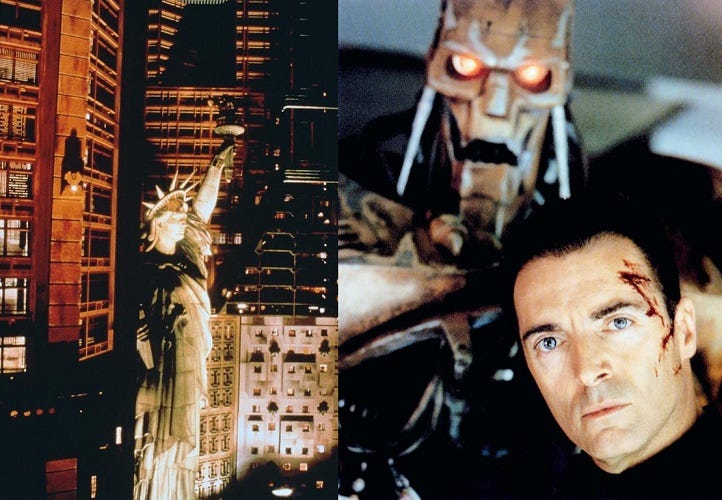
Nothing was left to chance: “I hate movies where the urban environments are relegated to a lifeless backdrop. If you want the audience to believe in your story and feel involved in the characters, everything has to be perfectly arranged and credible. You have to give equal importance to all the details, including those of the sets. That's where good movies find their particularity and stand out.”
Referring to the director of Stallone’s Assassins (1995): “I wanted to shoot a genre film and I did it. Richard Donner admitted to me that this type of film is particularly difficult to direct because there is no trust; the director can only trust himself, especially since everyone wants to put their two cents into the project. You have to remain faithful to your intentions, to your vision, while knowing that there will be compromises. As a result, you are never very clear.”
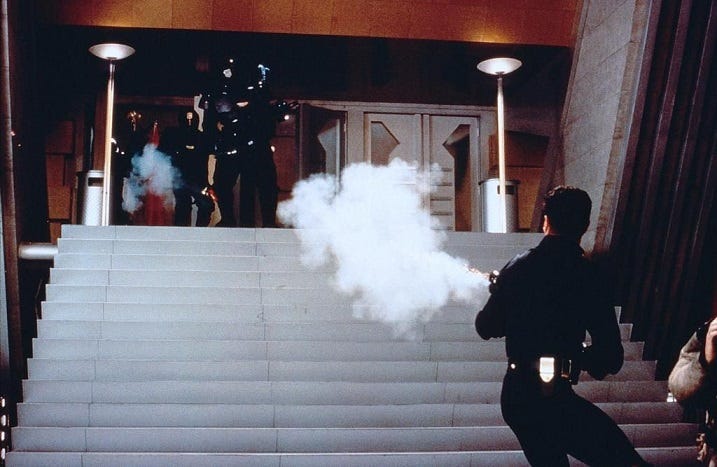
Looks can be deceiving: “The shootout at the very beginning took two weeks to shoot. And it doesn't exceed two minutes of screen time. I suffered the worst migraines on the set of Judge Dredd, especially from the constant pressure from the financiers. The more you spend, the more paranoid the treasurers become. A mathematical fact. It was imperative for the financiers to receive storyboards so they knew what company they were investing their money in. I spent so much time reviewing the script and considering all the problems that I only had one afternoon to find my actors, except for Sylvester Stallone. That was enough for me because I had memorized the faces of my protagonists. Sometimes, castings require crazy deadlines for money reasons. Fortunately, in the majority of cases, the actors place passion above money. Everyone I contacted answered the call.”
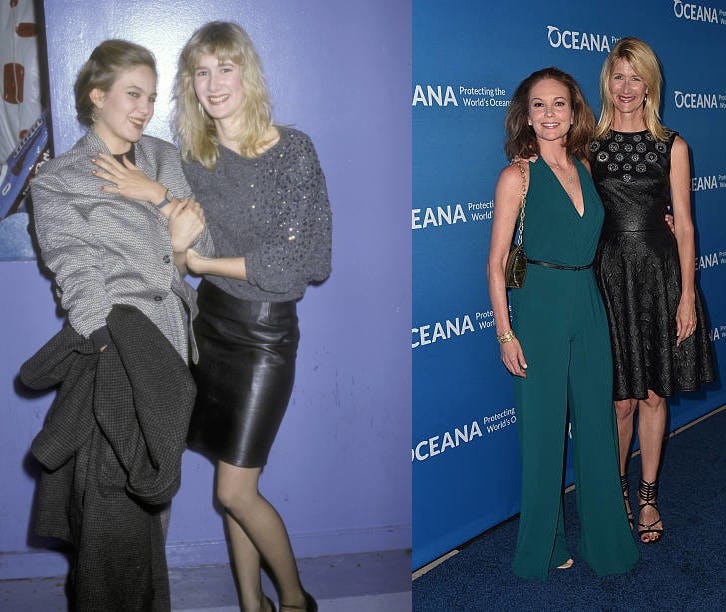
As for actress Diane Lane, she referred to the blonde actress above: “Laura Dern, my best friend, spoke to me at length about her experience on Jurassic Park; she spent most of her time screaming at dinosaurs that were out of her field of vision. A disaster.”
She went from skeptical to cynical: “There, at the Shepperton studio and still suffering from jet lag, I met this guy. He said, "Well, we've watched the tape of your submission and you're perfect in it. There's a great deal of natural power about you." Who could he be? Was he some random grunt? How did he get hold of the tape? Turns out, my interviewer was one of the main producers of Judge Dredd, Beau Marks! I immediately asked him why he needed me. To fight a ten-foot-tall robot and be replaced by a stunt double whenever the stunt gets even slightly dangerous? Oh, to ride a big motorcycle that ends up exploding.”
Diane was ready to turn around, take the first flight to Los Angeles, and return to the set of the series Lonesome Dove, which she currently starred in. With all the passion that characterized him, Danny Cannon managed to convince her to stay. Finally, the actress is interested in her character, Judge Hershey. Diane looked for motivations, as she was sick of the Barbie Doll roles that producers offer her daily. Diane affirmed a preconception about her role: “In my opinion, it's a man who cross-dresses! All the Judges wear the same uniforms. Nothing distinguishes between women's and men's clothing. It's been a while since sexism in clothing was regulated. What differentiates Hershey from Dredd? Dredd is a virgin. He only lives by the law, for the law, while Hershey tries more and more to delimit his professional life from his private life.”
Miss Lane, who divorced Christopher Lambert in 1994 (several months before filming began), still had her reservations about Mr. Stallone: “He is so imposing that I was afraid of looking like a dwarf next to him. I even suggested to Danny Cannon to avoid showing us in the same shot.”
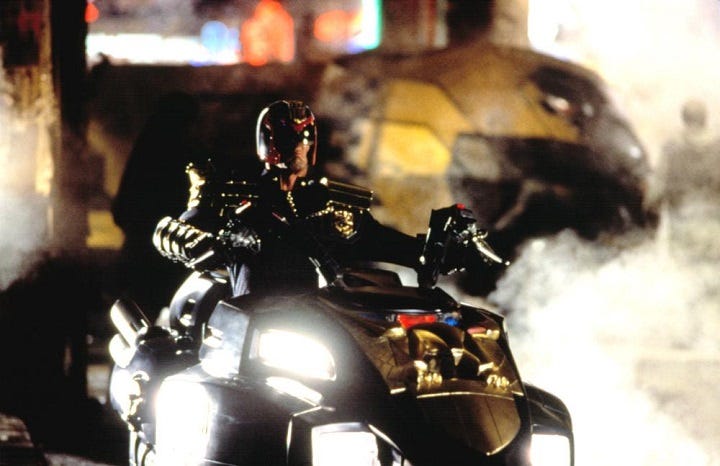
Safety concern about riding a vehicle: “I was there, perched on this enormous machine, with on my head a helmet that did not provide the slightest protection and which almost blinded me. My feet were far from touching the ground, I was especially careful to keep my balance while directing my gaze upwards.”
There was one upside: “And the fight that opposes me to Joan Chen, the bad girl, is something other than a hair-pulling, than a fight of rag-pickers.”
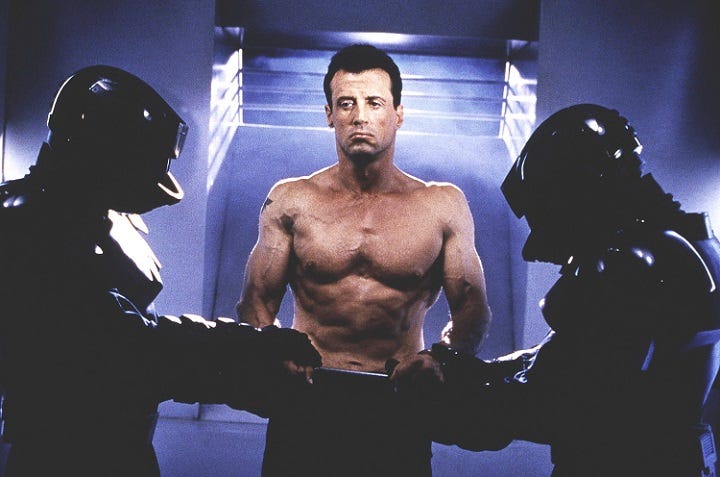
That’s it for the August 1995 issue of Impact. Now it’s time to delve into what was duly noted in the July issue of Mad Movies. Besides the Cinderella story of being a fan of the comic book since he was a child, director Danny Cannon made a rather astute point during pre-production: “The first thing I told them was to please not make a "future cop" film, with a classic detective story plot transposed to another era. The film had to be on another level, epic, brilliant, moving. I kept saying please, don't make Lethal Weapon in Space!”
Too many cooks: “When I arrived on the project, there was still a lot of confusion. Five screenwriters, all very prestigious had worked on the project at different stages, but on certain points they didn't really understand what Dredd was, they made him out to be just another vigilante. Dredd is Star Wars meets Ben Hur. When we think of films like Ben Hur, El Cid or Spartacus, or those classic peplums that I love, we all remember the conviction that the directors and the actors had for their characters, who took on a tragic, grandiose dimension. Judge Dredd stems from the same spirit. You have to totally believe in this universe, and immerse the audience in it. That's the great richness of this story. There are references to Greek mythology, to the Roman Empire. Dredd could have been a centurion, or even a knight of the Arthurian era. In this we can say that Dredd is an absolute hero, totally timeless.”
My joke is that Danny Cannon could have revived the Cannon Films company. In all seriousness, he really stepped up to the plate…perhaps realizing that his swing is more of a miss than a hit: “If the film fails it will be entirely my fault. I will assume responsibility.”
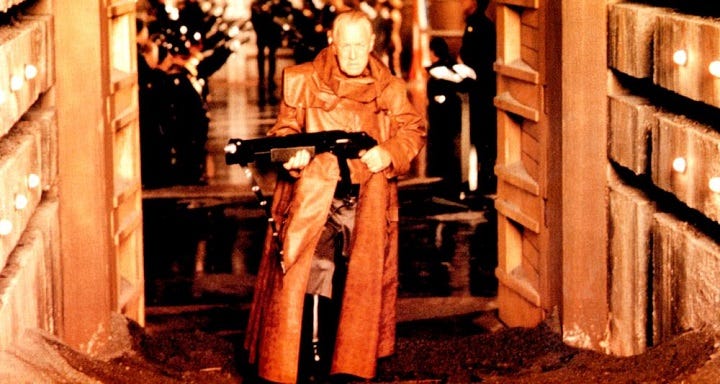
Time for a fresh perspective in the form of production designer Nigel Phelps, who worked on a Tim Burton film in the late eighties: “On Batman, we had come up against an immeasurable number of difficulties, because we were starting from scratch, we had never designed a city as a whole. Everyone learned a lot from this shoot, which means that Mega City One, despite its complexity, was not such a difficult challenge to take on.”
Contacted by Marco Brambilla (the director of Sylvester's Demolition Man), who was once attached to the project, Phelps had no trouble converting Danny Cannon to his rather pessimistic vision of the world of tomorrow. Over the weeks, it quickly became obvious to Nigel's team that it was impossible to literally transpose the Mega City One from comics to celluloid: “Basically, we started with elements that existed in the comics, in particular the fact that the city is surrounded by titanic walls, a megalopolis where architectural styles mix happily. But the contribution of the original work stopped there, since in any case, each artist who has drawn it since the early years has given it a very different graphic treatment each time. In any case, it never seemed viable to me to want to stick too closely to a comic strip, which is a medium that works very differently from cinema, despite appearances. For me, comics must always remain a starting point, not a constraint. You will find this idea throughout the film.”
A bit of a left turn from his cause, there. About the hill that Nigel Phelps will die on: “I absolutely wanted to stay very close to the New York that we know in terms of topography, as opposed to a film like Batman for example, whose approach remained much more fanciful. You will see that at street level, we are still architecturally quite close to today's Manhattan. It is a place with strong red, dark, dusty dominants. The higher you go, the more you reach the upper classes in society. Modern buildings have covered the old buildings, and on the extreme heights of the city, we have really high-tech buildings, on which we worked a lot on the computer, to give a particular texture to the reflective surfaces of the buildings. This idea of a city built high up, in layers, is something that we had tried a little on Batman, but which is pushed to the extreme here.”
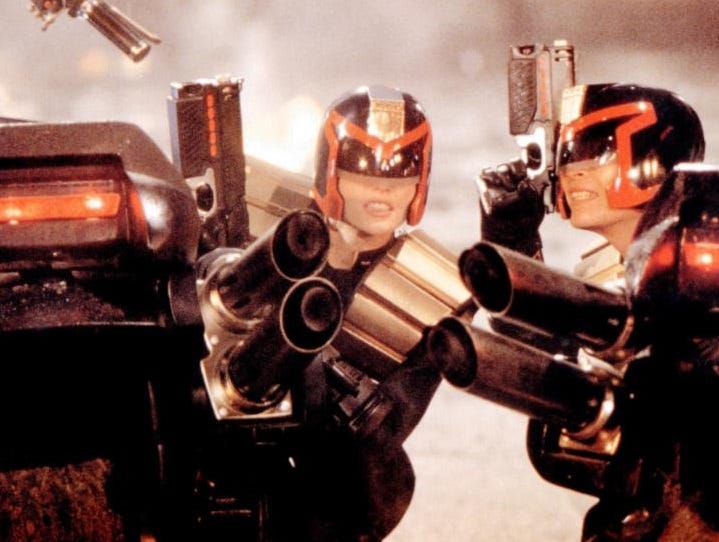
About the finale, Danny Cannon said: “Towards the end of filming, the producers wanted to add an additional action scene. During a meeting, I pitched the idea of a flying motorcycle chase. Everyone was enthusiastic, and very quickly we storyboarded the sequence, which was shot straight away!”
Robot supervisor Joss Williams talked about one of the main antagonists - Mean Machine: “We wanted to avoid the classic look of guys in armor like Gort in The Day the Earth Stood Still or C3PO in Star Wars. In addition, the character regularly had to fight against the protagonists of the film, and designing him digitally involved almost insurmountable difficulties.”
Costume designer Emma Porteous (who worked on Aliens) said: “I don't think it's really possible to reproduce the Judges' uniform as is, simply for practical reasons. The comic book costume, with a stylized eagle on one shoulder and an American football epaulette on the other, necessarily has to be reinterpreted. These elements have to be able to fit on the actor's shoulders, which is no easy feat, and he still has to retain a certain autonomy of movement.”
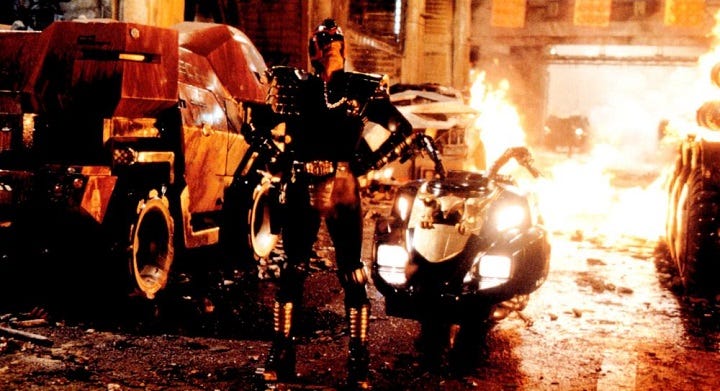
All in a day’s work for the judge, jury and executioner. Director Danny alluded to there being a future day: “There were so many obstacles to overcome: it was necessary to create a universe from scratch, introduce characters unknown to the public, show crazy technology... Now that it's all finished, you know who I envy? The guy who will make Judge Dredd 2, because he will really only have to tell his story. We will have done a hell of a job for him!”