
Design Desire

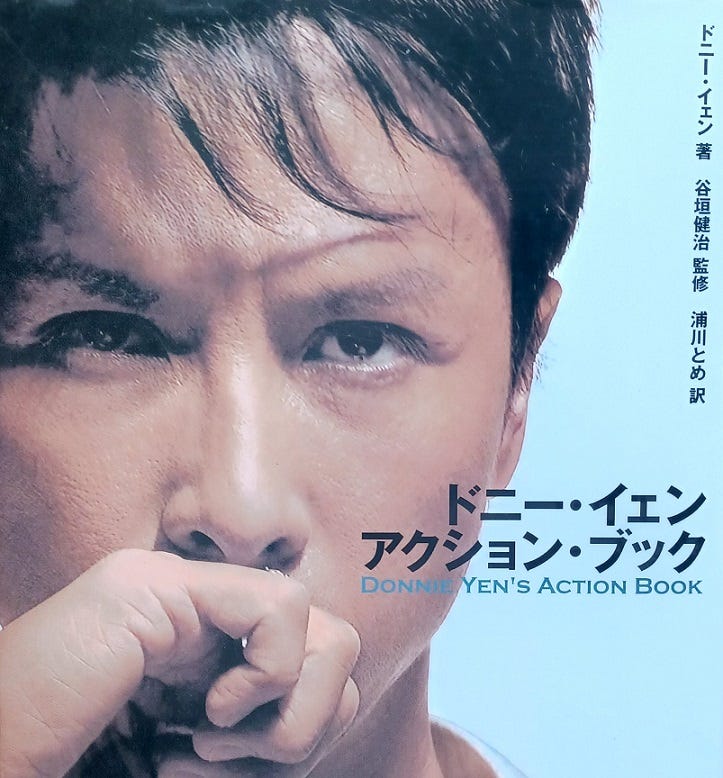
Donnie Yen’s Action Book is a rare book that was aimed at just the Japanese market. Don’t let his surname fool you, Donnie is not Japanese. His book was published in late 2005 by the publisher of a magazine called Kinema Junpo, as mentioned in English on one of the pages. On the same page, it’s mentioned (also in English) that the book was published under a license granted by Donnie in favour of a literary agency called Japan UNI Agency, Inc.
Here are some important lessons imparted by the book, starting with the first most important one: Try watching a movie with the volume set to zero. When you turn off the sound, you reduce the number of elements that make the picture look smoother (by eliminating the sonic connections), and the cuts become more clearly visible. A clear plot will tell most of the story. On the other hand, in the minimalist plots of art films, much of the decision is left to the audience. Critics look at the finished film and offer many insightful interpretations, but ironically, the core of the film is actually a realistic response to the problems that arose during filming.
John Woo's films make good use of telephoto lenses to create a romantic effect on screen. Telephoto lenses magnify motion in the distance, focusing only on the subject and blurring everything else. A surreal feeling arises from this. Unlike wide-angle shots, the image is not distorted, and the subject appears in its actual state. John Woo rarely uses wide angles. Sometimes a close-up of a face is captured in one corner of the screen, but in most cases the images are realistic. A long lens has a shallower focal length than a short lens, so only the object that is in focus can be seen clearly, while the background and foreground are out of focus. This is useful when you want to cover up unnecessary objects in the background. However, if the actor who was in focus moves even slightly back and forth, it will immediately become out of focus. When you want to keep a clear view of fast action, it's difficult without a very skilled focus puller (the person in charge of adjusting the focus).
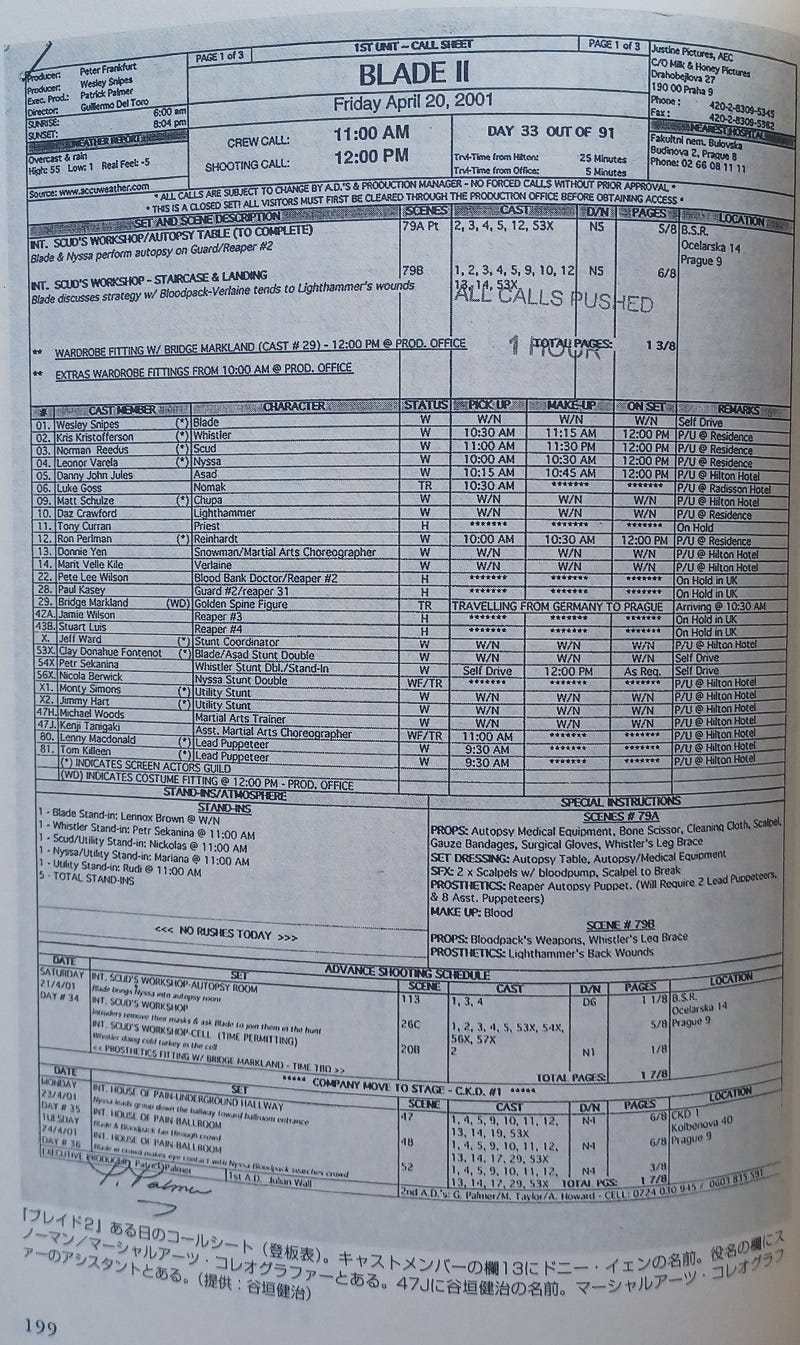
If you can understand the regularity of movements and the best angles, you can transform even half-baked actions into great-looking images. The basic concept of using wide angles in action movies is to add power to movement and make small things appear larger. The captured image curves around the edges of the frame. The closer the camera gets, the wider the angle becomes, and the closer the subject approaches the camera, the more distorted their face becomes, like when looking through a keyhole in a door. It has a deep focal length, allowing you to clearly see objects in the background, making it suitable for emphasizing depth and adding depth to the image.
In particular, wide angle shots from a low position make the action look powerful, creating the effect of making the action appear more clearly visible to the audience. On the other hand, wide angle images are not realistic. If a scene is shot entirely from wide angles, and the faces keep curving in the corners of the screen, the image will clearly look different. It gives an open impression. This method was adopted by Sammo Hung when he worked with Michelle Yeoh and Cynthia Rothrock. If you watch the action movies of Sibelle Hu or Moon Lee, you will notice that they are full of short cuts with wide angles, flashy action and crazy explosions along with almost no motivation as well as unconvincing actress poses (Donnie Yen’s words).
Donnie uses a Steadicam when he wants to take shots while moving in places that are too steep or uneven to use a dolly track. However, Steadicams are often unsuitable for shooting action scenes. First, the speed of the action is so fast that it is quite difficult for the cameraman to follow it while holding a Steadicam. Also, unlike martial arts movements which stop quickly and accurately, Steadicam uses the force of a spring to prevent camera shake, so it is not possible to suddenly stop the camera's movement. Steadicam footage is smooth, so it's good for shooting running scenes, but it's not suitable for capturing the roughness and explosiveness of action. So, the Steadicam is definitely a useful tool, but only for ambience-based shots. Traditional handheld cameras are better suited for quick stops and short movements.
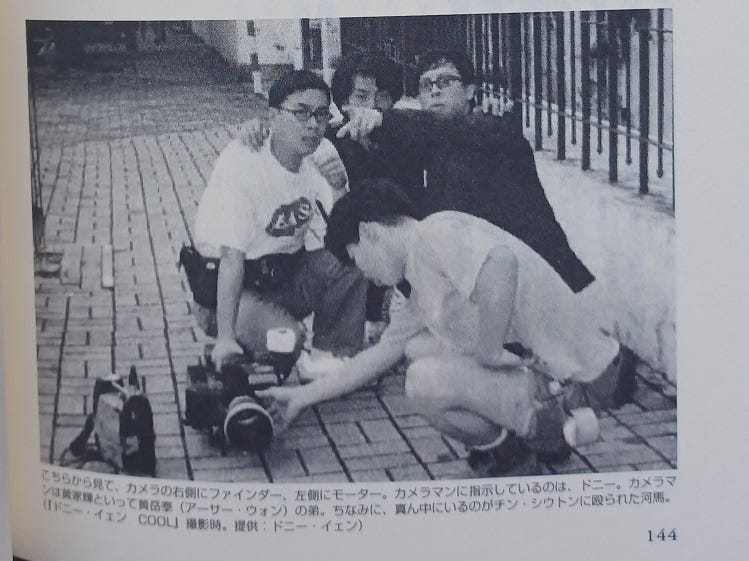
It is often thought that action scenes are cut at the end of one action, but in many cases, it is better to cut in the middle of the action because the consistency is stronger. It also helps editors easily find editing points. Otherwise, the continuity is choppy. In general, connecting long shots after long shots tends to result in boring images. The standard method is to sequence a long shot, close-up, and then another wide shot, and then change each shot to a different type of shot to give the scene sharpness and contrast. However, that doesn't mean it's wrong to connect a long shot to another long shot.
Donnie explains why himself and other Hong Kong mavericks don’t use storyboards: “Things change on the set of action movies. The lighting man would come and tell me that he couldn't put lights there. An actor may not be able to perform simple actions well. If his right leg is injured, he won't be able to kick with that leg. It is important to adapt to such problems as quickly as possible, and whether or not there is a storyboard, it naturally exists in the director's head. Otherwise, it means that the director doesn't know what he wants to shoot. In Hong Kong, at the peak of film production, one director would make four or five films a year. Directors who have shot many films in this way know what they want to film.”
Another reason that he gives: “Typically, I make a rough cut, then let the scene rest for a while, then go back and tweak it to make it even better. You may even change your mind and change the order of the shot list. The advantage of Hong Kong films is that they are flexible on set. That doesn't mean you don't prepare anything in advance. This means that you can immediately bring your ideas to life on screen, and you can make various changes on-site. That doesn't work in Hollywood, and I think it's difficult to do that in Japanese movies as well.”
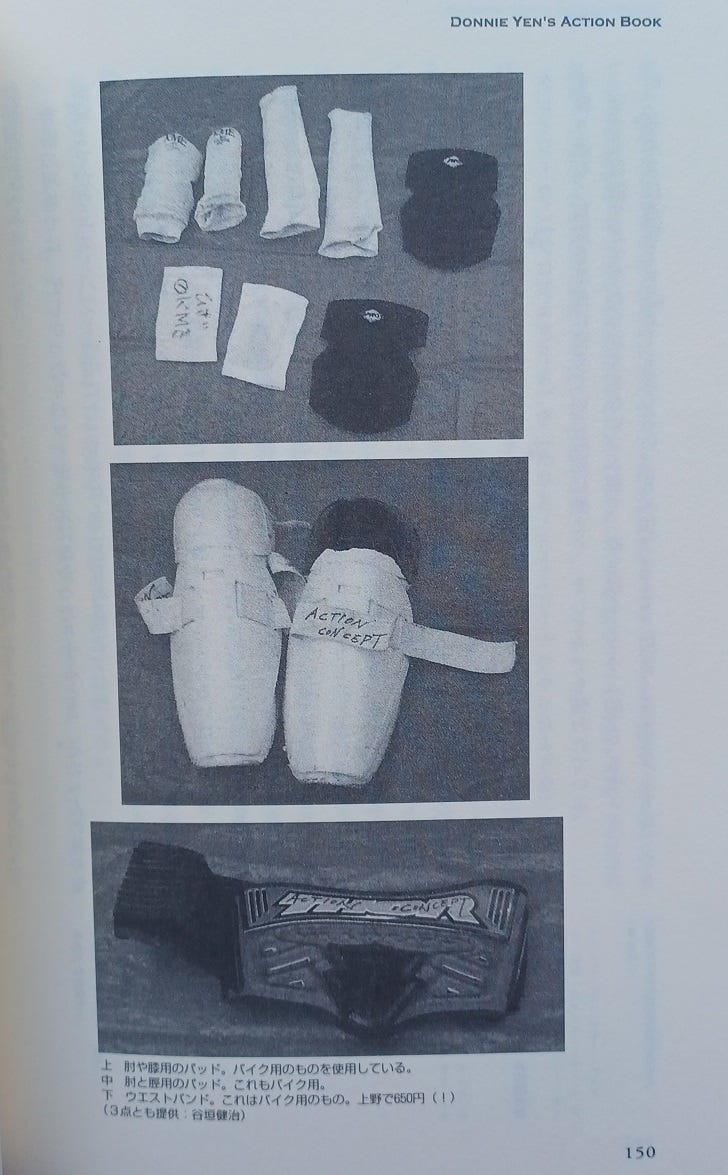
There is a special spray that you apply to the soles of your shoes to help you run up walls or stop suddenly on the floor. But using cola is cheaper. When cola is dry and sticky, it plays the same role.
Baby powder isn't the only way to emphasize your strikes. Sometimes water is used to achieve similar effects. When someone destroys a table, by dusting it with powder beforehand, a large amount of dust will fly off as soon as a person hits the table, clearly expressing the power of the blow. However, baby powder is too white in color, so if you want a more sophisticated effect and your budget allows, you can mix baby powder with cement-like powder (so-called hattai flour).
Donnie Yen likes looking at fashion magazines with sophisticated designs and decors. He keeps the image in mind and often applies it to martial arts scenes and action scenes in general. For example, in a wide shot, you might want to place something like the corner of a chair in the foreground. This will allow the audience to see more information so that they don’t get jaded. This method is different from the old Kung Fu movies where people fight in an empty space.
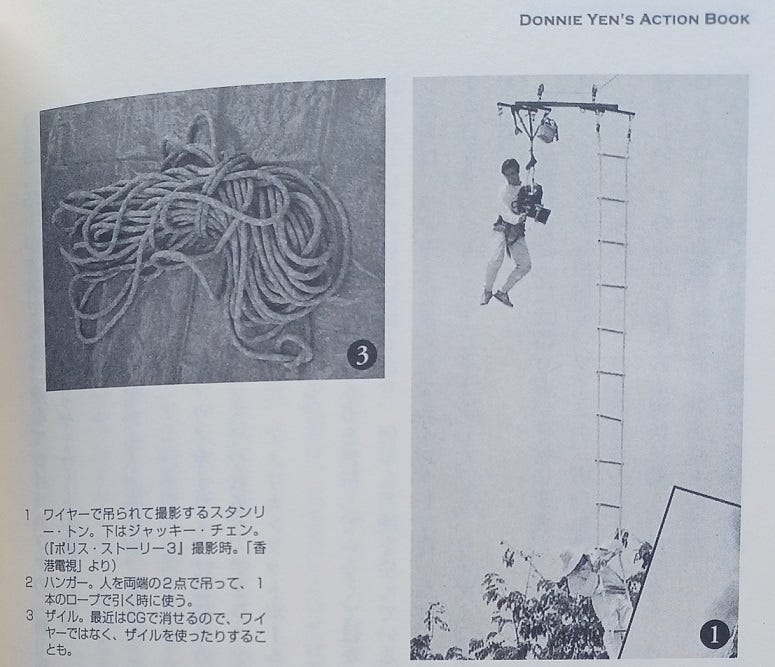
Besides being used for wirework, Donnie said this about ladders: “When using a trampoline, I usually also use a ladder. A ladder is essential, especially if the shooting location is small and there is little space for a run-up. Running and jumping while wearing elaborate costumes and large swords consumes energy, so ladders are often used. Actions using a trampoline often do not look realistic because the person suddenly enters or exits the frame.”
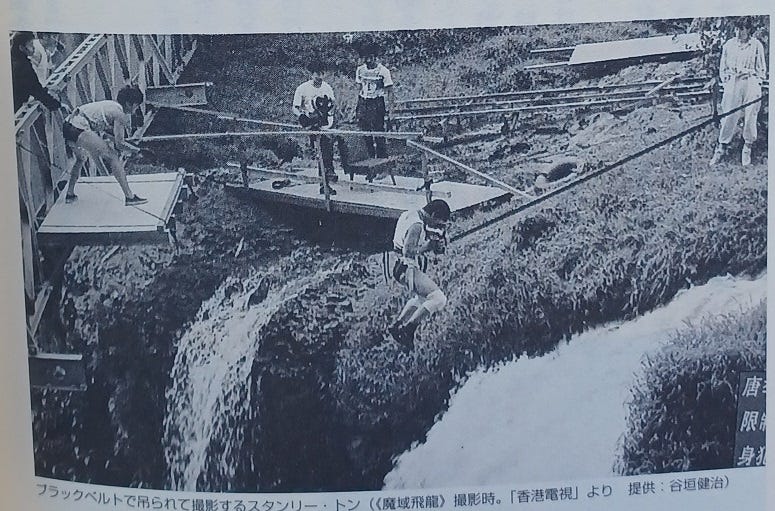
The right photo on the above page depicts Stanley Tong directing Jackie Chan during the making of Police Story III: Super Cop (1992). The below photo shows Stanley daringly direct Stone Age Warriors (1991). This movie was the reason why Jackie hired him, and it got to the point that Stanley was Jackie’s main collaborator in the nineties.
Yuen Woo-Ping’s favourite criticism is “without bridge” i.e. there is no concept without motive. That has become a habit for Donnie as well. A “bridge'' is rarely a specific action, but rather a discovery of a concept. A fight can’t just end for the sake of it. There has to be an explanation (not necessarily exposition) even if a fight gets interrupted. Even if a character dies, there has to be some kind of a response or continuation of a plot beat. This became apparent in the old days of Kung Fu movies where the story ended literally after the villain had been killed.
Like Jackie, Donnie is an abstract composer with how he plays with timing: “My basic concept for martial arts and film is rhythm and tempo. It's also my trademark. Rhythm is the most important element. Everything has a rhythm and pace. Sometimes rhythm is created through choreography, sometimes through editing, and sometimes through sound effects. Certainly, there are fundamental and technical aspects to action that suggest chaos and spontaneity. But in the end it's all about the harmony of the whole.”
In Hong Kong movies, the director usually makes decisions such as slow motion here, speed up here, or make this a junction (editing point). However, in Hollywood, the intentions (or inventions) of investors, producers, and editors make the finished product inconsistent. Speaking of inconsistency, changing the pace is important. When an actor's actions are so fast that it is difficult for the audience to understand what they are doing, slowing down the action with slow motion or a controlled pace is necessary. If there is a lot of fast-paced action happening one moment after the other, the audience's eyes may get tired or have trouble digesting the action. When the actors can't move fast enough or are too tired from filming action scenes for 10 or more days, as is often the case in Hong Kong, the action will be shot in slow motion to emphasize the power and drama.