
Caucasian Hawk

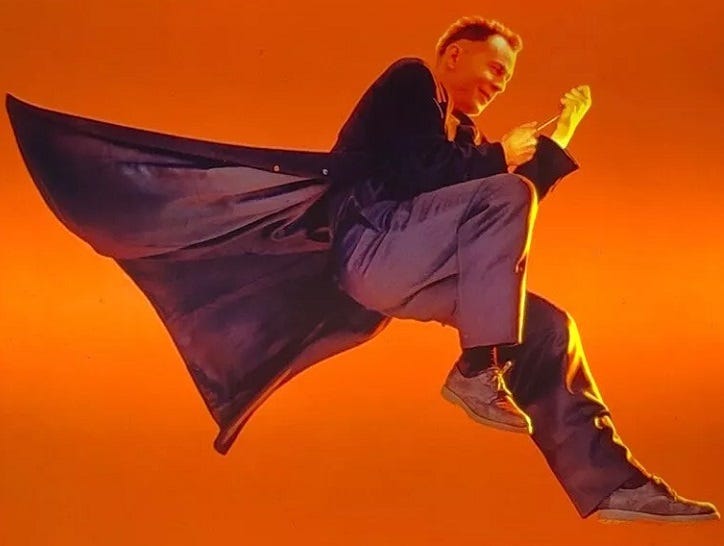
As opposed to Jackie Chan’s Asian Hawk. Hudson Hawk (1991) has more to do with the influence of Hong Kong cinema than James Bond or Indiana Jones. When the Bruce Willis movie was being filmed from July to December of 1990, Jackie was making Operation Condor - the sequel to Armour of God (1986). Hudson Hawk is more like a heist movie than an archaeology movie (or even an episode of MacGyver), and this has to do with the fact that John Woo had been working on Once a Thief (1991) for quite some time. Producer Terence Chang had mentioned in his 2023 memoir that John began location scouting in France circa May 1990, whereafter it was decided that Roman Polanski’s production company was to co-produce the French part of the production. Filming began in early November, and the movie was released in early February. Back to 1990, word had spread in Hollywood about The Killer, and John found himself being invited to work in Hollywood. Like Once a Thief, Jackie Chan’s Operation Condor was released in early February 1991.
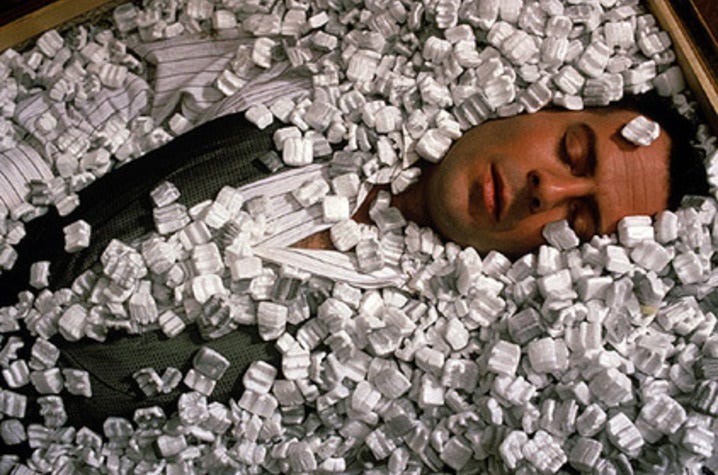
Hudson Hawk was released in late May 1991. Producer Joel Silver had long been a fan of Hong Kong movies. In fact, he almost made a movie with Cynthia Rothrock playing the sidekick of Sylvester Stallone in the late eighties. This was The Executioner. While that did not come to pass, Joel produced a 1993 movie (Demolition Man) where he originally wanted Jackie Chan to play the villain. Jackie’s Armour of God had an influence on Hudson Hawk in the form of many elements. There is a flashback that provides the literal history of the premise. The leading man meets the leading lady at an auction. The religious nature of the premise means that we get to see monks. There is a comedy scene that takes place in a dining area outside of a restaurant. During one of the heists, we get to see the protagonist ziplining. Both movies even share the novelty of the protagonist singing alongside his male sidekick. In Armour of God, one of the bad guys tries to force himself onto a woman whereas Hudson Hawk has a scene where a bad guy recommends to his cronies that they should r@pe the leading man and lady. Likewise, both movies contain different sight gags involving statues.
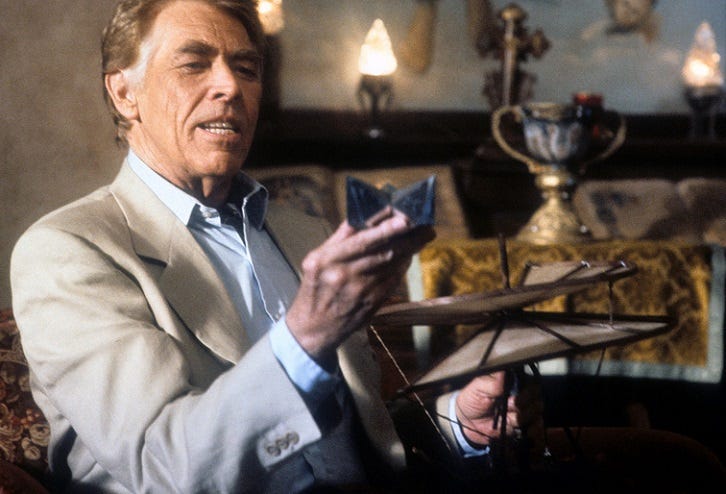
Jackie Chan’s Wheels on Meals (1984) also had an influence on Hudson Hawk. Both movies contain a scene where the protagonist and his sidekick ride skateboards. We have a character who uses dual blades. We have a charade involving an ambulance. The finale involves rescuing a damsel from a castle, right down to the inclusion of a crossbow and a spear. Instead of having some bad buys play softball outside the castle, we have one of the villains play with a tennis ball machine inside. In Wheels on Meals, a crazy man titled his head as if it was the pendulum of a clock whereas Hudson Hawk has a scene where Bruce Willis keeps on tilting his body backwards and forwards after being kicked from both sides. With all this going on, it helps that producer Joel Silver had cast Danny Aiello - Jackie’s sidekick in The Protector (1985). One of the villains is played by James Coburn, who was one of Bruce Lee’s students. It’s not a coincidence that Coburn’s character is a martial artist. His final scene pays homage to the shortened block of wood gimmick in Fist of Fury (1972) and Bruce’s final scene in Marlowe (1969).
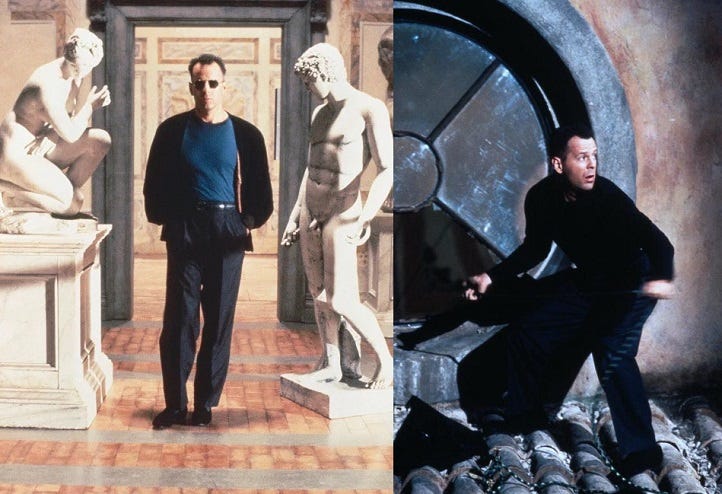
When it was released in early 1991, Jackie Chan’s Operation Condor had a reputation for being the most expensive Hong Kong film with a budget of 15 million U.S. dollars. Hudson Hawk would have received a similar status in Hollywood had it not been for Terminator 2: Judgment Day (1991). The former cost 70 million whereas the latter was well over 90 million (the specifics being redundant when you consider the magnitude of the 90 million barrier). Both movies were distributed by TriStar Pictures (Hudson Hawk even contains a sight gag that alludes to the Pegasus mascot), but Terminator 2 was produced by Carolco. They were the rich man’s equivalent to the Cannon Films Group because of how much record-breaking money was invested in their earlier action movies i.e. Sylvester Stallone’s Rambo III (1988) had a whopping 63 million budget whereas Arnold Schwarzenegger’s Total Recall (1990) had an astounding 65 million budget. This is not a laughing matter when you consider the colossal box office failure of Ishtar (1987) whose ground-breaking budget was 51 million.
In fact, Joel Silver must have known that he was biting off more than he can chew given the risky nature of making a goofy action movie where Bruce Willis doesn’t even fire a gun (albeit other people do). This is no small feat, which makes the movie rather impressive in the grand scheme of things. With a more measured approach towards the material, Hudson Hawk could have been rewritten to be PG-13 so that more people could watch the movie. As you might gather from my comment, the movie was not a big hit in America. How I know for a fact that Joel Silver sensed that the movie would underperform can be detected in two scenes featuring newspapers. In one scene, the date is June 3. In a later scene, the date is June 8. Having the movie released on May 24 meant that it could get an early start in word-of-mouth before the releases of Robin Hood: Prince of Thieves (released in mid-June) and Terminator 2 (released in early July). Given that he would later direct Bruce Willis in Death Becomes Her, it’s a mystery that Robert Zemeckis wasn’t hired to direct since he was already co-producing a TV series with Joel Silver i.e. Tales from the Crypt.
Let’s get back to John Woo’s Once a Thief. In the movie, Chow Yun-Fat spends most of the running time in a wheelchair. Bearing in mind that this was a comedy where Chow showed signs of the goofiness that made him endearing in Wong Jing’s God of Gamblers (1989). According to screenwriter Daniel Waters, there was a comedic scene involving a wheelchair in the original (two hours and forty minutes) cut of Hudson Hawk. This cut was only seen in the first test screening because Bruce Willis didn’t realize that not all of the jokes had landed. Among the 160 minutes, who’s to say that there couldn’t have been other moments of Hong Kong inspiration? When you make a movie with an exorbitant budget that has to lose 60 minutes of footage, you have to shoot more footage so as to cover the cracks of the missing hour (especially if there was a disastrous test screening). After all, six months went by from when principal photography ended to when the movie was released nationwide in the U.S.
Wong Jing’s God of Gamblers III: Back to Shanghai (released in August 1991) contains some interesting similarities to Hudson Hawk. Besides sight gags about electrocution, there is even a part of the finale where Stephen Chow is dressed similar to Bruce Willis in an earlier part of Hudson Hawk. Both movies contain a comedy scene that takes place in a church’s confession booth. Also, the cataract effect of a villain’s left eye in the finale of Hudson Hawk is similar to the left eye of a bad guy in Wong Jing’s movie; this bad guy who already had that look in God of Gamblers II (released in December 1990). I know that Jing had a reputation for going to America to see movies before they were released in Hong Kong so that he could be ahead of the curve when anticipating trends. Joel Silver isn’t the only fan of Hong Kong movies; Bruce Willis is also a fan if you compare the opening shot of Striking Distance (1993) to that of Jing’s Crocodile Hunter (1989). In Jing’s God of Gamblers Returns (1994), there are two scenes that evoke the memory of Hudson Hawk - a male character pretends to be a half-naked statue, and there is another male character who kills a pet.
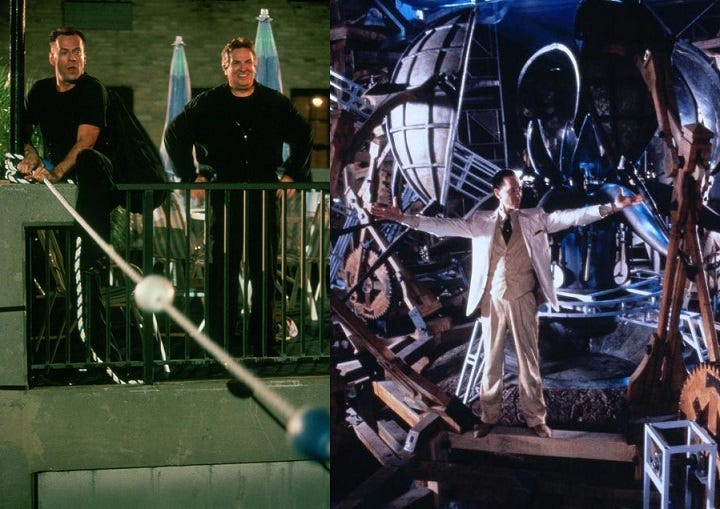
While Wong Jing is derivative, one can’t forget the influence that Hong Kong cinema had on Hollywood. All that it took to be inspired would be to go to an American Chinatown to find a film that could be purchased either on video, VCD or LaserDisc. If Michael Jackson can visit the Shaw Brothers film studio in 1987 then anything is possible. It’s not a stretch to think that Wong Jing was on the minds of Bruce Willis and Joel Silver. The aforementioned Crocodile Hunter would have got the attention of Bruce on the basis that the movie begins and ends with scenarios similar to Die Hard (1988). As such, Hudson Hawk contains a humorous exchange between two security guards about the number of Wongs in the phone book. The second guard makes a pun about Wong rhyming with wrong. The difference between Hudson Hawk and a Hong Kong movie is that the former went through numerous rewrites mid-production whereas the latter had a more casual yet confident attitude towards making things up as they went along. While too many cooks can spoil the broth in Hollywood, everyone in Hong Kong can chip in as long as you don’t step on anyone’s toes.
Although the screenplay for Hudson Hawk gets a lot of flack how things play on the screen, there is something to be admired about how the final reel reflects what happens in the opening scene. This is sort of akin to Jackie Chan’s Armour of God - the first fight scene that Asian Hawk has is with a group of black guys whereas his final fight scene is with a group of black women. In Hudson Hawk, only one of the villains is a black woman. Of course, comparing both movies only serves to highlight the limitations of Hudson Hawk. Jackie’s consumption gimmick was the way that he used his fingers to throw chewing gum into his mouth whereas Bruce Willis has a running gag about not being able to enjoy a cup of cappuccino. Jackie jumped out of an airplane for the air balloon scene, but Bruce relied on a projection screen for his aerial escape from the castle. This may seem like a silly pet peeve, but Bruce needed to take martial arts lessons if he was going to make an action movie where he doesn’t shoot anyone, drive cars or ride bikes.
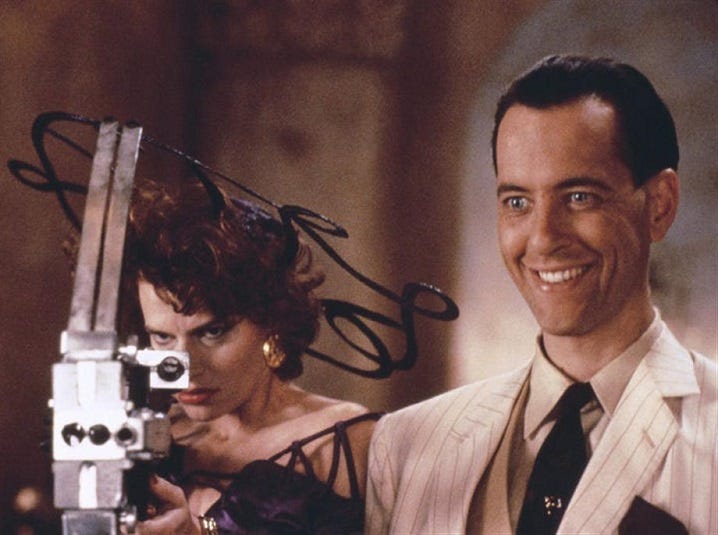
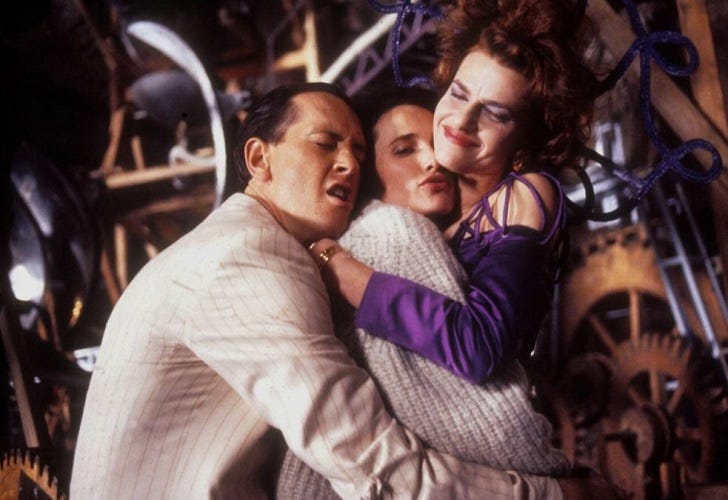
Andie MacDowell as Anna Baragli has a modest charm to go with her modest beauty but she doesn’t compete with Lola Forner’s May Bannon, even if they share the desire to rebuff the sexual advances of their male protagonists. Besides the spelling of Anna’s surname being enough to convey the impression of being inspired, two of the villains are a couple whose surname is Mayflower. Of all the surnames to choose, why that? The best way to be inspired by a film is to distort the original’s ideas like writing a book or screenplay where a group of people become a composite. It’s obvious that Hudson Hawk was an attempt to reinterpet Armour of God in an abstract manner. In Armour of God, Alan Tam was injected with a needle by his love interest (Rosamund Kwan) that allowed him to be kidnapped. In Hudson Hawk, Bruce’s cup of cappuccino is drugged by his love interest - the aforementioned Andie/Anna. Although, having said that, there is a scene in an ambulance where he defends himself against an Italian gangster by shoving a tray of syringes into the man’s face.
Just to digress for a moment, Jackie Chan’s first autobiography (I Am Jackie Chan: My Life in Action) revealed that Bruce Willis had expressed an interest in starring alongside him in a film but they could never find the right project to fit their personalities. Both men have proven to be professional singers in that they released more than one album, as was the case with Eddie Murphy. All three men could have done a film about three singers in the music industry who have to come together in order to literally fight off jealous rivals and gangsters eager to extort them. Eddie was the first choice for Chris Tucker’s role in Rush Hour (1998), and it’s not difficult to understand why. Beverly Hills Cop (1984) had an influence on Police Story (1985) whereas Jackie’s Miracles (1989) predated Eddie’s Harlem Nights (1989). I mentioned more about this in a WordPress article titled Zodiac Brothers.
There is one thing that I will regurgitate from that article which actually ties in with Hudson Hawk. In those 1989 movies, two actresses were replaced for reasons that haven’t been provided satisfactorily. Producer Joel Silver has had bad luck with the leading ladies of his films. Kelly Emberg was fired well after filming began on Weird Science (1985) just because Kelly LeBrock changed her mind about doing it. Emberg was used as bait since they were rivals in Rod Stewart’s love life. Annette Bening was meant to play Patrick Swayze’s love interest in Road House (1989) but was ditched in favour of Kelly Lynch due to a lack of chemistry. I’m not buying this because that’s why you have chemistry tests during the audition stage. Finally, we have the example of Lori Petty being replaced by Sandra Bullock on Demolition Man (1993). Like with Road House, it was another chemistry issue…but that has about as much weight as the usual “creative differences” excuse.
The truth of the matter is that Joel Silver had let slip that he thought Lori Petty’s haircut made her look like a lesbian. He didn’t use the D word but he did use the M one. You can find out what he said if you search for the June 1993 issue of Spy in the Google Books section. As for the casting mishap on Hudson Hawk, it was reported in November 1989 that Isabella Rossellini would play Anna Baragli. In the spring of 1990, it was reported that Anna would be played by Isabelle Adjani. When it was announced in late July 1990 that Maruschka Detmers would play Anna, it had been more than a fortnight since principal photography had begun. Clearly, Joel Silver wanted a European actress to rival Lola Forner. After a month of filming, Maruschka had “back problems” that caused her to be replaced by Andie MacDowell. This replacement only happened after Bruce and Joel had failed to convince Madonna to take over from Maruschka.
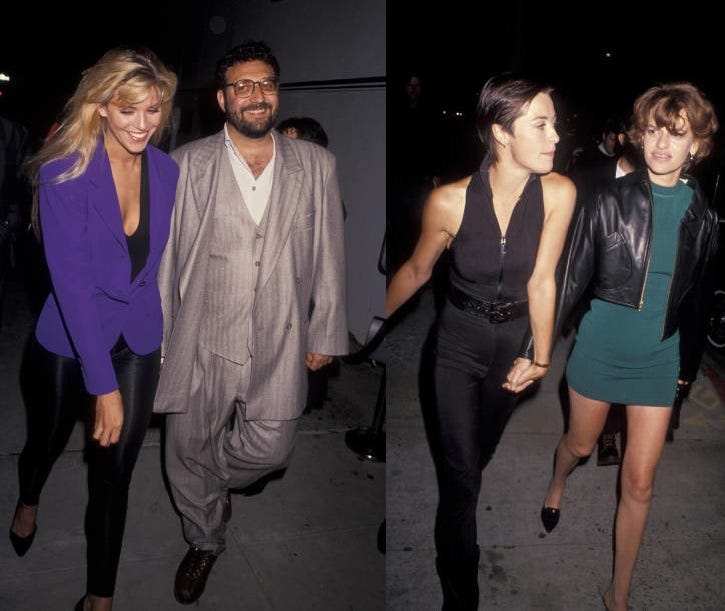
The above collage is the right kind of curveball. Alongside Joel is his Playboy model girlfriend, Lisa Matthews. Not only was she in Hudson Hawk but in an earlier film of his - The Adventures of Ford Fairlane (1990). Let’s get back to Joel being a homophobe. The woman on the far right is Sandra Bernhard. She is a bisexual actress who played one of the villains in Hudson Hawk. Her date for the film’s premiere was Amanda Donohoe - an English actress who had recently received a lot of attention for playing a bisexual in L.A. Law. To conclude, here is some serendipitous trivia: Ernie Hudson played a character named Hawk in an American TV movie (Walking Shadow) directed by a Hong Kong film director: Leung Po-Chi.