
Category 3 Hurricane

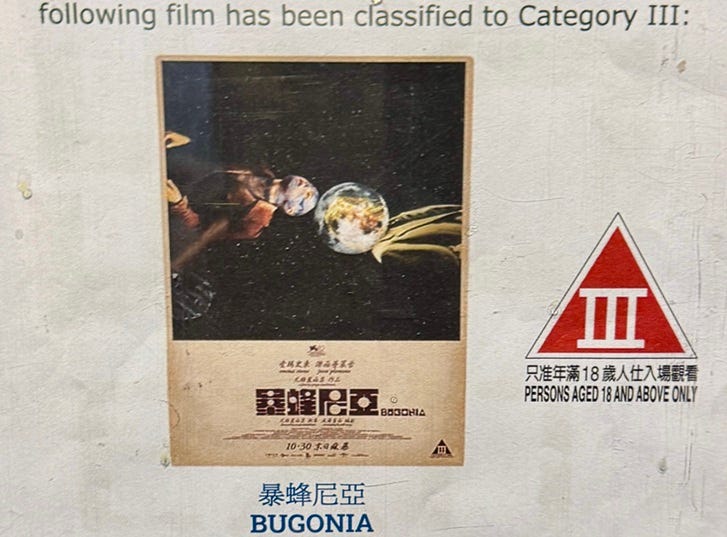
Hong Kong’s Category III is the polar opposite to the equally triangular U rating in Britain. U (as in universal) is presented in green as in “go” whereas the red triangle is reminiscent of “stop” in traffic and appliances. In Britain, the only other triangular rating is PG - the colour for that is reminiscent of Asia’s Golden Triangle. Emma Stone starring in the III-rated Bugonia (2025) and Poor Things (2023) is ironic given that she no longer has the red hair to go with the rating. By comparison, Jennifer Lawrence wore a red dress in the III-rated Red Sparrow (2018). Back when Hollywood was desperate to cater to the Chinese market, American film moguls missed out on making Category III H.K. movies with Hollywood stars. While many film critics cite internet p*rn*graphy as the reason why we no longer have erotic thrillers and sex comedies, there will always be a thrill in seeing regular actors in scenes that you would associate with the raincoat crowd.

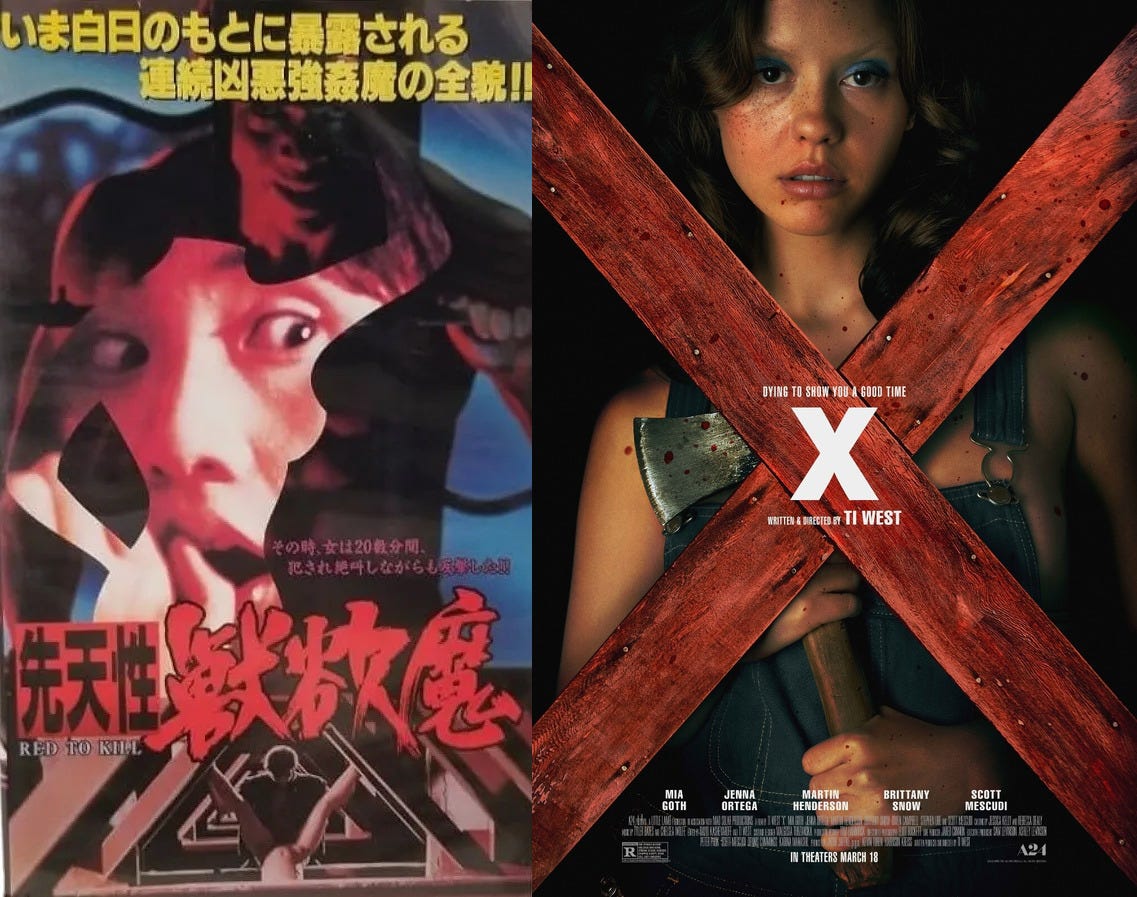
The fear of missing out didn’t really get to Wong Jing. When Michael Douglas starred in the sexually charged Fatal Attraction (1987), Jing did nothing to capitalize on it. When Douglas starred in the pulsating Basic Instinct (1992), that’s when Jing took the bull by the horns by greenlighting a Hong Kong remake called Naked Killer (1992). The idea that Red to Kill (1994) had of literally constructing an image reminiscent of a film rating clearly rubbed off on Ti West’s X (2022). Another example of Category III influencing Western cinema is the invisible sex scene in The Eternal Evil of Asia (1995). The influence was clearly felt on the Butterscotch movie franchise (all five films were made in 1997). In Chinese culture, eight is a lucky number. This is why Robert Clouse’s biography on Bruce Lee was published in the eighth month of 1988. In one paragraph, Clouse wrote: “No matter where a film is being made, information about a project can be rapidly transmitted. The easy flow of conversation between artists and executives by transcontinental telephone, and through a million daily lunches, late-night parties and bar talk, starts the process toward a consensus of any given production.”
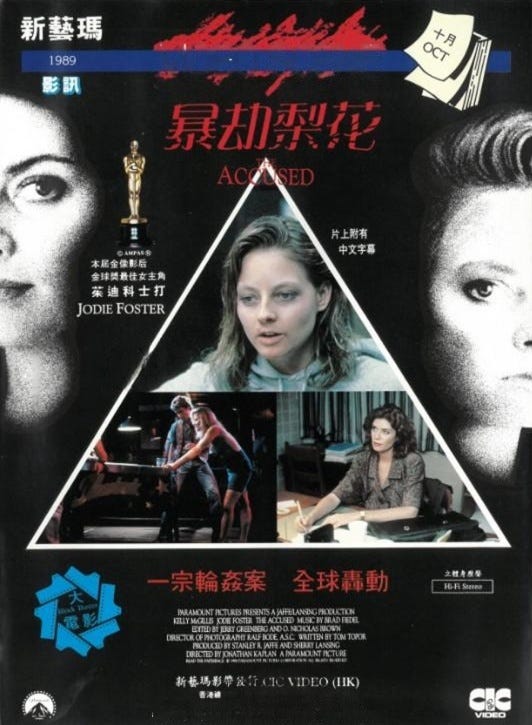
None of this is more true than in the case of The Accused. It was released in America on October 14, 1988. In what could be perceived as a pre-emptive strike, the Hong Kong film industry was already cashing in with similar-themed films in the form of Her Vengeance (released in H.K. on October 7) and Vengeance is Mine (released in H.K. on October 28). The caveat is that Category III came into effect on November 10. America’s R and X ratings were licensed twenty years earlier on November 1, 1968. This was important because this imbued creative freedom in the writing team behind The Silent Flute in 1969 - Bruce Lee, James Coburn and Stirling Silliphant. Sadly, not only did the film not get made but 1969 was when two of Bruce’s friends were murdered - Jay Sebring and Sharon Tate. Back to the Category III rating, it’s telling that the date of establishment was the last theatrical date of Sammo Hung’s Spooky, Spooky and Billy Tang’s Vengeance is Mine.
In what could be perceived as the one year anniversary of the trifecta of female revenge films, October 1989 saw another significant event. Hsu Hsiao-Tan (a.k.a. Hui Hiu-Daan) was a provocative performance artist who ran for a seat in Taiwan’s Yuan legislature. She was Yoko Ono without John Lennon. Hsu had a supporting role in a Taiwanese film called Midnight Lover (1987). In real life, she drew attention to her campaign by combining activism with exhibitionism. Describing her body as a political weapon, she continued to tell the Taiwanese press that she was using breasts to fight against fists. Her legal defense was that politics are more dirty than the human body. Hsu failed to get elected but was immortalized in a sci-fi movie called Robotrix (1991). In Chinese culture, a nude woman is described as showing her three points. Perhaps pizza should be slang for that instead of inappropriate relations with minors. When people use pizza in code, it seems like they are conflating the U and Category III ratings. When you consider that not all professionally trained actors land jobs, the entertainment industry is a pyramid scheme.
Back to Hsu, she was known as Taiwan’s first nude model with a university degree. This suggests that there were supposedly no other female students who thought about needing sex work to survive. During my years on MySpace, I actually knew a uni student who relied on cam work to support herself. When Mainland China resumed control of Hong Kong in July 1997, that’s when Taiwan couldn’t afford to finance H.K. cinema like it had before. This included the financing of Category IV movies, which were illegal in H.K. and Mainland China. The below photo depicts an anti-p*rn rally in Taiwan circa late September 1997. In front of the Taipei train station, there were 50,000 books, 20,000 videos and miscellaneous discs that were to be vanquished. A pyramid that became a pyre. It made for a questionable about-turn when you consider that the Taiwanese versions of Category III movies tended to feature more explicit content. For instance, a man in Brother of Darkness (1994) shows his limp front to his girlfriend.

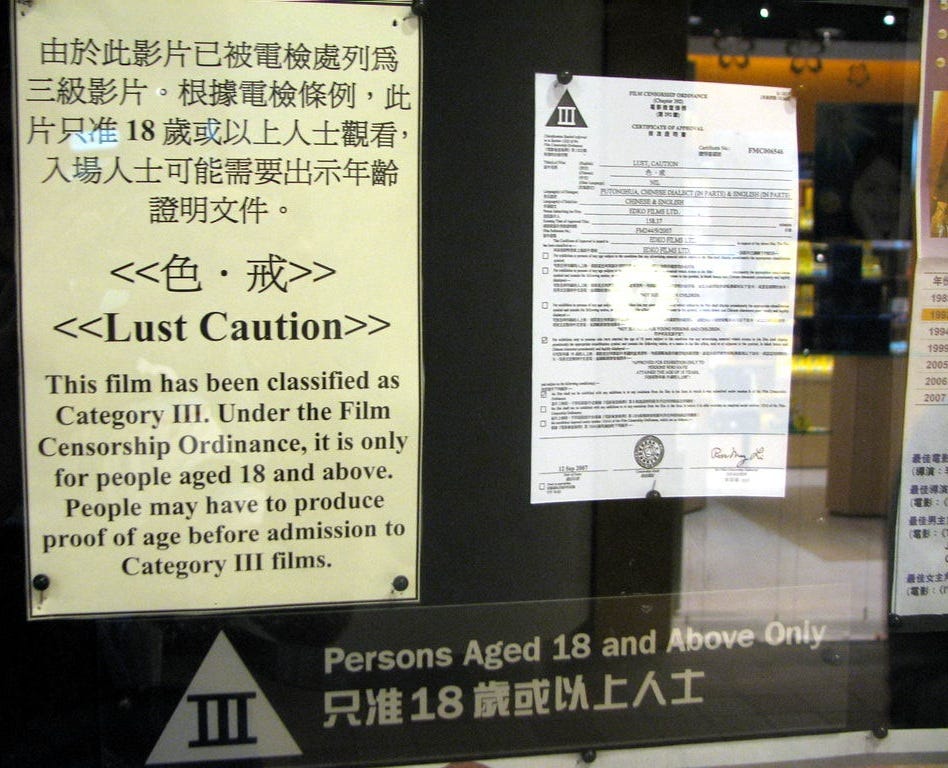
Ten Septembers later, but a few days too late to be an anniversary, Ang Lee’s Lust, Caution had a record-breaking opening in Hong Kong and Taiwan. In the latter, the Venice Golden Lion winner grossed 35 million Taiwanese dollars in two days (think back to the critically acclaimed Poor Things). Starring Tony Leung Chiu-Wai, Lust, Caution claimed the biggest mid-autumn day record, and also the biggest September Tuesday record. Buena Vista International handled the Taiwan release. Don’t forget that this was when Disney owned Miramax, who often failed when it came to releasing Chinese films in the West (as proven by their Dimension label). Lust, Caution was released uncut in both H.K. and Taiwan. As can be expected, an edited version opened in China at the end of October. Although Ang Lee oversaw the edit himself, about half an hour had been cut from the film.
While October 2007 was humbling for Ang, October 2018 was liberating for Hsu Hsiao-Tan because she masterminded a three dimensional event - paintings, live dance and theater performances. The name of the exhibition was The Story of the Most Beautiful Celestial Bodies. The intention was to celebrate women across generations. The binding qualities between them were love, romance, innocence, and freedom. Hsu narrated six tales from her life. The exhibition had been prepared for three years, and drew on the talents of forty-three professional dancers. All paintings were auctioned off with proceeds going to charities that supported Taiwan’s artist community and some of the country’s most disadvantaged groups. Within the context of international cinema, Taiwan is often ignored in favour of H.K. and the Mainland, but there are so many ideal locations for shooting.

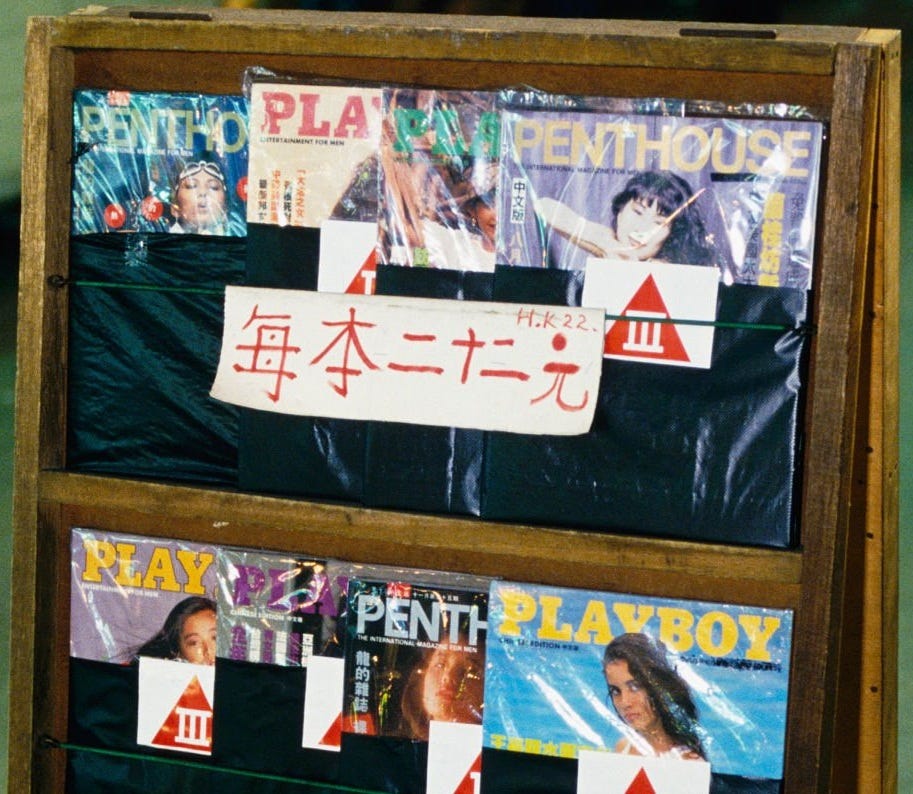
After filming Disclosure (1994), the third part of his sex trilogy, H.K. film fan Michael Douglas should probably have considered extending it into a quadrilogy by filming in Taiwan. After all, he acted in Japan for Black Rain (1989) and produced a 1991 film set in Hong Kong (Double Impact). This would have made the above image funnier. In Taipei, outside the GIO (Government Information Office) building, the Taiwanese government had launched a campaign cracking down on piracy and p*rn*graphy. In late November 2004, there were 3,412 video tapes which were destroyed. Adding to the casualty of physical media were 65,980 illegal discs (VCDs and DVDs but no mention of laserdiscs). The government’s representatives claimed that piracy not only hurt Taiwan’s image but also jeopardized artistic creation and a fair market competition. H.K. and the Mainland were not more immune to piracy, but H.K. had more talent than Taiwan whereas the Mainland had more land. The H.K. edition of the Penthouse magazine finished in March 2004.

The Category III rating would take on a whole new meaning if there were steamy collaborations between Mainland and Russian crews. The proximity between China and Russia is something that has been exploited in some H.K. films. For example, an American named Roy Horan played a Russian in a Kung Fu movie called Snuff Bottle Connection (1977). If Matt Damon can play an Irishman in The Great Wall (2016), and if John Cusack can play a Roman in Dragon Blade (2015) then anything is possible. The above photo depicts the production of 3D Sex and Zen: Extreme Ecstasy (2011). What prompted the latest installment of the Sex and Zen franchise was that Tinto Brass announced in 2010 about wanting to do a 3D remake of his Caligula. The 1979 original was an Italian co-production with Americans, but the kicker is that the co-company was the Penthouse magazine. Even Roman Polanski wasn’t above making a 1971 Macbeth adaptation that was produced by Playboy.