
Bloody Heroism

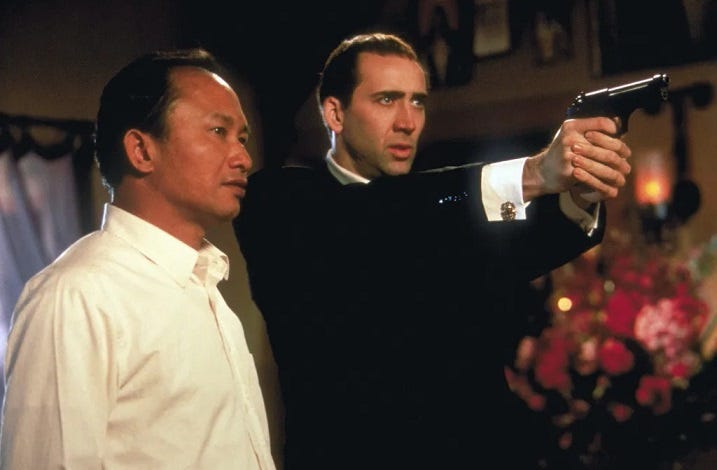
Watching Tom Cruise play a villain impersonating the hero in Mission Impossible 2 (2000) makes me wonder what would have happened had he been cast opposite Ben Stiller in Face/Off (1997). Ben had actually impersonated him for an MTV spoof when Tom was doing publicity for M:I-2. In Terence Chang’s 2023 memoir, he had plenty to say about John Woo’s other American films including Face/Off. For example: “I was so nervous, my blood pressure was very high, it was the first time I had such a big responsibility in Hollywood, and I couldn’t get it down for a long time. In addition, the production manager was always against me, so I had the idea of quitting the production. But Chow Yun-Fat’s words made me give up this idea: No matter how difficult it is, you have to endure it. You have worked so hard in the past, it would be a pity to give up! He was absolutely right. The four months passed quickly.”
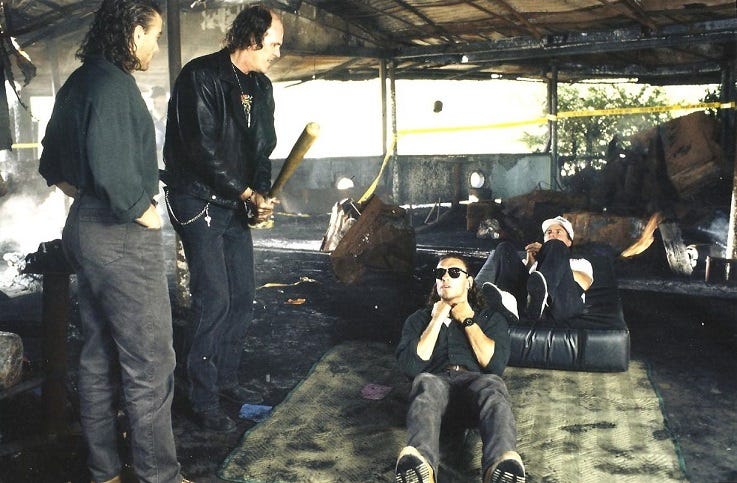
Hard Target (1993): “The one who was really interested in him was James Jacks, the vice president of Universal. The action film Hard Target starring Jean-Claude Van Damme may be suitable for John Woo, but the film already has a director. As early as 1989, I met American film critic David Chute and his wife Anne Thompson at the Toronto Film Festival. Anne is an authoritative entertainment columnist in Hollywood, and she happens to be a good friend of Universal’s Jim Jacks. With the strong recommendation of his couple, Jacks decided to invite Woo to film Hard Target. Later, both Van Damme and Jacks came to Hong Kong to visit our set. Van Damme had previously filmed in Hong Kong and seemed to be very satisfied with Woo. After the filming of Hard-Boiled was completed, Woo couldn’t wait to sell the house in Hong Kong and the family moved to Los Angeles. Many people in Hong Kong were very suspicious of the news that he was making Western films, but he had a burnt-out mentality and would never come back after this trip. And in June of 1992, I flew to Los Angeles again to start another chapter of my life.”
“Because our filming location was in New Orleans, a non-union area (non-IATSE regulated areas require that all key offline staff of a film cannot be union members), Universal treated the film as an independent production. On the one hand, the operation mainly uses non-union staff (three union members all used pseudonyms). On the other hand, they purchased life insurance to ensure that the film can be completed smoothly. The insurance company sent people to follow the scene every day, and before the start of work. We show them the shot list for each day’s shooting. If we can’t finish the shots that day, we will be forced to give up. It rained heavily one day, but work still had to start. This was of course a great constraint for John Woo.”
Broken Arrow (1996): “As for the other male lead, Fox hopes to find a young actor who has just emerged. John Woo wanted to hire Nicolas Cage, but he had not yet won an Oscar at that time and had just made an unprofitable film for Fox, so he was rejected. Fox even considered Jason Scott Lee, but ultimately decided on Christian Slater. As for the heroine, we auditioned dozens of actresses, including future popular actresses Halle Berry, Jennifer Lopez and Cameron Diaz, etc. Among them, I was particularly impressed by Lopez’s audition. But Samantha Mathis, who was relatively weak, didn’t look like the strong and independent National Park Ranger at all.”
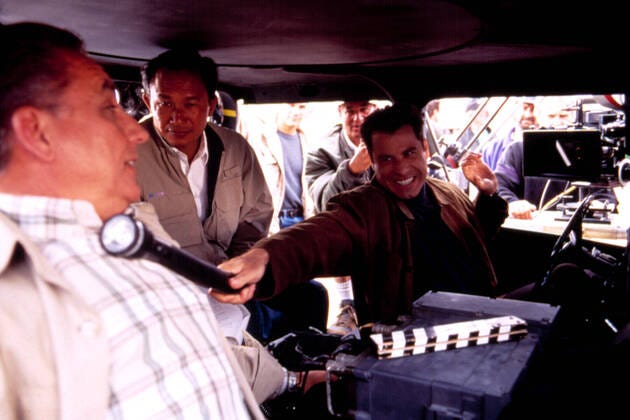
“On the first day of filming for Broken Arrow, the main producer Mark Gordon showed his authority, gesticulating at the scene, and kept looking at the camera lens, touching angry John Woo. Fox’s vice president was overseeing the film, and had a feud with Mark, so he teamed up with Woo to blast Mark away and not let him be at the scene. Such on-site monitoring is very important. The burden fell on me, and I had to call and report to the vice president every day. It just so happens that this vice president was a novelist before, and the final draft of the script this time was revised by him, so he asked John Woo to never change a word.”
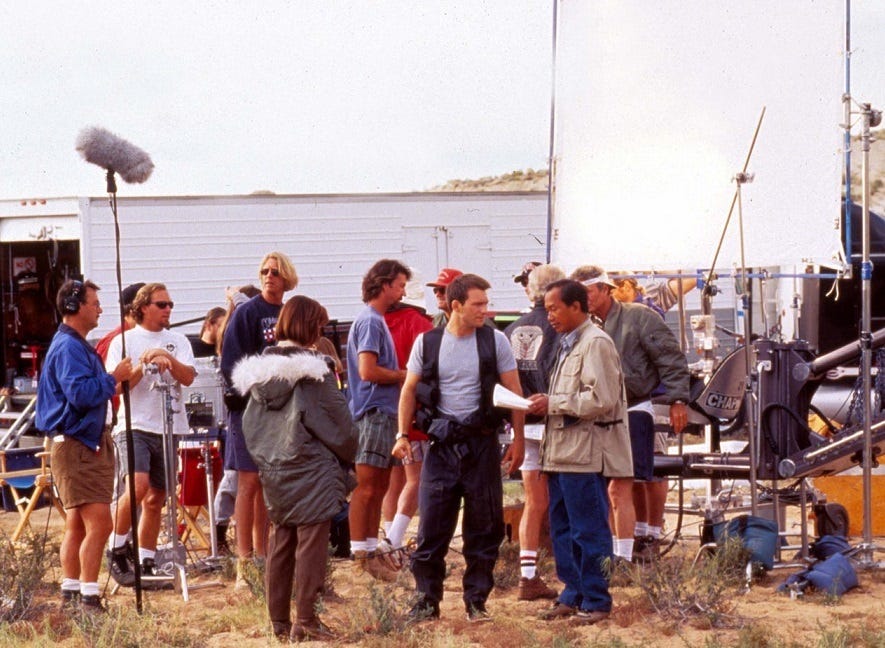
“After shooting the exterior scenes in a stunning location, we teamed up and returned to Los Angeles to shoot at Fox Studios. We set up a train car scene in the studio, where the two male protagonists were engaged in a life-and-death struggle. In order to demonstrate his knowledge in front of the two male actors, Christopher Godsick unwisely corrected the director’s guidance in front of everyone. John Woo was very angry and yelled at him, telling him to get out of the studio! I felt bad. Sure enough, after the film was completed, John Woo said that he would end his cooperation with Godsick and asked him to leave the company. WMA came forward to mediate, and later we took over the filming of Face/Off and we still let Godsick be the executive producer.”
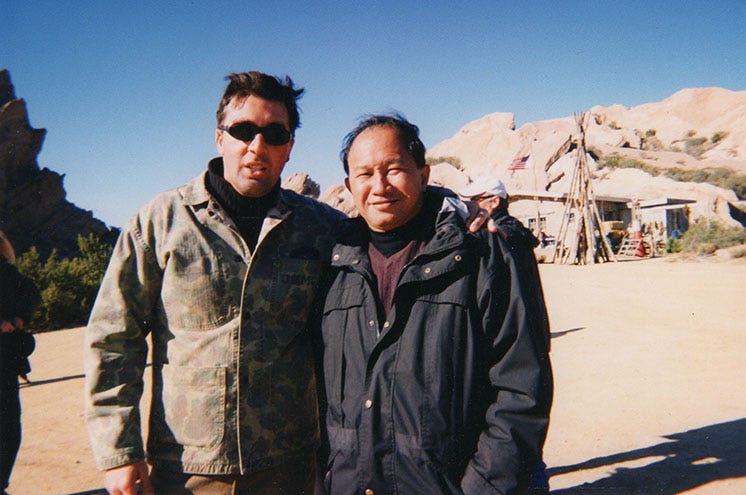
Windtalkers (2002): “Before the filming of M:I-2, we developed a World War II project and sold it to MGM. John Woo promised to start filming Windtalkers after M:I-2 was completed. There are also some military advisers who are trying to flatter the director and keep telling the director “You are better than Spielberg's Saving Private Ryan” and “Your war scenes are so awesome.” As a result, another scene was added in which Nicolas Cage rushed directly to the enemy's nest with gunpowder regardless of life and death, but it could not be completed due to weather conditions. The soldier played by Cage has the duty and task of protecting the code whisperer played by Adam Beach. This charge shot is not impossible, but it is a bit outside the scope of his responsibilities.”
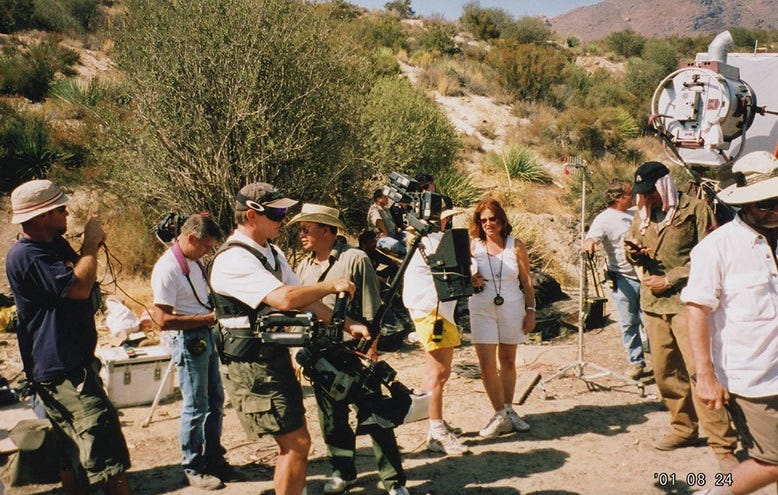
“The big problem is that the weather continues to rain, and the subsequent scenes will definitely not be completed within the budget. So MGM headquarters ordered that the filming in Hawaii be cancelled, and that we return to Los Angeles. We continued shooting in Lancaster, a two-hour drive north of Los Angeles, but the plants in California are very different from those in Hawaii. The palm trees in California are tall, with short and hard leaves, while the palm leaves in Hawaii are soft and flexible. The wind swings. As a result, we built a dozen Hawaiian palm trees and planted them on the location. On the first day of shooting, I was shocked when I arrived at the location and saw everything was completely white! It turned out that it snowed heavily at night, and we had to wait a few hours for the snow to melt before we could start shooting.”
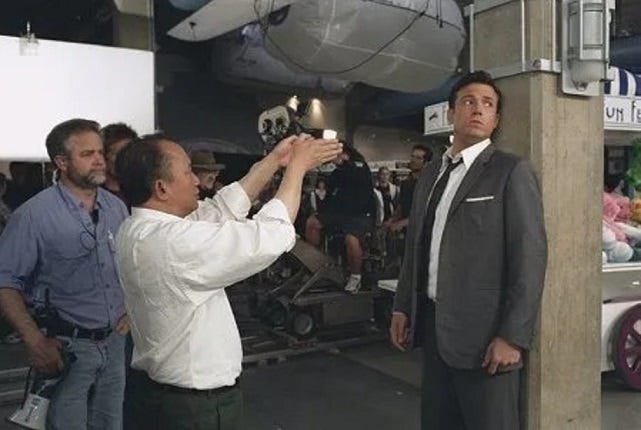
Paycheck (2003): “The lead actor is Paramount's designated Ben Affleck. There was nothing wrong with him, but I always felt that he was not very involved. Maybe it was because his girlfriend at the time, Jennifer Lopez, was also filming in Canada and would come to visit the studio sometimes. The two of them often made love to each other in front of the staff, as if no one else was around. The heroine Uma Thurman is very dedicated, but I always felt that there was a little lack of chemistry when filming the emotional scenes between the two.”
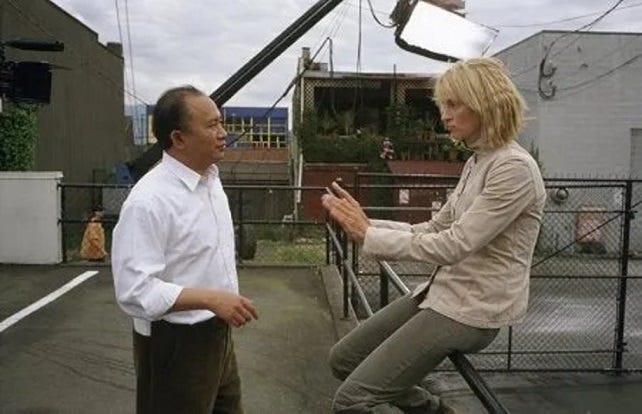
Terence Chang debunks the claim that Woo’s box office status made him unwanted by Hollywood: “Entering 2004, John Woo's career in Hollywood hit a bottleneck. There are many people looking for him to film movies, but they are all action movies. Many people classify him as an "action director", which is a title that I don't quite agree with. He wanted to make a meaningful movie, but he never had the chance.”