
Avid David's Affidavit

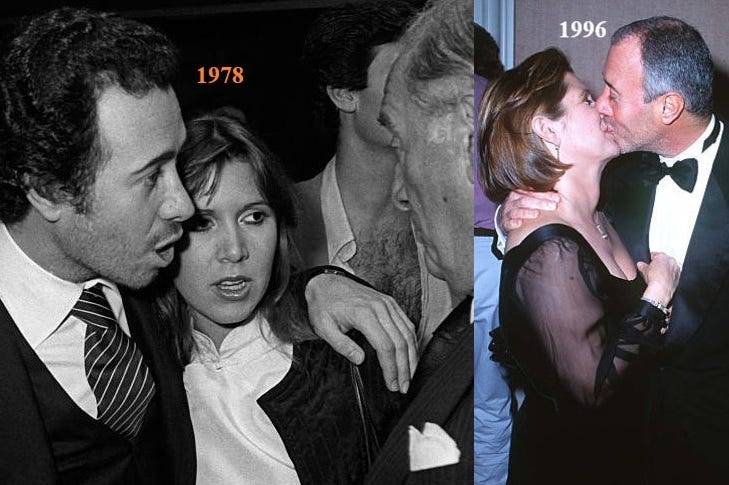
David Geffen came out as gay on November 18, 1992. It was almost the anniversary of Freddie Mercury’s death. November 24 symbolized that 1991 was the final best year for rock music. David came out at an APLA (AIDS Project Los Angeles) event, but this organization was formed in 1983, and it makes you think why he couldn’t have come out in December 1991 where you think that there would have been some sort of Christmas fundraiser. In 1991, DGC Records was acquired by MCA. This didn’t stop Kurt Cobain from writing a letter to David Geffen in August 1992 after he had read an article about Courtney Love in the September 1992 issue of Vanity Fair. Kurt may or may not have known that David is gay when he wrote: “You may not even be aware that Courtney’s band Hole is also on DGC. They are a very important band to be heard especially my wife’s openness and embrace of women’s rights and homosexuality.”
According to the 2018 memoir of Michael Ovitz (who used to be Hollywood’s most powerful agent), David Geffen became MCA’s biggest individual stockholder when the conglomerate bought his record company. In the middle paragraph of his letter to Kurt Cobain on August 18, 1992, David wrote: “I sympathize with what you’re going through and how it can affect you. The press have a way of sabotaging your privacy. The thing you have to remember is that these things pass and people quickly forget about articles of this type. You just have to let your life go on.”
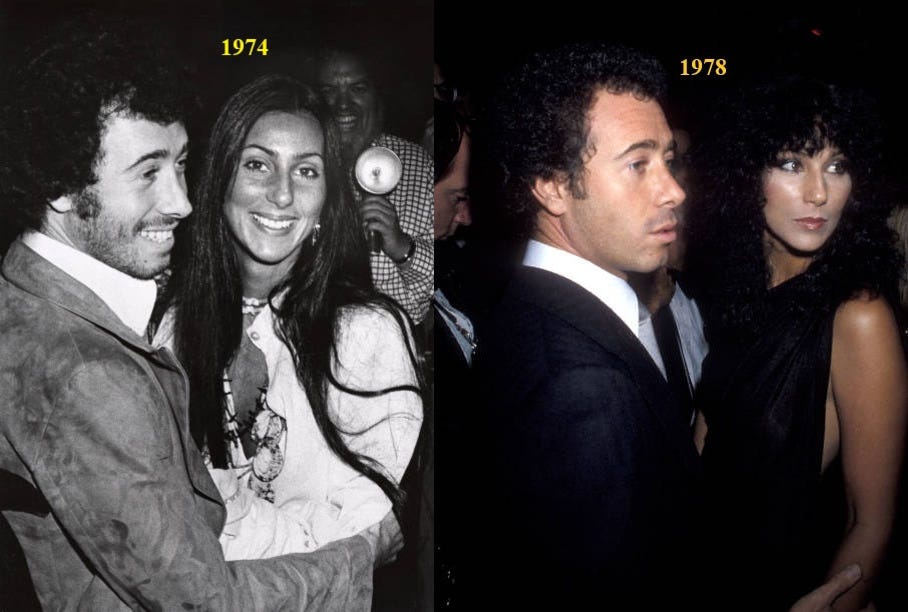
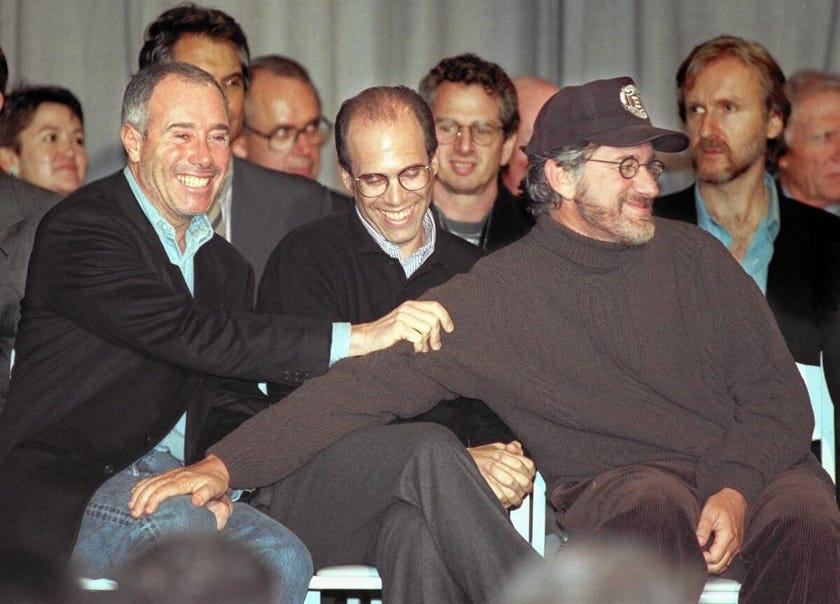
A better example of David Geffen lending a helping hand had happened in May 1992 when he saved Calvin Klein’s company by paying a debt that was well over 40 million dollars. This was when Calvin was married to a woman, but it was only in 2006 that he came out as bisexual. When David came out of the closet, it was at a dinner that was held at the Universal Amphitheater. This belonged to Universal Pictures, whom Steven Spielberg worked for. David, Steven and Calvin share a common denominator in that they met each other through Ali MacGraw in the seventies. Ali introduced Steven to David at Ron Fletcher’s workout salon whereas Ali introduced David to Calvin when the latter was working as a costume designer for a film called Players (1979). Several years later, Steven produced a sci-fi movie where the main character is mistakenly referred to as Calvin Klein.
A common denominator between David Geffen and Steven Spielberg is Tom Cruise. Steven first met Tom on the set of Risky Business when it was being filmed in 1982. This movie was produced by David’s production company, The Geffen Film Company, but the distributor was Warner Brothers. This leads to an elephant in the room as it’s never been explained why Tom Cruise was not considered for the role of Marty McFly in Universal’s Back to the Future circa 1984. In July 1985, it was reported that David Geffen had secured a deal to have Michael Jackson have his first starring role in a film (i.e. he was previously the co-star of a 1978 musical called The Wiz). At this point, Steven’s connection to Warner Brothers was solidified in that he had two Amblin productions that were to be distributed by Warner - The Goonies (1985) and The Color Purple (1985).
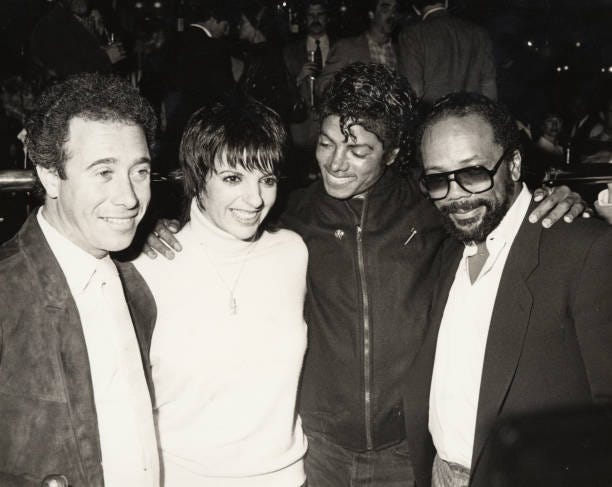
In June 1990, when DGC Records was still under the umbrella of the Warner Bros. corporation, Michael Jackson sent a letter to David Geffen which was addressed to Universal Plaza. The intention of the letter was to show his gratitude for the flowers that were sent during Michael’s illness. In 2003, Vanity Fair reported that Michael had hired a voodoo doctor to put a death curse on Geffen and Spielberg. Michael’s brother, Jermaine, claimed in 2003 that the DreamWorks logo (a boy fishing while sitting on a moon crescent) was plagiarized from the entrance to Michael’s Neverland Ranch. It probably didn’t help that DreamWorks had a record label where a band by the name of Alien Ant Farm released a cover of Michael’s Smooth Criminal in May 2001. Moving on to another Michael, 1996 was when the TV division of DreamWorks had greenlit a Michael J. Fox sitcom called Spin City. It was a no-brainer considering that Spielberg had co-produced the Back to the Future trilogy.
Going back to the other Michael, Spielberg was a friend of Michael Jackson during the 1980s and appeared in his Liberian Girl music video circa 1989. Supposedly, Michael was disappointed that Spielberg didn’t go through with casting him as Peter Pan. However, there may have been a thorny issue at play that Spielberg wasn’t willing to reveal in public. In Corey Feldman’s 2013 memoir, Coreyography, there was a carefully worded anecdote where Spielberg had to tell Corey that the stars of The Goonies couldn’t meet Michael in his hotel room because he was too worn-out from touring. Although Michael wanted to meet them in his hotel room, they still got to meet him when he visited the set. When The Goonies finished filming in March 1985, Michael J. Fox was still filming Back to the Future.
When Michael Jackson began acting in the short film, Captain EO, this was in July 1985 - a month after the release of The Goonies. Instead of being produced by Amblin, it was produced by Lucasfilm. Instead of being distributed by Warner, it was Buena Vista. Instead of being written by Steven Spielberg and directed by Joe Dante, it was written by George Lucas and directed by Francis Ford Coppola. It wasn’t even produced by David Geffen. Coppola’s involvement is suspect because he would, many years later, be responsible for Victor Salva’s return to the director’s chair. I won’t go into specifics but let’s just say that Victor’s crime redefines what it means to commit a “minor” offence. While he got to achieve a victorious salvation with the success of Jeepers Creepers (2001), the same can’t be said for Michael Jackson whose Captain EO wasn’t released in cinemas (instead becoming a staple for Disney’s theme parks). His first lead role in a feature film, Moonwalker (1988), was only released in cinemas outside of the U.S. for a reason that wasn’t convincingly stated.
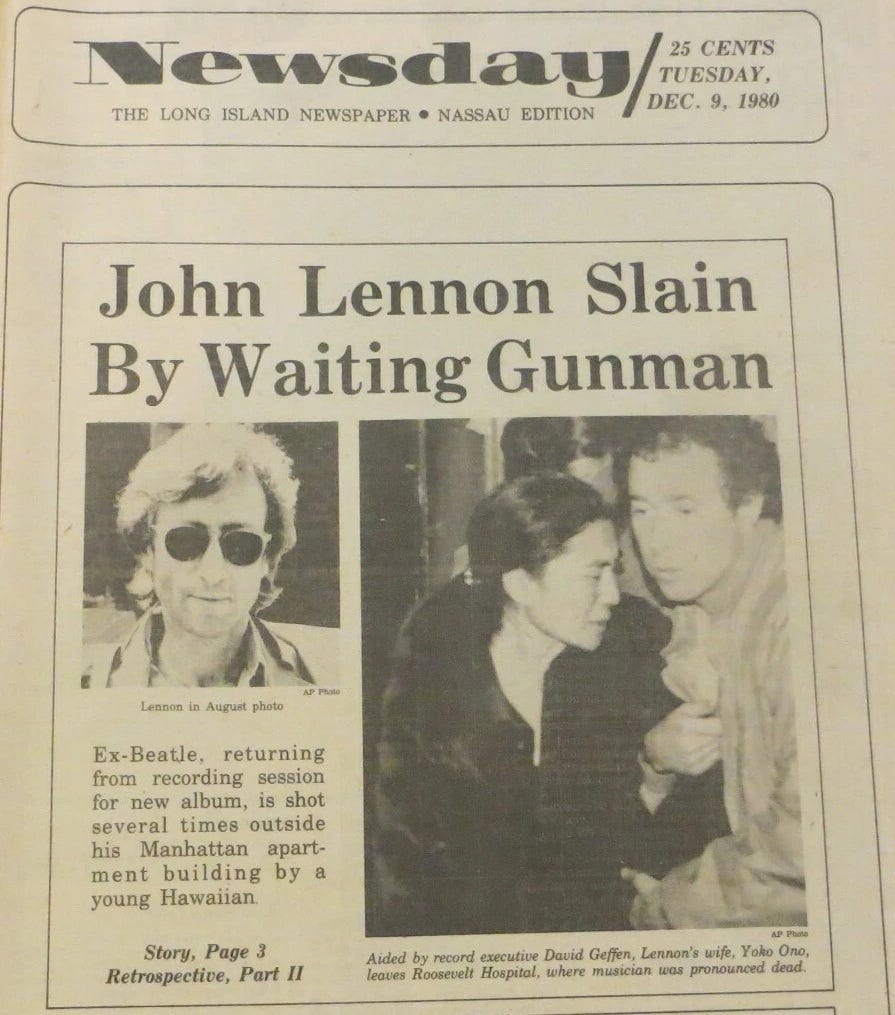
Of all the kids that had to be featured in Moonwalker, they just had to feature one of John Lennon’s sons - Sean. In December 1980, David Geffen escorted Yoko Ono from the hospital after John’s death, so you can imagine that David wasn’t too thrilled when Michael Jackson wanted to purchase the publishing rights to the entire catalogue of The Beatles. Steven Spielberg is a big fan of them, and even produced a movie about Beatlemania called I Wanna Hold Your Hand (1978). Ten years after that, Moonwalker would prove to be awkward in another way since Paul Reubens had provided the voice of Pee-Wee Herman. Like Michael, he later found himself in a similar controversy involving minors, albeit Paul claimed that the only inappropiate thing that he owned was the 1988 sex tape of Rob Lowe having a threesome with a 16-year-old girl.
As proven by the sex tape, Rob Lowe is bisexual. In fact, there was an attempt to straighten his image when it was claimed by the L.A. Times in 1989 that there was another tape of himself with two women. Despite being more handsome than Tom Cruise, Rob never got to star in a film for David Geffen. One missed opportunity would have to include Brad Pitt’s role as Louis de Pointe du Lac in Geffen’s 1994 adaptation of Anne Rice’s Interview with the Vampire. Had it not been for the sex tape, Rob Lowe might have played opposite Cruise - thereby reuniting after The Outsiders (1983). Despite the homoerotic nature of the novel, Geffen didn’t lean into it. Perhaps he feared that someone would joke that the brat pack became the fudge pack.
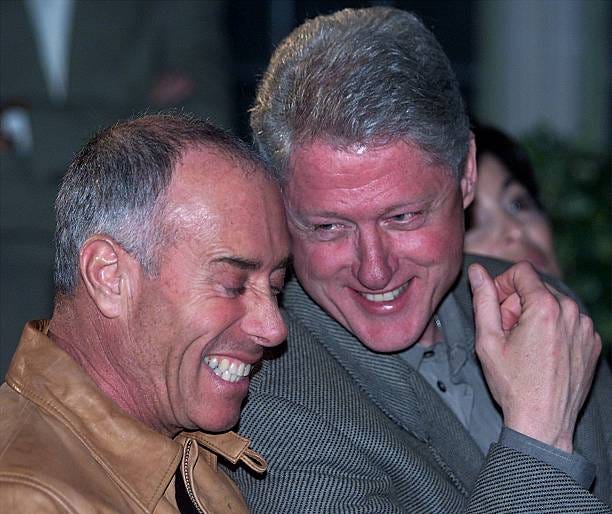
Like Steven Spielberg, David Geffen was a close friend of Bill Clinton. However, I have yet to see photos of Steve and David with Jeffrey Epstein. In terms of dodgy relations, David was an investor of a bad company that Bryan Singer was involved in i.e. Digital Entertainment Network a.k.a. DEN. However, I can’t find a single photo of these two gay guys together. Although Bill Clinton was on good terms with Kevin Spacey, I can’t find a single photograph of Kevin alongside David Geffen.
Bronson Pinchot, one of Tom Cruise’s co-stars from Risky Business, did a 2009 interview for a site called The A.V. Club for whom he relayed: “He was tense and made constant, constant unrelated homophobic comments, like, “You want some ice cream, in case there are no gay people there?” I mean, his lingo was larded with the most… There was no basis for it. It was like, “It’s a nice day, I’m glad there are no gay people standing here.” Very, very strange. Years and years later when people started to torment him with that, I used to think “God, that’s really fitting, because he tormented a lot of people as a 20-year-old.” He made such a big deal about it.”
When it came to casting Risky Business, David Geffen had told writer/director Paul Brickman that he wanted someone who he would want to have sex with. Perhaps Tom Cruise found out, and didn’t want people thinking he was using the casting couch (although you would think that he would have been making jokes about Geffen instead of gays in general). In 2002, former agent Michael Ovitz gave an interview for Vanity Fair where he blamed his own downfall on the nefarious conspiring of a “gay mafia” led by David Geffen. In the 2018 memoir of Ovitz, Who is Michael Ovitz?, he wrote: “David and I had fallen out back in 1980 when he was producing Personal Best and our dispute over writer-director Bob Towne’s compensation delayed the start date.”
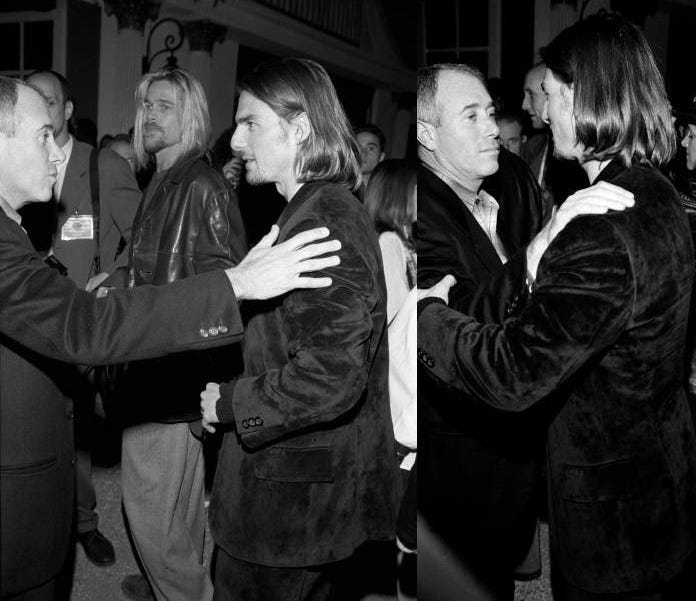
In Powerhouse: The Untold Story of Hollywood’s Creative Artists Agency, a 2016 oral history book about CAA, David was quoted as saying: “When I was an independent, when I had Geffen Films, I tried to do business with CAA. I tried to have a good relationship with Mike Ovitz. Unfortunately, that never seemed to work out. He’d make lots of promises and never kept them. So I had a lot of problems with Mike Ovitz over the years. I helped him get his first very big star, which was Paul Newman.”
One of Geffen’s biographies was written by a gay man - Thomas R. King. David initially wasn’t interested in Tom’s proposal until he found out that he was gay in the spring of 1996. Over the years, Geffen had not only fended off other prospective biographers but also managed to get books snuffed out including a memoir by a former boyfriend. While still in the closet circa 1989, Geffen even got Random House to excise gay evidence from Fredric Dannen’s Power Brokers and Fast Money Inside the Music Business. Coincidentally, Fredric is someone who I’ve already referenced in past articles because he had co-written a book about Hong Kong cinema.
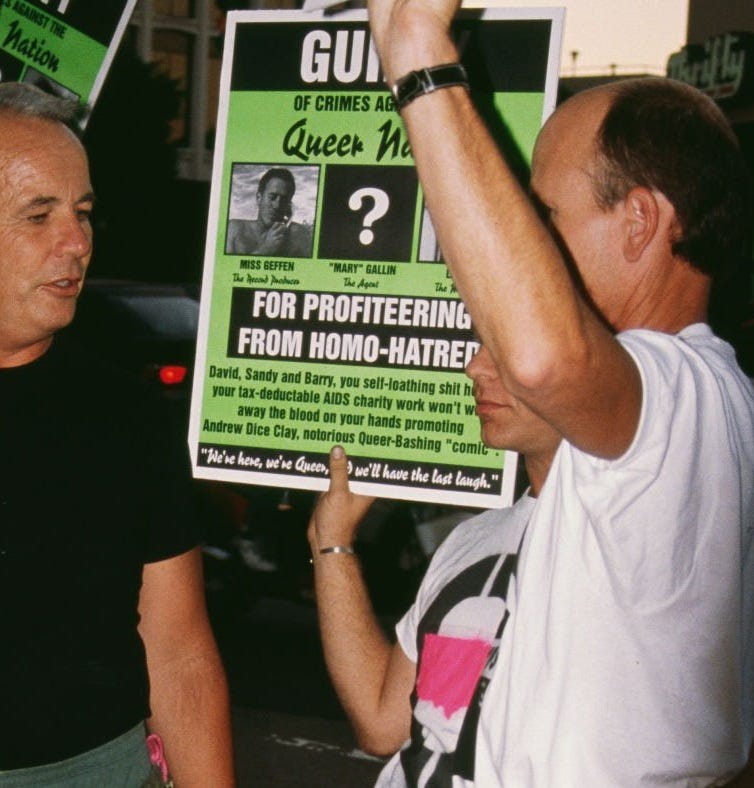
Tom King’s book was published in March 2000, but there had already been a 1997 biography written by Stephen Singular. It’s nothing to scoff at since 1996 was when Stephen rattled cages and ruffled feathers with his Michael Ovitz biography. In spite of being a weighty tome that clocks in at way past 600 pages, King’s book does not reference the above 1998 demonstration outside an APLA benefit. While Sandy Dallin was just as gay as Geffen before he died, Barry Diller is bisexual. It remains to be satisfactorily explained why they would want to support Andrew Dice Clay when they could easily have supported an openly gay actor like Rupert Everett.